
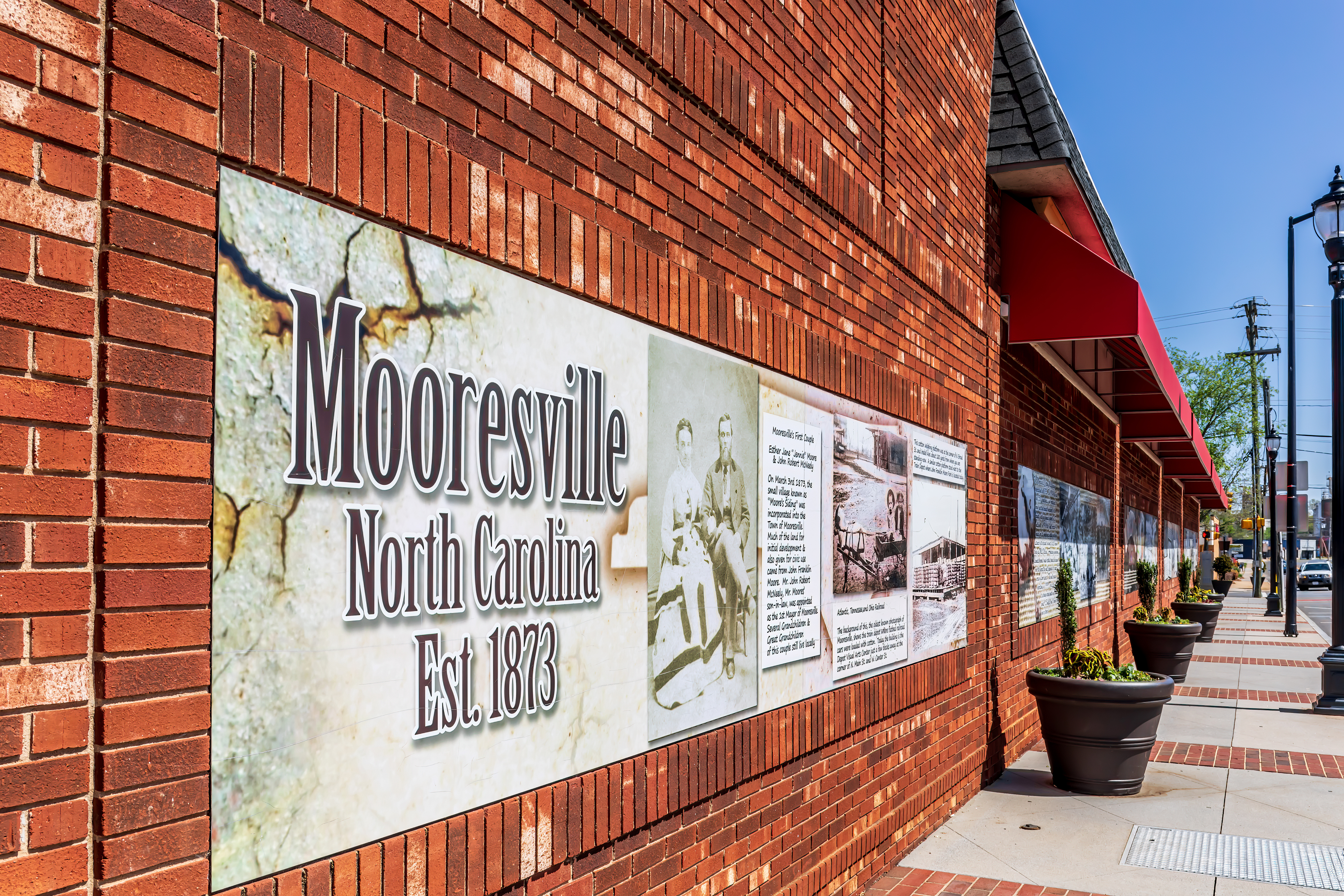

Mooresville, North Carolina, sits today at the crossroads of tradition and growth, a town where centuries of history are layered into its landscape. Along the same ground where Catawba trading paths once wound through hardwood forests, cotton fields later stretched across the Linwood Road countryside, and today the roar of NASCAR engines and precision engineering fills high-tech race shops.
Mooresville’s story is not a straight line but a woven tapestry:
- It begins with the Indigenous peoples who traveled and traded across this fertile Piedmont land.
- It moves into the colonial era, when settlers from Rowan and later Iredell County carved farms out of the wilderness.
- By the early 1800s, it was defined by plantations and cotton, with homes like Mount Mourne and Johnson-Neel anchoring the antebellum economy.
- The arrival of the railroad in the mid-19th century created Moore’s Siding, the stop that became Mooresville, while the Civil War brought both devastation and lasting stories like the tragedy of the Lipe family.
- In the late 19th and early 20th centuries, the town grew into a textile boomtown, its mills and Main Street shaping the lives of generations.
- The 1960s saw another transformation with the building of Lake Norman, which submerged farmland, spawned a lakeside culture, and drew waves of new residents.
- By the late 20th century, Mooresville had earned its global reputation as “Race City USA”, home to NASCAR teams and the NASCAR Technical Institute.
- Today, it balances that racing heritage with its role as a fast-growing Charlotte suburb, headquarters to Lowe’s and a hub for technology, healthcare, and advanced manufacturing.
Mooresville is, in short, a community where past and present converge: from Catawba trails to commuter rail proposals, from plantation houses to subdivisions, from mill whistles to the hum of race cars. Its layered history explains not only how the town grew, but how it continues to define itself at the intersection of memory and modernity.
Early Land and People
Centuries before Mooresville took shape, the lands along the Catawba River and its tributaries were part of the homeland of the Catawba Nation, one of the most influential Indigenous groups in the Carolinas. The Catawba and their neighbors lived in villages, farmed the river bottoms, and maintained a wide trading network. Sherrill’s Path, an ancient corridor that cut across the river near today’s Mooresville, was more than a trail—it was a conduit for commerce, diplomacy, and migration, linking communities across the Piedmont.
By the mid-1700s, new waves of settlers were moving into the area, spurred on by the opening of the Great Wagon Road. This major migration route stretched from Pennsylvania through Virginia’s Shenandoah Valley and into the Carolina backcountry. Families of Scots-Irish, German, and English descent followed the road southward, carrying with them traditions of frontier farming, Presbyterian worship, and communal self-reliance.
These settlers found a landscape well-suited for agriculture. The red clay soils and rolling hills of the Piedmont supported corn, wheat, and eventually cotton, while streams like the Rocky River and smaller creeks watered both livestock and crops. Early homesteads clustered near road junctions and churches, forming the backbone of what would later become communities such as Deep Well and Mount Mourne.
At the time, the area fell under Rowan County’s jurisdiction. Courts, deeds, and militia musters tied these frontier families to Salisbury, the county seat. By 1788, population growth justified carving a new county—Iredell—out of Rowan, with Statesville as its hub. The boundaries of the new county included the farmland that would eventually give rise to Mooresville.
The combination of Indigenous trade paths, wagon roads, and fertile soil ensured that this part of southern Iredell was never isolated. Even before a town existed, the region was well connected—to neighboring farms, to county courts, and to the broader currents of colonial and early American settlement.
From Rowan to Iredell: Frontier to Farms
As settlement pushed deeper into North Carolina’s Piedmont, population growth demanded new administrative boundaries. In 1788, Iredell County was created out of Rowan County, with Statesville established as the county seat. Within this new county, families carved homesteads along creeks and wagon paths. The area around present-day Mooresville, then known as Deep Well, became one of the most fertile farming districts in southern Iredell.
Early settlers raised corn, wheat, and livestock, but by the early 1800s the crop that defined the economy was cotton. Small farms began to expand, and many evolved into larger holdings. This shift marked the rise of a plantation society, with prosperity built upon both fertile land and the forced labor of enslaved African Americans.
Among the best-known examples was Mount Mourne Plantation, established by Major Rufus Reid (1797–1854). Reid became one of the most prominent planters in Iredell, holding more than 2,000 acres and enslaving at least 81 people by the 1850 census. His grand home, completed in 1836, took its name from the Mourne Mountains in County Down, Ireland, reflecting his family’s heritage. Mount Mourne not only served as a center of agricultural production but also stood as a symbol of the planter elite’s wealth and influence.
Reid was not alone in shaping the plantation landscape. Several other estates dotted the countryside:
- The Johnson-Neel House (c. 1826–1830), attributed to master builder Jacob Stirewalt, represents one of the county’s earliest substantial brick homes and survives today as a National Register site.
- The Cornelius House (c. 1825), a T-shaped Federal-style dwelling near Mooresville, reflects the refinement of prosperous farming families.
- Forest Dell Plantation and the colonial-era Belmont Plantation were also part of this network of antebellum estates, where cotton fields stretched to the horizon.
Together, these plantations highlighted both the economic ambition of Iredell County and its human cost. Enslaved men, women, and children labored in the fields, tended livestock, and built the very houses that symbolized prosperity. Their unfree labor laid the foundation for wealth and social standing in the community, even as it deepened the divisions that would erupt in the Civil War.
By the mid-19th century, the Mooresville area was firmly tied to the cotton economy and to the culture of the South’s plantation belt. These farms and estates left a lasting imprint not only in architecture and land use but also in the cultural memory of the region.
The Coming of the Railroad and Moore’s Siding
The arrival of the Western North Carolina Railroad in the 1850s marked a turning point for southern Iredell County. For decades, farmers had relied on rough wagon roads and river crossings to carry their crops to market. The railroad promised something entirely new: a direct line connecting the region’s cotton and produce to larger markets in Salisbury, Charlotte, and beyond.
Among those who recognized the opportunity was John Franklin Moore (1822–1877), a local farmer, brickmaker, and entrepreneur. When the rail line was surveyed through his land, Moore pressed for a depot stop. His efforts paid off, and soon the settlement around the tracks was known informally as “Moore’s Siding.” The stop quickly became a gathering point for trade and travel, attracting merchants, blacksmiths, and other services.
The Civil War Years
Progress was short-lived. The outbreak of the Civil War in 1861 turned railroads into strategic assets — and frequent targets. Troops and supplies moved along the line, but bridges and tracks were also damaged in raids and skirmishes. Families across Iredell County watched sons march off to join the Confederate ranks, and the toll on the community was staggering.
No story illustrates this more than the tragedy of the Lipe family of Deep Well, just a few miles from Moore’s Siding. Elias J. Lipe and Ann Cossey Lipe had five sons in uniform: James, Joseph, George, Abram, and William. Within less than two years, four would be dead:
- James McCree Lipe died of wounds from the Battle of New Bern (March 1862).
- Joseph S. Lipe, whose letters home form the heart of the family’s story, was mortally wounded at Gaines’ Mill (June 1862).
- George L.D. Lipe also died in 1862 under uncertain circumstances.
- Abram A. Lipe succumbed to typhoid fever in a Richmond hospital (1863).
- Only William L. Lipe survived, though he was badly wounded at Gettysburg.
The Joseph S. Lipe Family Letters, preserved at the Mooresville Public Library and Wake Forest University, remain some of the most vivid personal accounts of the war in Iredell County. Written in hurried, often misspelled lines, they reveal farm life during wartime, the strain of separation, hunger and disease in camp, and an unwavering faith in God. These letters offer not just family history but a window into how war reshaped communities like Mooresville.
Rebuilding and Incorporation
With the Confederacy defeated in 1865, the region faced the challenge of rebuilding farms, families, and commerce. The railroad was repaired, and John Franklin Moore again led efforts to revive the settlement around his depot stop. Stores and workshops multiplied, schools and churches appeared, and the small cluster of buildings grew into a recognizable community.
By 1873, the settlement was incorporated as the Town of Mooresville, taking the name of the man who had envisioned its potential. When John Franklin Moore died in 1877, his wife Elizabeth Rachel Summerow Moore carried on his work, continuing to encourage investment and growth. Their legacy lives on not just in the town’s name but in its enduring role as a center of trade, culture, and identity in southern Iredell County.
Mills, Main Street, and the New South
The decades after the Civil War ushered in what boosters called the “New South” — a vision of industrial progress built on the foundation of cotton. For Mooresville, this meant a transformation from a small rail depot community into a textile boomtown.
The Rise of the Mills
By the late 19th century, investors and entrepreneurs began constructing cotton mills around Mooresville. These large brick factories harnessed the raw cotton grown in the region, spinning and weaving it into cloth for national markets. Mill villages, consisting of rows of modest houses, sprang up around the factories, offering affordable housing for workers and their families. Life in these villages revolved around the rhythm of the mill whistle, with company-owned stores, churches, and schools reinforcing tight-knit communities.
The mills attracted not only local farm families seeking steady wages but also newcomers from across the Piedmont. The influx of labor changed the social fabric of Mooresville, bringing with it new cultural traditions, labor practices, and class dynamics.
Main Street Commerce and Civic Life
As mills flourished, so did downtown Mooresville. Main Street became the commercial and social heart of the town. Banks financed expansion, dry goods stores offered everything from fabric to farming tools, and drugstores doubled as soda fountains and social gathering spots. Theaters brought vaudeville, silent films, and later “talkies” to local audiences.
Civic pride was visible in parades, holiday celebrations, and community events. Fraternal lodges, women’s clubs, and church groups filled the calendar with meetings and festivals. The sound of marching bands often echoed down Main Street during school events and patriotic observances.
Railroads still cut through the center of town, connecting Mooresville to Charlotte, Salisbury, and beyond. Yet by the early 20th century, automobiles began reshaping life and commerce. U.S. Highway 21 and NC Highway 115 gave residents greater mobility, drawing trade not just to downtown but also to roadside businesses. Filling stations, diners, and motels began to line the highways, foreshadowing suburban growth.
The Local Press: A Mirror of Community Life
Mooresville’s newspapers chronicled every stage of this evolution.
- The Mooresville Monitor (founded 1885) proudly carried the motto “True to Principle and to North Carolina.” It featured not only political editorials but also poetry, serialized stories, and announcements of marriages, deaths, and town meetings.
- The Mooresville Enterprise (early 1900s) became the voice of a growing mill town. It printed reports on mill payrolls, church socials, school graduations, and tragedies like the influenza outbreaks of 1918 and the 1920s. Crime stories, prohibition-era liquor raids, and traffic accidents shared space with advertisements for Belk’s wash dresses or Winn-Dixie’s grocery specials.
- The Mooresville Tribune (mid-20th century onward) carried Mooresville into the suburban age. Its pages reported on town annexations, school board debates, zoning decisions, and the challenge of balancing small-town identity with rapid growth.
Newspaper ads themselves reveal how daily life was changing: Belk’s touting $0.97 dresses, furniture stores advertising payment plans, and grocery chains competing with promises of fresh produce at bargain prices. Together, the papers form an invaluable chronicle of the community’s economic, social, and cultural heartbeat.
Lake Norman and Suburban Edges
The mid-20th century brought one of the most dramatic changes in Mooresville’s history: the creation of Lake Norman, a man-made reservoir that reshaped the landscape, the economy, and the identity of southern Iredell County.
In the late 1950s, Duke Power (today Duke Energy) announced plans to build a hydroelectric station at Cowans Ford on the Catawba River. Completed in 1963, the Cowans Ford Dam flooded thousands of acres of farmland, river bottoms, and old homesteads, creating a lake that would become the largest in North Carolina — more than 32,000 acres of water with 520 miles of shoreline. Families who had farmed riverfront land for generations saw their property submerged. In return, Duke offered lease lots to displaced landowners, a practice that seeded the first wave of modest cabins and weekend retreats along the new shoreline.
What began as a utility project soon evolved into a cultural and recreational phenomenon. The new lake was quickly nicknamed the “Inland Sea,” attracting boaters, fishermen, and swimmers from across the Piedmont. Marinas sprang up to service the growing number of speedboats and sailboats. Annual festivals, like Lake Norman Days, celebrated the recreational opportunities and drew visitors who would later choose to live by the water.
At the same time, transportation was being transformed. The construction of Interstate 77, running parallel to U.S. 21, carved a direct corridor between Charlotte and Statesville. For Mooresville, the interstate was a game-changer. What had been a self-contained mill town and rail stop was suddenly positioned as a commuter hub. Families could enjoy lakeside living while working in Charlotte, and businesses could operate with easy access to metropolitan markets.
By the 1970s and 1980s, what had started with rustic fishing cabins and small marinas was giving way to planned subdivisions, golf course communities, and shopping centers. The lakefront became some of the most desirable real estate in the Piedmont. Realtors promoted it as a place where city executives could have both a short drive to Charlotte and a retreat-like home on the water.
This suburban shift also brought challenges. School districts faced surging enrollments. Roads strained under traffic. The character of Mooresville began to change as newcomers — many with no roots in Iredell — blended with families who had lived in Deep Well, Mount Mourne, and nearby farms for generations.
Still, the combination of Lake Norman’s shoreline and I-77’s mobility launched Mooresville into a new era. No longer just a textile town, it was now both a lakeside playground and a bedroom community for metropolitan Charlotte.
Race City USA and Economic Diversification
By the late 20th century, Mooresville was undergoing another transformation — this time from mill town and lakefront community into an international hub for motorsports.
The NASCAR Era
During the 1980s and 1990s, as Charlotte became the capital of stock car racing, many NASCAR teams and suppliers relocated to Mooresville. The town offered affordable land, quick access to I-77, and proximity to Charlotte Motor Speedway. Within a few decades, Mooresville earned the title “Race City USA”.
Major teams built sprawling shops on the outskirts of town, while countless smaller fabricators and specialty suppliers clustered in industrial parks. Fans flocked to see where their favorite cars were built, and the local economy began to thrive on motorsports tourism.
In 2002, the opening of the NASCAR Technical Institute (NTI) cemented Mooresville’s status. The NTI — the only school in the nation officially partnered with NASCAR — trained the next generation of mechanics, engineers, and pit crew members, ensuring a steady pipeline of skilled workers for the racing industry. Students from across the country moved to Mooresville, bringing with them energy and investment.
Industrial Growth and Downtown Renewal
While racing dominated the headlines, Mooresville’s economy was also diversifying. Industrial parks along I-77 attracted logistics companies, parts suppliers, and manufacturers. The corridor became a magnet for corporate distribution hubs, taking advantage of the highway’s link between Charlotte and Statesville.
At the same time, attention turned to downtown Mooresville. Many of the textile mills that once powered the economy had closed by the late 20th century, leaving behind cavernous brick buildings. Rather than let them fall into ruin, civic leaders and entrepreneurs invested in preservation and adaptive reuse. Old factories became loft apartments, office spaces, breweries, and cultural venues. This renaissance brought new life to Main Street, where independent shops, restaurants, and galleries flourished.
Global Connections
Mooresville’s motorsports identity even extended overseas. The town established a sister city relationship with Hockenheim, Germany, home to one of Europe’s most famous Formula One racetracks. The partnership symbolized Mooresville’s growing role in the global racing community — a small Piedmont town now tied directly to the international world of motorsports.
A Balanced Economy
By the turn of the 21st century, Mooresville was no longer defined solely by cotton or mills. Instead, its economy rested on a mix of racing, advanced manufacturing, corporate headquarters, and service industries. The town’s motto, “Race City USA,” captured one part of its identity, but beneath it lay a broader story of adaptation and resilience.
Mooresville Today
The 21st century has brought rapid change and remarkable growth to Mooresville. What was once a modest rail town and later a textile center has become one of the fastest-growing communities in the Charlotte metropolitan region, alongside neighboring Huntersville, Cornelius, Davidson, Sherrills Ford, and Denver NC on the eastern and western shores of Lake Norman.
Growth and Development
Since the early 2000s, Mooresville has expanded aggressively through annexations and new subdivisions, transforming farmland and forests into neighborhoods, schools, and shopping centers. Its population has surged, drawing both young professionals commuting to Charlotte and retirees drawn to the amenities of Lake Norman and nearby towns like Cornelius and Davidson.
Corporate investment has further reshaped the town. Lowe’s Companies, Inc., a Fortune 50 retailer, relocated its corporate headquarters to Mooresville in 2003, bringing thousands of jobs and establishing the town as a player on the national economic stage. Alongside Lowe’s, healthcare providers, technology firms, and advanced manufacturers have made Mooresville home, balancing the town’s racing heritage with a diverse economic base that complements the financial, medical, and tech hubs of Charlotte and the lakeside economies of Huntersville, Sherrills Ford, and Denver NC.
Transportation and Connectivity
With growth has come the challenge of transportation. Interstate 77 remains both a lifeline and a bottleneck, carrying commuters to and from Charlotte but often choking with traffic. Expansion projects have aimed to relieve congestion, but demand continues to outpace capacity, impacting not only Mooresville but also nearby communities such as Cornelius and Huntersville.
At the same time, Mooresville has kept an eye on rail transit. The proposed Lynx Red Line commuter rail would connect Mooresville and the Lake Norman towns of Cornelius, Davidson, and Huntersville to Uptown Charlotte, offering a long-term solution for mobility. While the project has been delayed for decades, recent agreements with Norfolk Southern signal renewed hope that it may one day become reality.
Community and Culture
Despite this transformation, Mooresville has worked hard to retain its character and sense of place. Historic Downtown Mooresville, once reliant on mill traffic, has been revitalized with independent shops, restaurants, breweries, and cultural venues. Festivals, art crawls, and concerts bring life to Main Street, while preserved architecture offers reminders of the town’s 19th- and 20th-century past.
Schools, churches, and parks continue to knit the community together. Mooresville Graded School District, one of the most innovative in the state, became a model for digital learning in the 2010s, gaining national attention. Churches remain community anchors, hosting not only services but also food drives, youth groups, and outreach events. Parks and greenways provide spaces for recreation, echoing the community’s emphasis on quality of life — a theme also seen across Cornelius, Davidson, and Huntersville, where greenways and waterfront parks connect families to Lake Norman.
A Town of Layers
Today’s Mooresville is best understood as a place of layers. Beneath the subdivisions and industrial parks lies the story of Indigenous trade paths and Deep Well farms. The antebellum plantations, textile mills, and cotton fields left a legacy preserved in both architecture and memory. The creation of Lake Norman reshaped its geography, while NASCAR garages and the title “Race City USA” gave it global recognition.
Mooresville’s identity is a balance of growth and heritage. It is a modern, thriving community shaped by corporate headquarters and suburban development, yet it remains deeply rooted in its history — a history carried in letters, newspapers, landmarks, and oral traditions. As Mooresville looks toward the future, its greatest challenge — and opportunity — lies in preserving those roots while embracing the growth that continues to define it, much like its sister communities of Cornelius, Davidson, Huntersville, Sherrills Ford, and Denver NC along the waters of Lake Norman.
Conclusion
The history of Mooresville is ultimately a story of resilience, adaptation, and reinvention. Each era has left its imprint: the Catawba and their trading paths, the frontier farmers who carved homesteads from Iredell’s red clay, the planters who built cotton wealth on enslaved labor, and the families who endured the staggering losses of the Civil War. The letters of the Lipe family, preserved across generations, give that sacrifice a human face, reminding us that local history is not abstract but lived in the choices and hardships of ordinary people.
The rise of the textile mills in the late 19th and early 20th centuries transformed Mooresville into a bustling industrial hub, where mill whistles structured daily life and Main Street reflected both ambition and small-town pride. The mid-20th century brought another sweeping change with the creation of Lake Norman, which submerged farmland but gave birth to a lakeside culture and a new wave of suburban growth. By the end of the century, Mooresville had taken on a global identity as “Race City USA,” marrying its small-town roots to the fast-paced world of NASCAR and international motorsports.
Today, Mooresville continues to evolve as part of the Charlotte metropolitan area, attracting corporate headquarters, advanced industry, and new residents from across the country. Yet amid the change, the community has remained anchored by its history. Its downtown storefronts, preserved plantation houses, church steeples, and local museums ensure that the past is never far from view.
Mooresville is a place where past and present converge — where one can stand on Main Street and imagine millworkers walking home, sit on the lakeshore where cotton once grew, or tour a race shop that builds engines known around the world. It is a town of layers, each chapter building on the last, united by a common thread: the ability to adapt, endure, and redefine itself for the future.
Adkins Law, PLLC — Located in Huntersville and serving the Lake Norman Community
At Adkins Law, PLLC, we combine local knowledge with legal experience to serve families and businesses throughout Huntersville, Mooresville, Cornelius, Davidson, and the greater Lake Norman region. From family law and custody matters to estate planning and civil litigation, our firm is rooted in the values of this community — resilience, growth, and connection. Whether you live on Main Street, along the lakeshore, or commute along I-77, we are here to help you navigate life’s challenges with clarity and care.


Leave a Reply