The Lake Norman Brief · Southern Campaign
Weitzell’s Mill: The Dangerous Crossing Before Guilford Courthouse
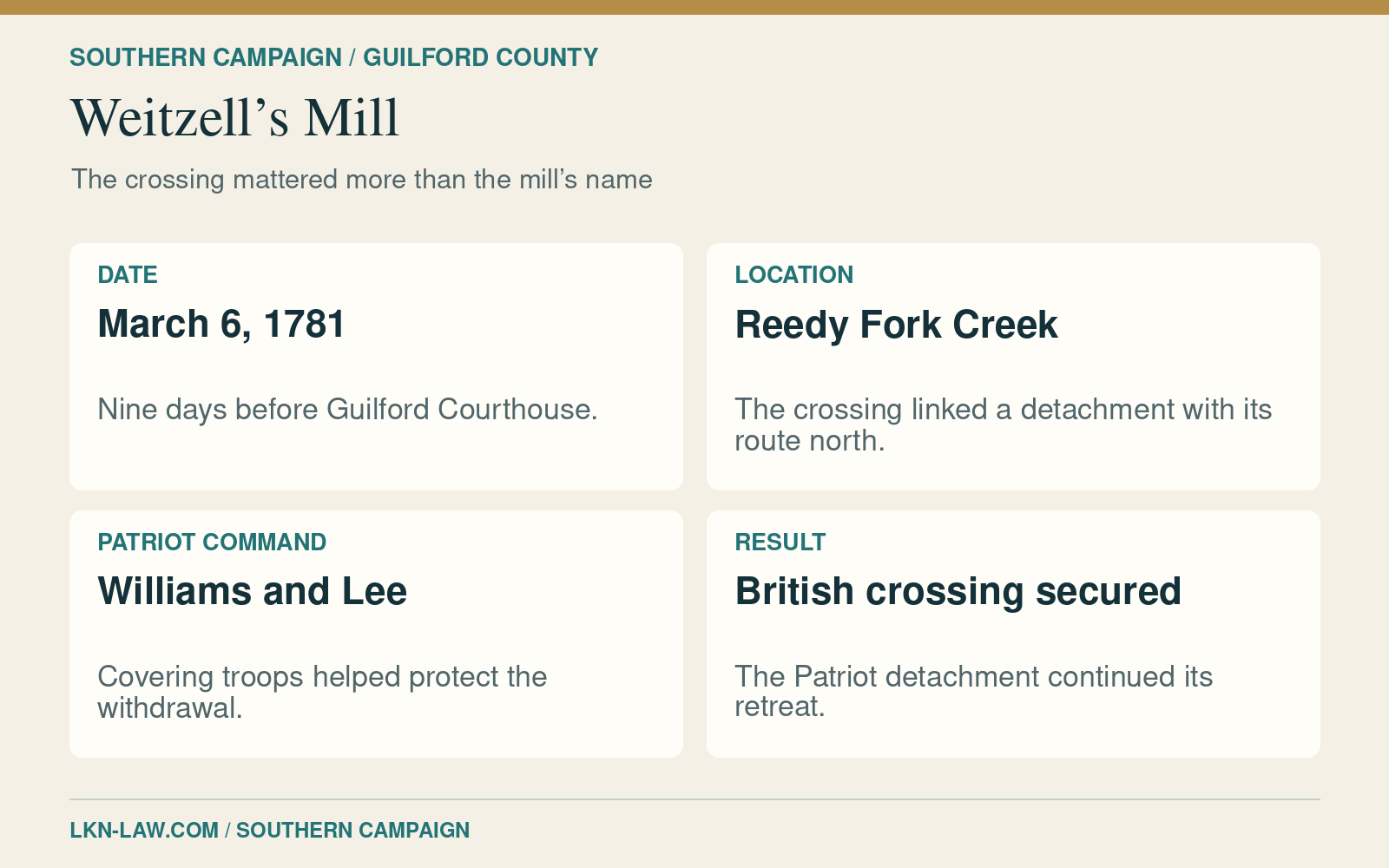
Nine days before Guilford Courthouse, Otho Holland Williams’s detachment faced a more immediate problem: reach a creek crossing before British troops closed the route. The Battle of Weitzell’s Mill on March 6, 1781, shows how a small action could threaten the survival and cohesion of a larger army.
The Southern Campaign Collection · The Lake Norman Brief
Explore the complete Southern Campaign collection
Nine days before Guilford Courthouse, Otho Holland Williams’s detachment faced a more immediate problem: reach a creek crossing before British troops closed the route. The Battle of Weitzell’s Mill on March 6, 1781, shows how a small action could threaten the survival and cohesion of a larger army.

Battle at a glance
| Date | March 6, 1781 |
|---|---|
| Place | Adam Weitzell’s Mill on Reedy Fork Creek, northeastern Guilford County, North Carolina |
| Also called | Wetzell’s Mill, Weitzel’s Mill and Whitsall’s Mill |
| Principal commanders | Otho Holland Williams and Henry Lee; James Webster and Banastre Tarleton |
| Outcome | British crossing secured; Patriot detachment withdrew |
Between the river retreat and the major battle
North Carolina’s public history resources place the engagement among the smaller actions surrounding Greene’s North Carolina campaign. Cowan’s Ford, Clapp’s Mill and Weitzell’s Mill belong to the connected story that culminated at Guilford Courthouse. They were not all fought for the same purpose, and their results should not be compressed into a single continuous American victory. [1]
By March, the question had changed from whether Greene could escape across the Dan to how he could maneuver without losing valuable detachments. A light force could observe an enemy and disrupt its movements. But sending it forward also created a separation that an alert opponent might exploit. At the mill, that danger became immediate.
The race to the ford
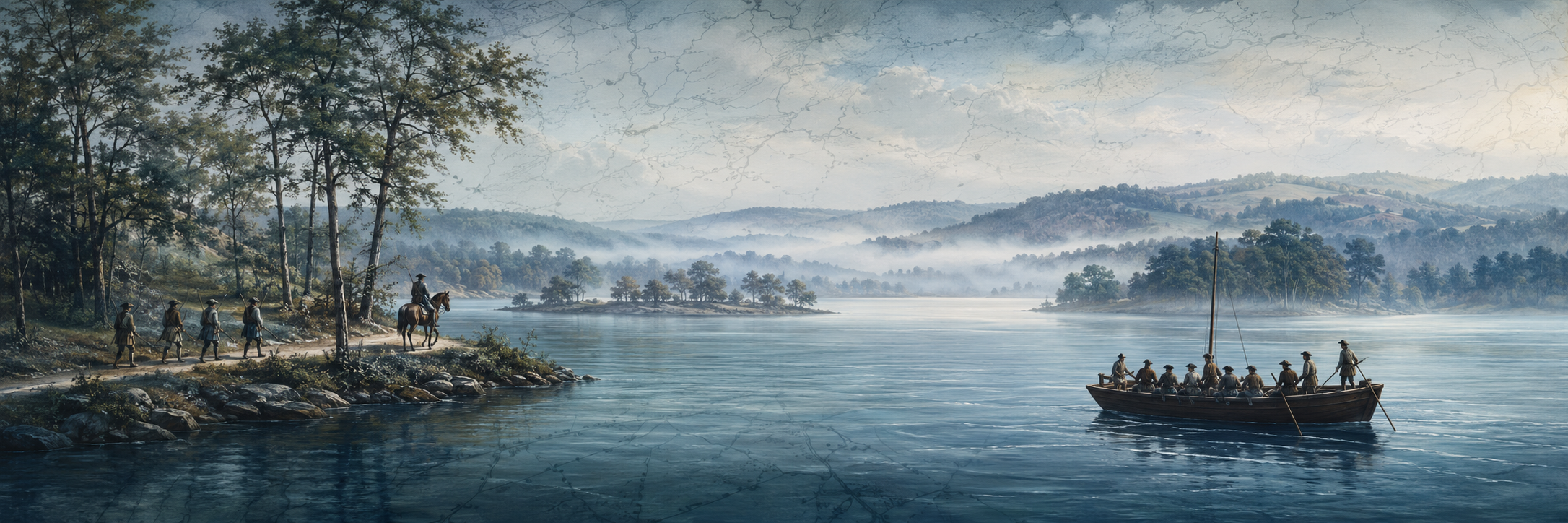
The state marker account describes British infantry and cavalry moving early on March 6 under fog. Williams’s troops were south of Greene’s main army, with the creek between them. Patriot sentries detected the approach, and the detachment moved toward the mill crossing. Lee’s men and riflemen helped cover the withdrawal as the opposing columns raced for the same vital passage. [2]
This is the central map-reading problem of the engagement. A creek that offered protection behind a retreating force could become a trap if the enemy reached the crossing first. The value of the ford depended on who could use it, in what order, and how long the covering troops could hold the approach.
A defense that bought movement, then gave way
NCpedia describes Williams placing troops to cover the ford after crossing. An initial British effort was checked, but Webster personally led another advance across the creek. The Americans then continued their retreat. The same account stresses a limit to the British success: Cornwallis did not turn it into an immediate attack on Greene’s main army, instead moving toward Bell’s Mill. [3]
Holding a crossing and saving a detachment are related but different objectives. Williams lost the position while avoiding the complete destruction of his force. British troops gained the crossing without capturing Greene’s army. Calling the result a British tactical victory is therefore useful only if the reader is also told what the victory did—and did not—produce.

The cost that casualty totals miss
The DNCR account gives particular weight to resentment among the militia and riflemen who believed they had been exposed to protect the Continentals. It connects that resentment with departures from Greene’s force after the action. Its emphasis brings an important issue into view: trust between different parts of a temporary army. [2]
A unit can lose effectiveness without losing every missing man to enemy fire. Men can leave when a tour ends, when they distrust a commander, or when the organization holding them together fails. That is why an operational account needs more than a killed-and-wounded column. Decisions about whom to preserve may be militarily understandable and still have a damaging effect on cooperation.
Spelling, casualties and claims of precision
The family’s name appears in several forms. The state marker uses Weitzell, while Lee’s usage helped circulate Wetzell. The differing spellings refer to the same engagement. Casualty estimates also differ: NCpedia discusses roughly fifty on each side and a lower British figure, while the current state marker essay uses about thirty on each side. Those numbers should remain estimates. [2][3]
A responsible graphic can show the essential relationship—approach, crossing, covering position and withdrawal—without pretending to locate every soldier. Exact-looking arrows do not make uncertain deployments certain. For the same reason, this article does not repeat the dramatic story of riflemen missing an exposed officer as though it were independently verified ballistics evidence.
Nine days later at Guilford Courthouse
North Carolina’s Guilford Courthouse account places the March 15 battle within this preceding series of maneuvers and smaller engagements. Greene then assembled a larger force and used successive lines with supporting troops on the flanks. Cornwallis held the final field, but suffered losses that shaped his subsequent movement to Wilmington. [4]
The comparison helps explain why Weitzell’s Mill belongs between Clapp’s Mill and Guilford Courthouse in a reading sequence. The same campaign contained pursuit, reconnaissance, withdrawal and a deliberately accepted major battle. Reading only the famous final encounter removes the uncertainty under which those choices were made.
Continue through the campaign
- Clapp’s Mill: an earlier encounter
- Cowan’s Ford and the Catawba crossing
- Find Guilford Courthouse in the campaign guide
Historical interpretation draws on the linked sources; surviving evidence and accounts may differ. Visitor access and site conditions should be checked with the relevant site manager.