The Lake Norman Brief · Southern Campaign
Eutaw Springs: The Costly Battle That Narrowed Britain’s Southern Foothold
At Eutaw Springs on September 8, 1781, Greene’s army drove into a British camp, then lost the field to a stubborn defense and counterattack. The British victory came at a cost that weakened their inland position. The battle brings together the Southern Campaign’s central problem: holding ground meant little if an army could no longer sustain its wider purpose.
The Southern Campaign Collection · The Lake Norman Brief
Explore the complete Southern Campaign collection
At Eutaw Springs on September 8, 1781, Greene’s army drove into a British camp, then lost the field to a stubborn defense and counterattack. The British victory came at a cost that weakened their inland position. The battle brings together the Southern Campaign’s central problem: holding ground meant little if an army could no longer sustain its wider purpose.

Battle at a glance
| Date | September 8, 1781 |
|---|---|
| Place | Near present-day Eutawville, Orangeburg County, South Carolina |
| Principal commanders | Nathanael Greene; Lieutenant Colonel Alexander Stewart |
| Battlefield result | British held the field after Greene withdrew |
| Strategic aftermath | British withdrawal toward the Charleston area; fighting in South Carolina continued |
Greene returns to the offensive
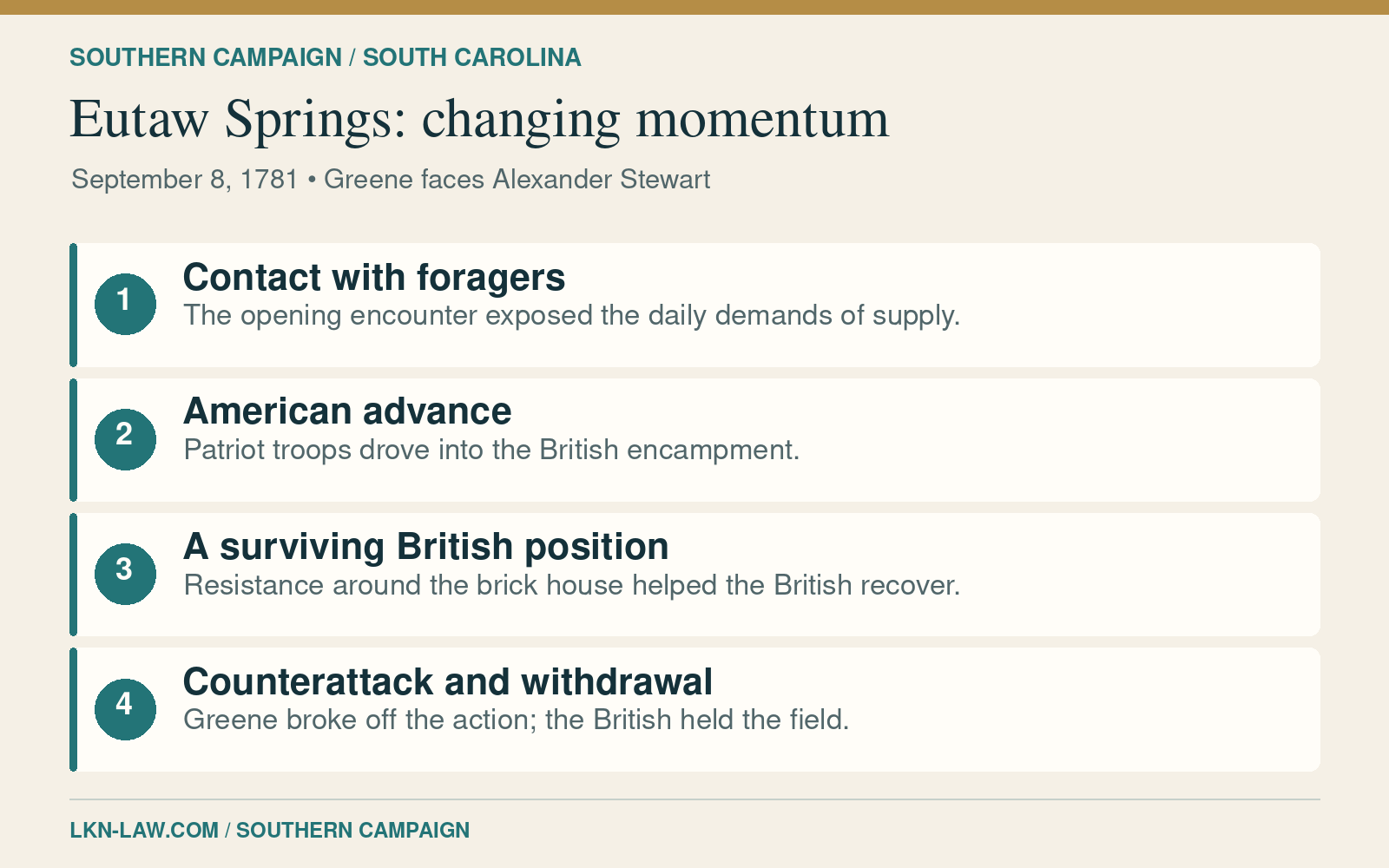
After the spring fighting around Camden and Ninety Six, Greene continued operations in South Carolina. The American Battlefield Trust describes his advance from the High Hills of the Santee toward Stewart’s force late in the summer. On September 8, contact with British foragers helped open the battle before the main lines met. [1]
The foraging encounter matters because it places supply in the opening scene. Soldiers needed food as well as ammunition, and gathering it exposed men outside a protected camp. A campaign history that begins only when formed lines exchange volleys misses these everyday activities through which one army could find another.
An advance that did not finish the battle
Greene put militia ahead of his more experienced troops. The American advance eventually carried into the British encampment, but Stewart’s force found a defensible position around a substantial brick house and adjoining enclosure. That surviving resistance gave the British time to recover. A counterattack followed, and Greene broke off the fighting. [1]
The South Carolina Encyclopedia adds an important complication: some Americans stopped to take goods from the camp while British elements still held firm. Its account places that loss of order beside the continued defense, rather than treating the first British withdrawal as a completed victory. [2]
The tactical danger is easy to overlook from a later map. An enemy camp feels like a destination. In fact, reaching it may simply carry attackers past their supporting troops and into range of another defended position. The difference between a breakthrough and a decisive victory depends on what remains organized after the apparent success.
William Washington’s war ends here
The National Park Service records that William Washington, whose cavalry played a prominent role at Cowpens, was wounded and captured at Eutaw Springs. His charge met a British position in difficult vegetation. Capture ended his active wartime service, and he remained a prisoner in Charleston for the rest of the conflict. [3]
His experience supplies a useful connection back to this collection’s Cowpens article. A capable officer and a successful arm of service did not produce the same result on every field. Cavalry depended on space, movement, support and the condition of the enemy. Eutaw Springs is a reminder to read the ground anew rather than assume a famous earlier performance guaranteed a later one.

The human cost beyond the commanders
The National Park Service’s study of African American soldiers associated with Guilford Courthouse follows several men through additional southern actions. It identifies Isaac Brown as serving at Ninety Six and Eutaw Springs, and Andrew Pebbles as suffering three wounds at Eutaw. Their later pension histories connect the battlefield to lives extending far beyond a commander’s report. [4]
These individual records broaden the meaning of loss. A casualty returned in an official tally could face years of impaired work, family dependence and difficulty proving service. The story of an army is therefore not complete when the last unit leaves the field. Following named soldiers into the pension record offers a different measure of what the campaign cost.
Who won—and what followed?
The British held the field, but Stewart subsequently withdrew toward Moncks Corner and Charleston. Published casualty totals vary considerably: the figures used by the American Battlefield Trust differ from those given in the South Carolina Encyclopedia. Both accounts support heavy losses; neither should be silently combined with the other to create a supposedly definitive total. [1][2]
Eutaw Springs is commonly described as South Carolina’s last major Revolutionary battle. That description should not be shortened to the last fighting in the state. The war and occupation continued after September 1781. In a chronology, Eutaw Springs therefore marks a major transition, not a clean end to violence. [5]
The most useful result statement keeps both levels in view: a British tactical victory followed by a contraction of the British inland position. That formulation respects the men who held the field while also explaining why Greene’s campaign could make progress through battles that were costly and inconclusive in their immediate results.
The battlefield and the reading route
South Carolina’s National Register description identifies the commemorative park near Eutawville and the grave of British Major John Marjoribanks. It is a surviving place of interpretation within a changed landscape. Readers should use current official visitor information and avoid treating the park’s boundaries as the complete extent of the historical battle. [6]
Read Eutaw Springs after Hobkirk’s Hill, Fort Motte and Ninety Six. Then return to the campaign guide and compare those results with Camden in 1780. The change becomes visible: a British inland system that had seemed expansive after Charleston was increasingly expensive to defend, even when its troops could still win an individual field.
Continue through the campaign
- Southern Campaign: the 1781 sequence
- William Washington’s earlier success at Cowpens
- Camden and the British position in 1780
Historical interpretation draws on the linked sources; surviving evidence and accounts may differ. Visitor access and site conditions should be checked with the relevant site manager.