
Backcountry Resistance After Charleston · By Christopher Adkins. Explore the complete Revolutionary War collection →
At Musgrove Mill, a smaller Patriot force built cover and used Shadrach Inman’s feigned retreat to draw a larger enemy into close-range fire.
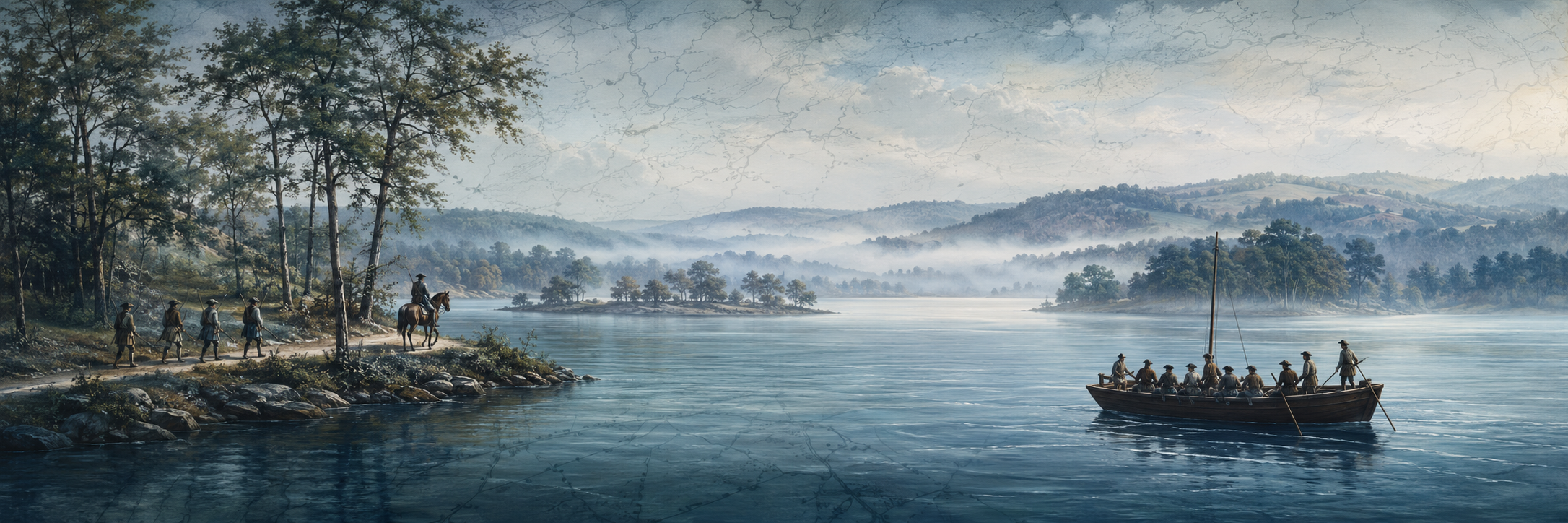
On the morning of August 19, 1780, about 200 mounted Patriots reached Edward Musgrove’s mill on the Enoree River. They expected to strike a Loyalist force of similar size. Instead, they learned that the post had been reinforced and now held roughly 500 men. Their scouts had already exchanged fire. Their horses were exhausted. Surprise was gone.
Colonels Isaac Shelby, Elijah Clarke, and James Williams chose to make the enemy attack them.
The Battle of Musgrove Mill is a compact lesson in Southern Campaign tactics. A ford and a grain mill gave the place strategic value. A ridge offered defensive ground. A temporary breastwork multiplied the power of a smaller force. A deliberate lure turned aggression into vulnerability. The result was a Patriot victory at the moment news of disaster at Camden was beginning to travel across the region.
A mill at the center of war
Edward Musgrove’s mill supplied an agricultural community divided by allegiance. The Enoree ford carried people, animals, information, and military traffic. Whoever controlled the crossing and grain supply gained more than a campsite.
Musgrove himself tried to remain neutral, a position that reveals the pressure civilians faced. Neutrality did not remove a family or business from the war. Armies consumed food, occupied property, demanded information, and transformed transportation nodes into targets.
The Patriot force embodied the campaign’s regional character: Clarke brought Georgians, Williams led South Carolinians, and Shelby commanded men from the trans-Appalachian settlements then associated with western North Carolina. Their cooperation foreshadowed the overmountain mobilization for Kings Mountain.
The defenders combined Loyalist militia with provincial regulars from South Carolina, New York, and New Jersey. Colonel Alexander Innes commanded the force that moved against the Patriots. Published totals differ slightly, but the widely used estimate is approximately 500 defenders against 200 Patriots.
Thirty minutes to build a defense
Once warned of the reinforcement, the Patriots selected a ridge across the road from the mill and constructed a semicircular breastwork of logs and brush. They had little time—perhaps thirty minutes. The work was crude, but it forced an attacker to approach uphill against protected marksmen.
Captain Shadrach Inman led a small detachment across the Enoree. His mission was dangerous and precise: engage the enemy, appear vulnerable, and retreat fast enough to survive without losing the pursuers. The Loyalist and provincial column followed.
The defenders waited. One tradition says they were ordered to hold fire until they could distinguish the attackers’ buttons. Whether or not every word survives exactly, the principle is clear: conserve the first volley until it can do maximum damage.
At roughly seventy yards, the breastwork erupted.
Bayonets against a militia line
The first fire hit hard, but Innes’s men continued forward. Provincial regulars fixed bayonets and pressed Shelby’s right. Many frontier riflemen did not carry bayonets, leaving them vulnerable if the fight closed to hand-to-hand distance. Shelby’s line bent back.
Clarke attacked the enemy’s right to relieve the pressure. Innes was shot and fell wounded. Patriot units rallied; the attackers lost cohesion; withdrawal became rout. The fighting lasted about an hour.
The American Battlefield Trust estimates sixteen Patriot casualties and 133 British and Loyalist casualties. Other accounts break the losses into roughly sixty killed, ninety wounded, and seventy prisoners while listing four Patriots killed and about a dozen wounded. Those figures cannot all be reconciled perfectly. What can be stated confidently is that the larger attacking force suffered more than 130 total losses—over one quarter of its strength—while Patriot losses were far lighter. Inman was among the Patriot dead.
Victory beside catastrophe
After the battle, the Patriots received news that Horatio Gates had been defeated at Camden on August 16. Remaining near the British post at Ninety Six was dangerous. Burdened with prisoners and facing the possibility of pursuit, the force dispersed and moved away from the low country.
That retreat did not erase the victory. Shelby carried the news west. Musgrove Mill showed that coordinated militia could defeat provincial regulars when discipline and terrain were used intelligently. The action helped build confidence among the communities that soon answered Patrick Ferguson’s threat and marched toward Kings Mountain.
The tactical family resemblance is striking. At Huck’s Defeat (related article), fences and surprise trapped mounted troops. At Hanging Rock (related article), dispersed camps invited a concentrated attack. At Musgrove Mill, the Patriots reversed the relationship: they prepared the position and made the enemy expose itself. At Cowpens, Daniel Morgan would use controlled withdrawal, layered lines, and an enemy’s momentum on a larger scale.
Civil war on the Enoree
Musgrove Mill should not be told only as clever tactics. Many combatants were Americans fighting Americans under competing flags. Families, mills, farms, and enslaved labor sustained the landscape in which armies maneuvered. Patriot victory did not end slavery or political exclusion, and Loyalist defeat could bring confiscation, exile, or retaliation. The battlefield’s modern interpretation is strongest when it allows visitors to confront that “war between neighbors” rather than treating allegiance as simple.
What visitors can see
Musgrove Mill State Historic Site, 398 State Park Road, Clinton, South Carolina, preserves and interprets the landscape. Official materials describe a one-mile British Camp Trail and a roughly 1.5-mile Battlefield Trail. Trail surfaces and accessibility vary. Confirm hours, closures, fees, programs, and accessibility with South Carolina State Parks before publication or travel.
Sources and editorial note
- South Carolina State Parks — Musgrove Mill history
- National Park Service — A War Between Neighbors
- American Battlefield Trust — Musgrove Mill map
- The Liberty Trail — Musgrove Mill
Historical strength and casualty figures vary among reputable sources. This article preserves those qualifications rather than presenting uncertain numbers as exact. Visitor information should be verified with the responsible park or historic site before travel.



Leave a Reply