Backcountry Resistance After Charleston · By Christopher Adkins. Explore the complete Revolutionary War collection →
Sumter’s force exploited the divided encampments at Hanging Rock, but exhaustion and plunder prevented complete destruction of the post.
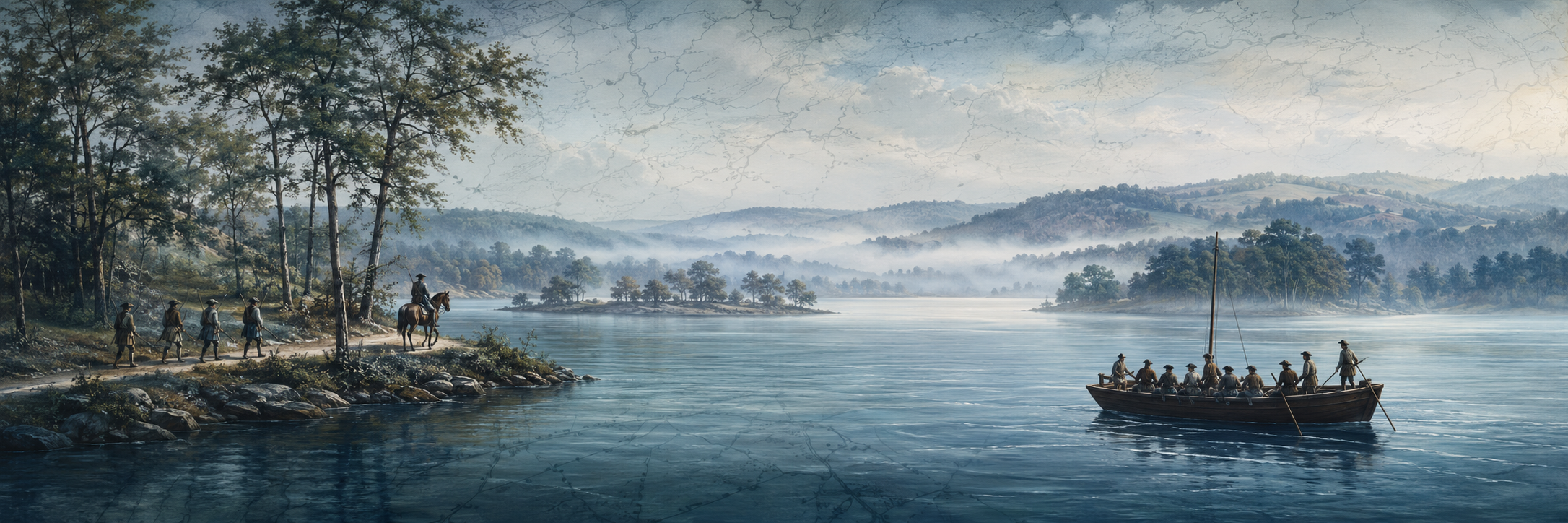
At six o’clock on the morning of August 6, 1780, Thomas Sumter’s militia crossed Hanging Rock Creek after an all-night march. Ahead lay not one compact fort but several British and Loyalist encampments spread around a strategic crossroads between Camden and Charlotte. That separation created an opportunity. It also created confusion.
The Battle of Hanging Rock became one of the most important Patriot successes between the fall of Charleston and the victory at Kings Mountain. Yet the familiar word “victory” needs explanation. Sumter’s men overran camps, inflicted serious losses, captured prisoners and stores, and withdrew safely. They did not destroy the entire post. Discipline frayed at the moment when success might have become decisive.
Why Hanging Rock mattered
The post stood on the road linking Camden to Charlotte and near routes that carried information, livestock, recruits, and supplies through the Waxhaws. British control there threatened Patriot communities and supported the wider occupation network. Sumter understood that isolated posts could be made costly even if his militia could not hold ground permanently.
His failed assault on Rocky Mount (related article) sharpened the plan. On July 30, William Richardson Davie had conducted a successful diversion at Hanging Rock, attacking a detached Loyalist position and carrying off horses and weapons. On August 5, Sumter crossed at Land’s Ford and joined reinforcements under Davie and Mecklenburg militia leader Robert Irwin. The combined force is usually estimated at about 800.
The defenders may have numbered 1,100 to 1,400, though totals vary. They were divided among three camps: Loyalist militia associated with Samuel Bryan, the Prince of Wales’s American Regiment under Major John Carden, and additional Loyalist or provincial troops under Joseph Robinson. Around thirty-five Catawba warriors reportedly fought with the Patriot force, a presence that should be integrated into the narrative rather than reduced to a footnote.
The wrong camp—and the right opportunity
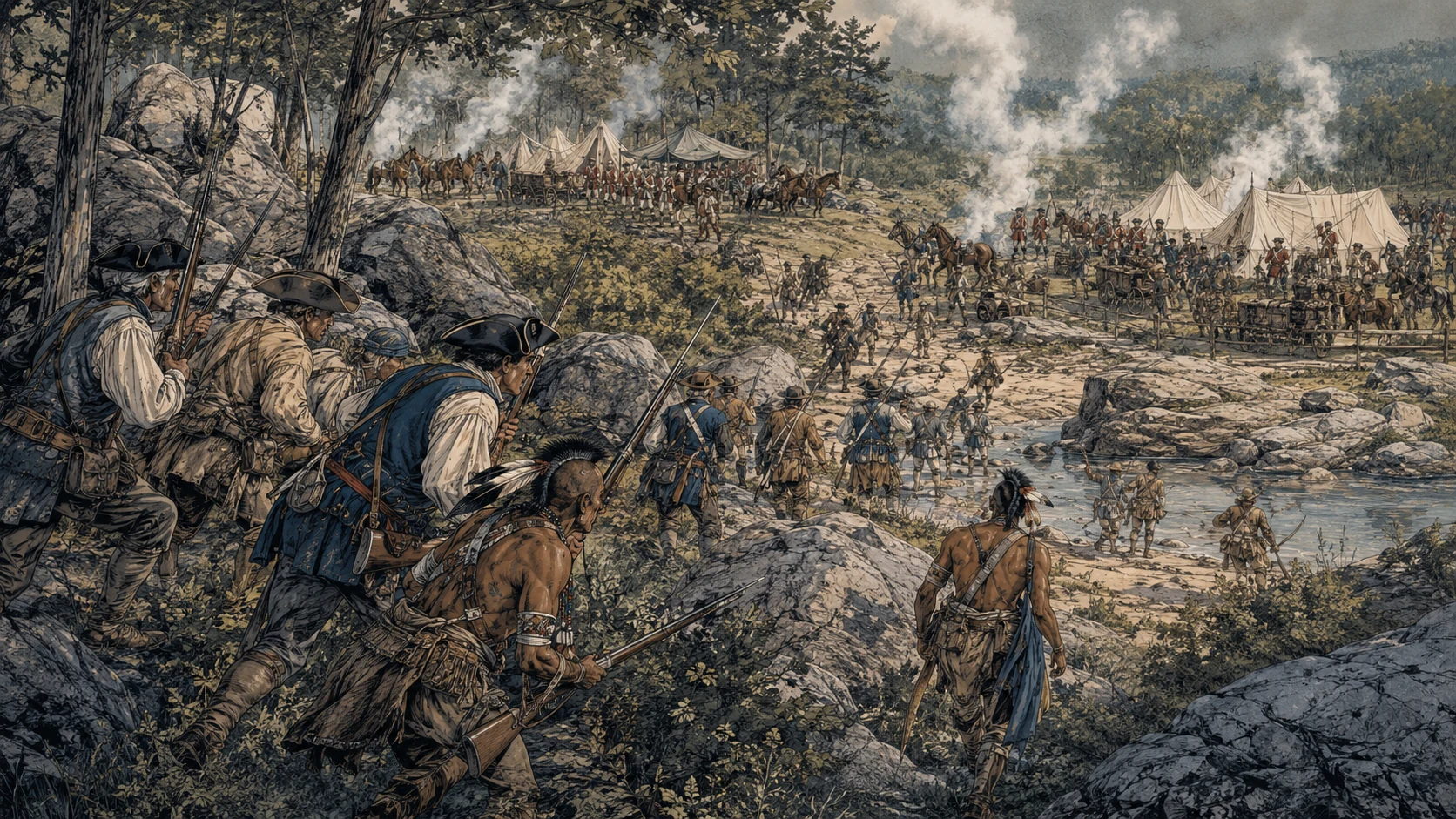
Guides became confused in the dark, and Sumter’s columns did not strike the entire line as intended. Instead, much of the Patriot force hit the northern camp. The mistake concentrated their strength. Bryan’s Loyalist militia broke, and the attackers then pressed into the Prince of Wales camp.
The fighting was close and intense. Defenders charged with bayonets; riflemen used trees, rocks, and uneven ground for cover. Officers fell. When ammunition ran low, Patriots used captured cartridges to continue. Davie helped check reinforcements and keep the attack moving.
The divided encampments that made Hanging Rock useful as a broad occupation post now made mutual support difficult. Sumter’s men captured much of the camp and drove defenders south. A three-pounder and organized resistance helped prevent complete collapse.
Heat, rum, and the limit of victory
After roughly three hours in punishing August heat, Patriot momentum slowed. Men were exhausted and thirsty. Ammunition was short. Captured stores offered food, equipment, horses—and rum. Plundering and drinking broke formation. Sumter could not restore enough order to assault the remaining position and chose to withdraw with prisoners and supplies.
Casualty figures vary widely. Sumter’s contemporary report claimed twenty killed, forty wounded, and two missing, along with seventy-three prisoners, one hundred horses, and 250 stands of arms captured. Modern summaries commonly estimate around fifty-three Patriot casualties and roughly 200 British and Loyalist casualties; some narratives give higher defender losses. A contemporary commander’s report is evidence, not infallible arithmetic. The article should present the range and identify the source of specific claims.
Both sides could construct a victory story. The defenders still possessed part of the post. The Patriots had broken two camps, carried off material, and retired unmolested. In operational and psychological terms, Hanging Rock strengthened the resistance. In tactical terms, it was an incomplete success.
People behind the battle
The roster connected several strands of Carolina history. Davie and Irwin tied the action to Mecklenburg and the Battle of Charlotte. William Hill and William Bratton connected it to Huck’s Defeat (related article). Catawba fighters continued a long, consequential alliance with the Patriot cause even as Native communities faced war, disease, land loss, and postwar dispossession.
Peter Harris, a Catawba veteran associated with Stono Ferry, Rocky Mount, Hanging Rock, and Blackstock’s, later appealed for public aid after losing the use of an arm. South Carolina granted him a pension. His story interrupts any easy claim that military service produced equal citizenship or security.
Tradition also places thirteen-year-old Andrew Jackson at Hanging Rock, often holding horses with his brother Robert. It may have been his first military experience. The detail is memorable, but the battle should not be reduced to a future president’s origin story.
From Hanging Rock to Camden
Ten days later, Horatio Gates’s Continental army suffered catastrophe at Camden. Two days after that, Banastre Tarleton surprised Sumter at Fishing Creek. Hanging Rock did not reverse the campaign by itself. It did prove that British posts could be penetrated and that militia could coordinate across districts.
The tactical lessons continued at Musgrove Mill (related article): choose the ground, build cover, conserve fire, and force the enemy to advance. Those lessons would mature further at Kings Mountain and Cowpens.
What visitors can see
The Hanging Rock landscape includes a battlefield trail and historic-site interpretation near Heath Springs, South Carolina. The Liberty Trail describes a roughly three-quarter-mile loop, while the historic rock formation and older park are nearby. Verify current access, parking, trail conditions, and accessibility before publication. Stay on marked routes and distinguish the battlefield landscape from the rock attraction.
Sources and editorial note
- American Battlefield Trust — Battle of Hanging Rock
- The Liberty Trail — Hanging Rock tour
- South Carolina Archives — Hanging Rock Historic Site
- Thomas Sumter’s August 9 report
Historical strength and casualty figures vary among reputable sources. This article preserves those qualifications rather than presenting uncertain numbers as exact. Visitor information should be verified with the responsible park or historic site before travel.



Leave a Reply