
Backcountry Resistance After Charleston · By Christopher Adkins. Explore the complete Revolutionary War collection →
Earle’s Ford began as a successful nighttime surprise but changed when Charles McDowell’s nearby militia formed behind the Georgians.
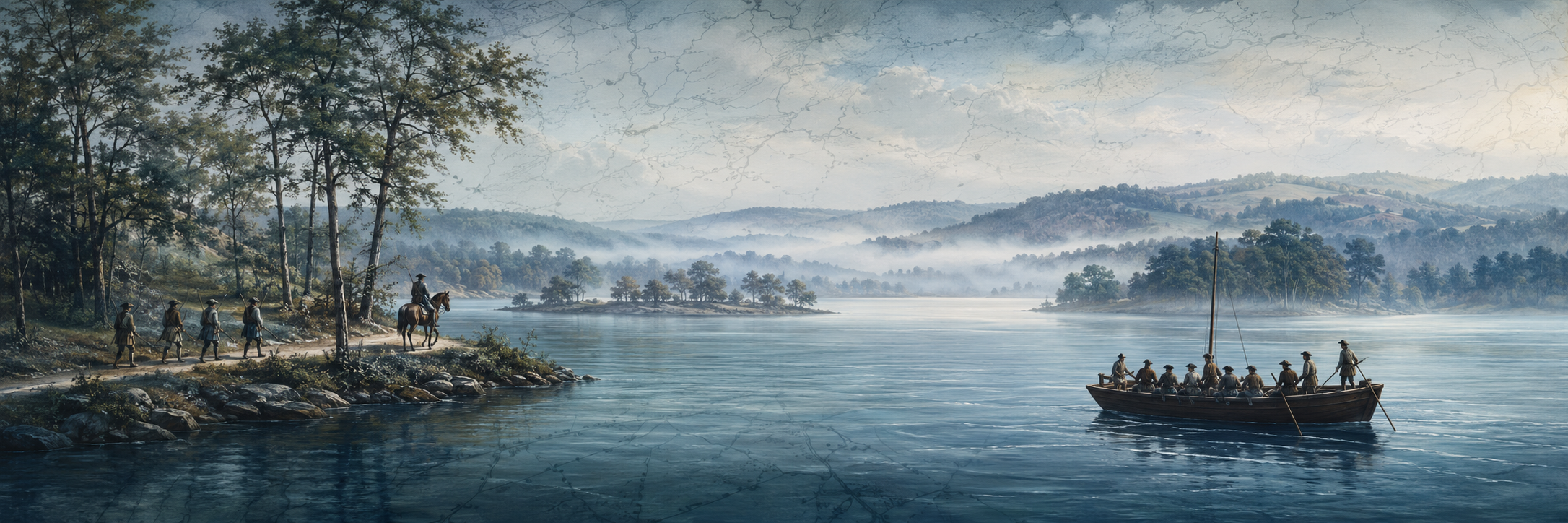
Two nights after Huck’s Defeat (related article), the initiative shifted violently. At Baylis Earle’s Ford on the North Pacolet River, British dragoons crossed in darkness and struck a sleeping Georgia militia camp. The attackers achieved surprise and inflicted terrible wounds. They also discovered, too late, that a much larger Patriot force was close enough to intervene.
Earle’s Ford deserves attention because it strips away the clean labels often attached to Revolutionary battles. It was a raid born from another raid. Its units were small, mounted, and locally informed. Its geography crossed the modern North Carolina–South Carolina boundary. And its outcome unfolded in two stages rather than one.
From Gowen’s Old Fort to the Pacolet
On July 13, Colonel John Jones of Georgia ambushed Loyalists near Gowen’s Old Fort on the South Pacolet River. Jones then moved north to join Colonel Charles McDowell, who was assembling Patriot militia near the state line. McDowell’s camp represented the reconstitution of resistance after Charleston: not a fully supplied Continental army, but a gathering place for North Carolinians, South Carolinians, Georgians, and frontier fighters.
Jones crossed the North Pacolet at Baylis Earle’s Ford and camped near McDowell. British Colonel Alexander Innes responded to the earlier raid by sending Major James Dunlap and about seventy dragoons in pursuit. The horsemen reached the ford late on July 15. They knew where Jones had gone, but apparently did not know that McDowell’s larger body was nearby.
Sabers in the dark
Dunlap’s men crossed quietly and charged the sleeping Georgians. NCpedia’s account reports eight killed and thirty wounded. Jones suffered eight saber wounds to the head, an extraordinary detail that conveys both the closeness of the combat and the brutality of cavalry surprise.
The first minutes belonged to the attackers. Some Georgians fell back toward a fence roughly one hundred meters behind the camp. That ordinary boundary became a rallying position. McDowell’s troops formed beside the survivors, converting a routed camp into an organized line. Dunlap, suddenly facing far more men than expected, broke off the attack and withdrew across the river.
The next morning, Captain Edward Hampton led fifty-two men in pursuit. About fifteen miles away on the Old Blackstock Road, Hampton surprised Dunlap’s column, reportedly killing eight in the initial attack. The surviving dragoons escaped toward Prince’s Fort near present-day Inman, South Carolina.
Victory, defeat, or two tactical episodes?
Calling Earle’s Ford simply a Patriot or British victory conceals more than it explains. Dunlap accomplished the immediate purpose of a surprise attack and inflicted disproportionate losses on Jones’s command. He failed to destroy the wider Patriot concentration, withdrew when McDowell appeared, and suffered casualties in the next-day pursuit.
The more useful lesson is operational. Mounted troops could travel fast, cross rivers quietly, and turn intelligence into shock. Yet speed also created risk. A commander who acted on incomplete information could ride directly into a larger concentration. The engagement mirrored Huck’s Defeat in reverse: at Williamson’s Plantation, mounted Loyalists were trapped before they could exploit mobility; at Earle’s Ford, British dragoons converted mobility into an initial advantage before local reinforcement stopped them.
The state line was not a military boundary
Today the Pacolet country is divided by state and county lines. In 1780, roads, kinship, river fords, and militia districts mattered more. Fighters moved between the Carolinas, Georgia, and the mountain settlements. That regional network would appear again at Musgrove Mill (related article), where Elijah Clarke’s Georgians, James Williams’s South Carolinians, and Isaac Shelby’s overmountain men fought together.
Earle’s Ford also helps explain why the Lake Norman and Charlotte region belongs inside Southern Campaign history. Mecklenburg militia under Robert Irwin soon joined Thomas Sumter for the attack on Rocky Mount (related article). William Richardson Davie’s mounted North Carolinians connected the Catawba corridor to Hanging Rock (related article) and later to the Battle of Charlotte. Rivers joined this theater; they did not divide it.
Memory at the ford
For generations, Earle’s Ford remained less visible than major battlefield parks. In 2025, a memorial monument was dedicated near the site on the east bank of the Pacolet, reflecting renewed interest ahead of America’s 250th anniversary. A monument is an invitation to investigate, not a substitute for the record. The safest article language distinguishes the documented sequence in NCpedia from commemorative claims and respects private property and current access rules.
Sources and editorial note
Historical strength and casualty figures vary among reputable sources. This article preserves those qualifications rather than presenting uncertain numbers as exact. Visitor information should be verified with the responsible park or historic site before travel.



Leave a Reply