

Huntersville, North Carolina is one of the fastest-growing communities in the state—a place where Revolutionary War backcountry, Scotch-Irish settlement patterns, cotton-mill roots, and modern Lake Norman development intersect to create a uniquely Southern identity. What began as a quiet rural crossroads north of Charlotte has evolved into a dynamic suburban town, yet Huntersville has never fully shed the character of its past. Its early farms, old Presbyterian congregations, and long-established family names still anchor the landscape, even as new neighborhoods, schools, and commercial centers stretch across what used to be open fields. Today, Huntersville stands as both a gateway to Lake Norman and a bridge between the region’s deep history and its fast-moving future—a center for business, recreation, and community life, and a home for families drawn by strong schools, safe neighborhoods, and seamless access to Charlotte’s expanding economic corridor.
Early Settlement and Origins (1700s)
The land that would become Huntersville began as part of North Carolina’s untamed backcountry—a frontier of hardwood forests, game-rich creeks, and rolling pastureland that attracted waves of Scots-Irish Presbyterians and German farmers in the mid-1700s. These settlers came southward from Pennsylvania and Virginia along the Great Wagon Road, carrying with them a culture of independence, a distrust of distant authority, and a strong emphasis on faith, family, and hard work. What emerged was not a town in the modern sense, but a constellation of small farming communities connected by wagon paths, churchyards, and militia musters.
At the center of early life stood Hopewell Presbyterian Church, founded in 1762, one of the most influential institutions in the region. The church served not only as a house of worship, but also as a civic anchor—a school, meeting hall, burial ground, and community organizer rolled into one. Its elders were often the same men who led local militias, settled land disputes, and represented the community during the political and religious turmoil of the Revolutionary era. Families like the Torrences, Samples, Gileads, Hendersons, and Holbrooks built farms around these church centers, establishing lineages that shaped northern Mecklenburg County for generations.
During the 1770s and 1780s, Mecklenburg County functioned almost like an independent republic. Royal courts collapsed after the outbreak of the Revolution, leaving local Committees of Safety to enforce order, issue directives, and coordinate militia activity. Settlers in what is now Huntersville were part of this homegrown system of governance—a blend of frontier justice, collective decision-making, and Presbyterian moral authority. Their worldview was shaped by the rugged demands of frontier life as well as by the political language of independence that swept through the region long before the Declaration of Independence reached North Carolina.
Though no formal Revolutionary War battle took place directly in Huntersville, the surrounding countryside was anything but quiet. The area lay between key strategic points—Cowan’s Ford, where General William Lee Davidson fell in 1781; Torrence’s Tavern, where Patriot militia clashed with British dragoons; and numerous Catawba River crossings used by both armies. Skirmishes, raids, and militia musters marked the backcountry landscape, and many Huntersville-area farmers served as mounted riflemen or guides. By the end of the Revolution, the region had forged a cultural identity rooted in independence, faith, and self-reliance—traits that would define northern Mecklenburg County for generations.
A Cotton Town Is Born (1870s–1900)
After the Civil War, the scattered farming communities of northern Mecklenburg County slowly developed into a more unified settlement. In 1873, the General Assembly officially incorporated Huntersville, naming it after Major Robert B. Hunter, a local landowner and cotton innovator who helped steer the region toward commercial agriculture. Cotton dominated the Piedmont economy during this era, and Huntersville—positioned between Charlotte and the Catawba River communities—was ready to take advantage of it.
The arrival of the railroad changed everything. Huntersville’s quiet crossroads became a point of connection as freight trains carried cotton, timber, grain, and livestock to Charlotte, Salisbury, and beyond. New storefronts appeared near the depot, and farmers gathered in town not only to attend church but also to ship crops, service equipment, and purchase supplies.
Cotton gins soon became the heartbeat of the community. Farmers hauled wagonloads of cotton down dusty roads, where bales were processed before being loaded onto boxcars. General stores stocked with hardware, seed, coffee, and kerosene served both town residents and rural families. Unlike Cornelius or Davidson, which built large textile mills, Huntersville developed into a vibrant trade center—small in scale, but essential to the region’s agricultural economy.
By the early 1900s, Huntersville had established itself as the northern Mecklenburg gateway to Charlotte, its identity shaped not by heavy industry but by commerce, transportation, and the steady reliability of the farming families who had worked the land for generations.
Mid-Century to Modern Development (1950s–1990s)
For much of the early 20th century, Huntersville remained a quiet agricultural community. Families raised cotton, soybeans, and cattle; children attended small community schools; and the town revolved around a handful of brick storefronts and the railroad. Life moved at a slower, rural pace, defined by churches, high school sports, and neighbors helping neighbors.
Everything changed between the 1960s and 1990s, when two transformative forces reshaped Huntersville entirely.
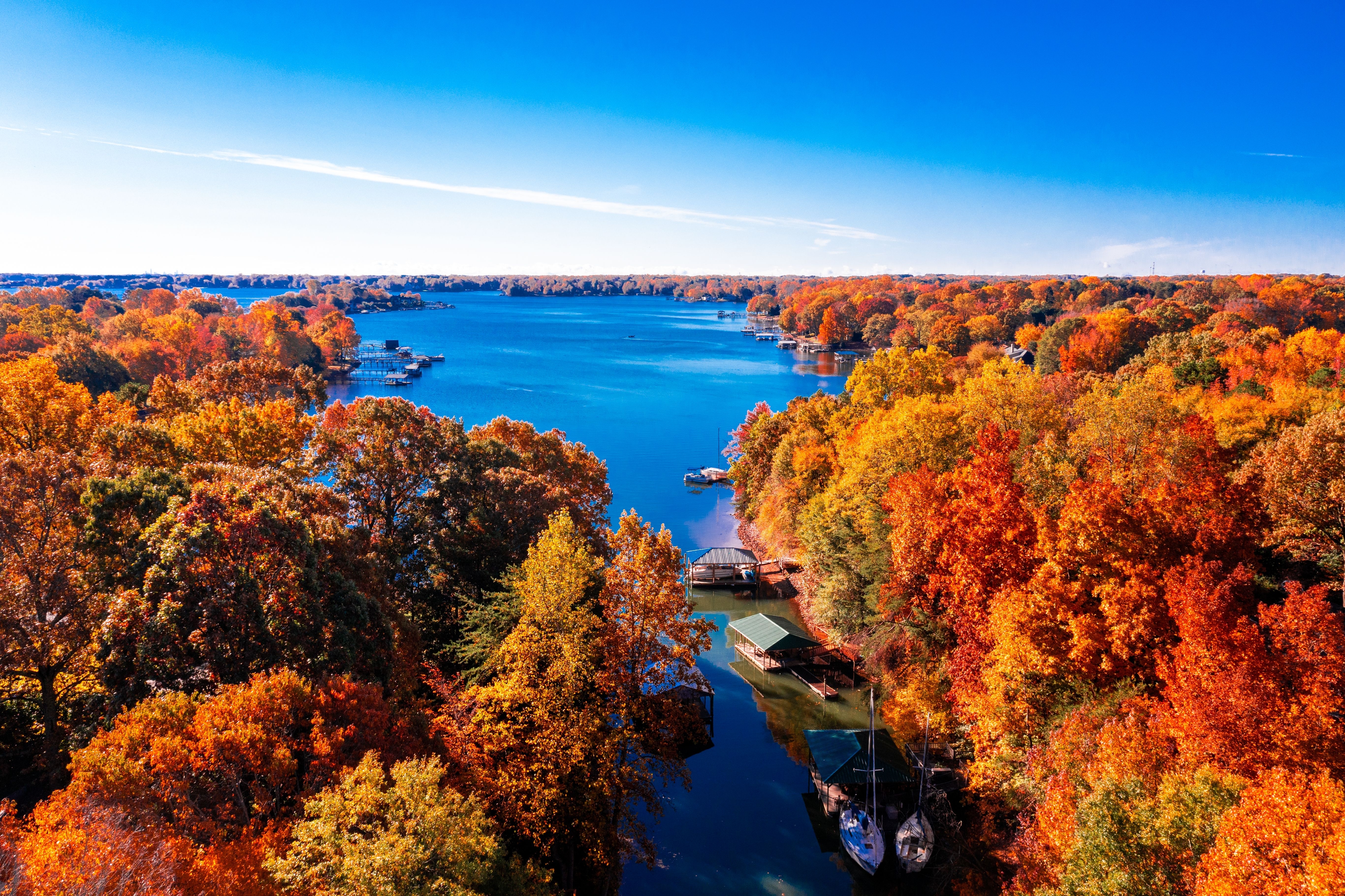
The first was the creation of Lake Norman in 1963. Duke Power’s hydroelectric project flooded thousands of acres along the Catawba River, turning farmland into shoreline and creating the largest man-made lake in North Carolina. Fishermen, boaters, and families seeking recreation were drawn to the new waters, and the entire region began to shift toward lake-centered living.
The second—and more powerful—force was the construction and expansion of Interstate 77. Built in segments from the 1960s to the 1980s, I-77 connected Huntersville directly to Charlotte, turning the once-isolated farming town into a commutable suburb. Developers bought large tracts of former pastureland and converted them into neighborhoods that defined the suburban boom of the era. Communities such as Cedarfield, Wynfield, Rosedale, and The Hamptons emerged across what had once been open countryside. By the late 1990s, the creation of Birkdale Village signaled a new era—a walkable, mixed-use town center that instantly became one of Lake Norman’s defining landmarks.
By the end of the century, Huntersville had transformed from a quiet agricultural outpost into one of the most desirable suburbs in the Charlotte region—anchored by its proximity to Lake Norman, its expanding residential communities, and its new economic opportunities.
Huntersville Today: A Modern Suburb with Historic Roots
Today, nearly 70,000 residents call Huntersville home. The town has grown rapidly, but it remains deeply tied to its past. Families are drawn by its excellent schools, safe neighborhoods, and easy access to Charlotte and Lake Norman. Birkdale Village continues to define the town’s social and commercial identity with its walkable layout, restaurants, shops, and community events.
Historic and cultural anchors remain central to Huntersville’s identity. Rural Hill preserves the memory of early Scots-Irish settlers. Latta Nature Preserve protects thousands of acres of forest and wildlife habitat. Hopewell Presbyterian Church stands as a testament to more than two centuries of local history. The Loch Norman Highland Games keep cultural traditions alive for a new generation. Huntersville is a growing suburb, but also a town with deep continuity.
Its economy has diversified far beyond its agricultural roots. Corporate headquarters, manufacturing facilities, medical providers, logistics centers, small businesses, and tech companies now operate in the town. Huntersville’s strategic location—situated between Charlotte and Lake Norman—has made it a magnet for families, professionals, and employers alike.
Recreation is one of the town’s greatest strengths. Between Lake Norman, Mountain Island Lake, Latta Nature Preserve, and greenways such as Torrence Creek, Huntersville offers a blend of outdoor experiences that few suburban regions can match. The town’s commitment to protecting green space has enhanced its quality of life and preserved the natural landscape that once defined the region.
Community life remains vibrant. Schools like Lake Norman Charter, Hopewell High, Hough High, and Christ the King attract families from across North Mecklenburg, while local festivals, farmers markets, concerts, youth sports leagues, church communities, and Birkdale events create a shared social fabric. Huntersville continues to grow, but it has not lost the close-knit identity that has long defined it.
Looking forward, Huntersville faces the challenge of managing growth while preserving its character. Transportation, development, and infrastructure planning will shape the coming decades. Yet the same qualities that carried Huntersville from its frontier beginnings into the 21st century still guide it today: a strong identity, a strategic location, and a community rooted in both heritage and opportunity.
Huntersville is no longer simply a suburb of Charlotte. It is a town with its own story—shaped by generations of families, strengthened by newcomers seeking opportunity, and rooted in a landscape that holds both history and possibility.
Huntersville in the Lake Norman & Greater Charlotte Region
Huntersville’s identity is interwoven with the broader Lake Norman and Charlotte metro region. Its history, economy, and culture connect it to a network of communities that share common growth, heritage, and regional pride. Together, they form one of the fastest-growing and most dynamic regions in North Carolina.
Huntersville’s regional partners include:
- Cornelius
- Davidson
- Mooresville
- Troutman
- Sherrills Ford
- Denver
- Terrell
- Charlotte
- Statesville
- Concord
- Mountain Island Lake community
Together, these communities form a connected landscape of history, development, and shared identity—one that Huntersville stands proudly at the center of.
About Adkins Law — Serving Huntersville and the Lake Norman Region
Adkins Law is proud to call Huntersville home. Led by attorney Christopher Adkins, our firm is built on the same values that define this region: family, service, and community. We provide clear guidance and strong advocacy in divorce, mediation, estate planning, and civil matters for clients throughout Huntersville, Cornelius, Davidson, Mooresville, and the greater Lake Norman area. Whether you are navigating a divorce, protecting your children, planning for the future, or seeking a practical resolution to a difficult dispute, Adkins Law is here to help you move forward with confidence—rooted in local experience, committed to the people we serve, and dedicated to delivering solutions that truly meet your needs.
From its deep roots to its bright future, Huntersville remains a community defined by its people—and Adkins Law is honored to serve them.



Leave a Reply