
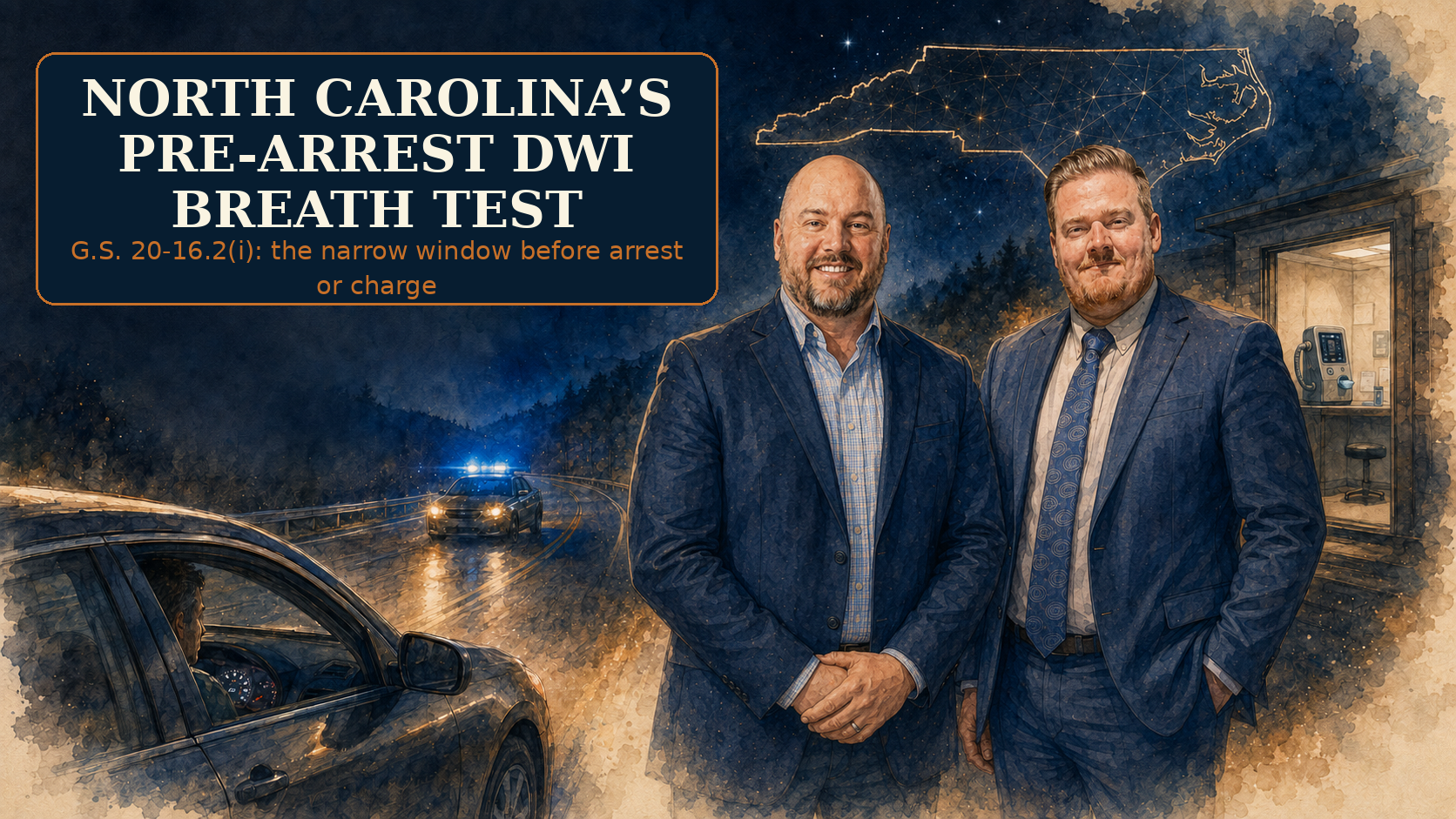

North Carolina law gives a person under DWI investigation a narrow, little-known opportunity to request an evidential breath analysis before arrest or charge. The opportunity can help, hurt, or disappear in a matter of minutes.
A detailed guide to G.S. 20-16.2(i), the narrow window before arrest or charge
By Chris Adkins and Chris Purkey, Adkins Law
Legal review date: August 16, 2026
Most North Carolina drivers have heard of the breath test that comes after a DWI arrest. Many have seen an officer use a handheld device beside the road. Almost no one knows that a third procedure exists: under N.C. Gen. Stat. § 20-16.2(i), a person being investigated for an implied-consent offense may request a chemical analysis of the person’s breath before any arrest or other charge is made.
That single sentence sounds simple. It is not. The request is time-sensitive. The requested analysis is not the same thing as a portable roadside screen. The result can be used against the requester. A qualifying result can produce an immediate civil license revocation if the person is later charged. The request also operates as consent to officer transport. And the appellate law directly interpreting the subsection is remarkably thin.
This article separates the statute’s actual text from police custom, identifies the decisions that matter, and explains the factual record a defense lawyer should preserve. It also says where North Carolina’s appellate courts have not supplied an answer. That distinction is important. A serious legal guide should mark the edge of the map rather than draw imaginary roads beyond it.
The short answer: Before arrest or charge, a person under investigation for an implied-consent offense may request an evidential breath analysis under G.S. 20-16.2(i). If a breath analysis is available, the officer must afford the opportunity. The person must confirm the request in writing and receive three statutory notifications. The result is admissible and may lead to an immediate license revocation if it meets the applicable threshold and the person is later charged. The statute does not require the officer to volunteer that the option exists.
First, the vocabulary: North Carolina charges DWI, not DUI
People often use “DUI” and “DWI” interchangeably. In North Carolina, the principal offense is driving while impaired, or DWI, under G.S. 20-138.1. “DUI” is common national shorthand, but it is not the formal name of the ordinary North Carolina charge.
The testing vocabulary is just as easy to mix up. Three different procedures may appear in one investigation:
Three different tests that people call a “breathalyzer”
1. Alcohol screening test / portable breath test (PBT) — G.S. 20-16.3
- When and where: Roadside, during the investigation.
- Purpose: Helps the officer decide whether there are reasonable grounds to believe an implied-consent offense occurred.
- What it shows: Ordinarily a qualitative positive/negative result or refusal for the statutory purpose—not a courtroom alcohol-concentration number.
2. Pre-arrest or precharge chemical breath analysis — G.S. 20-16.2(i)
- When and where: Requested before arrest or charge; performed where an approved evidential instrument and qualified operator are available.
- Purpose: Produces an evidential breath analysis under G.S. 20-139.1(b).
- What it shows: An admissible result that may be used against the requester and may support immediate civil revocation if the statutory conditions are met.
3. Post-charge implied-consent analysis — G.S. 20-16.2(a)
- When and where: After arrest or issuance of criminal process.
- Purpose: Evidence gathering after an implied-consent charge.
- What it shows: The result or a willful refusal may be admitted; refusal can generate a separate DMV revocation.
Calling all three a “breathalyzer” creates trouble. In the one North Carolina appellate decision squarely addressing whether a driver requested the subsection (i) analysis, that very ambiguity decided the issue.

The pre-arrest right exists in the middle of a moving investigation. Once an arrest occurs or criminal process issues, the subsection (i) window has closed.
The statute, element by element
The current caption of subsection (i) is “Right to Chemical Analysis before Arrest or Charge.” Its operative parts can be translated into eight rules.
1. The officer must be investigating a possible implied-consent offense
The person must have been stopped or questioned by a law-enforcement officer who is investigating whether the person may have committed an “implied-consent offense.” That category includes DWI and other offenses the General Assembly has placed within the implied-consent system. This is not a general right to demand government-administered alcohol testing in any police encounter.
2. The person must make the request
The statute is activated by a request. It does not direct the officer to advise every driver that the option exists. In State v. Thabet, the Court of Appeals expressly said there is no statutory requirement that an officer inform a person of the subsection (i) right. Thabet is unpublished and therefore not controlling precedent, but it is the only appellate opinion directly analyzing invocation of this right.
3. The request must precede arrest or another charge
Timing is central. Under G.S. 20-16.2(a1), a person is “charged” for this statute when the person is arrested or criminal process has been issued. A request made after handcuffs are applied may or may not be too late, because handcuffs do not invariably equal arrest. A request made after the officer clearly announces an arrest is ordinarily outside subsection (i).
4. The requested analysis is of breath
The current subsection directs the officer to afford an opportunity for a chemical analysis of breath, if available, performed under G.S. 20-139.1(b). It does not let the requester choose blood or urine as the precharge test.
5. The analysis must be “available”
The statute says “if available.” It does not say “at the nearest jail,” “within a reasonable distance,” or “without delaying the investigation.” No published North Carolina appellate decision has squarely defined “available” for subsection (i). In a real case, availability may turn on the condition and location of an approved instrument, the presence of a properly permitted chemical analyst, instrument downtime, staffing, transportation, and the actual communications between officers and dispatch.
Because the word remains judicially underdeveloped, an officer’s bare statement that “nobody was available” should be tested against records, not accepted as self-proving. Conversely, the statute does not clearly require an agency to summon an off-duty operator, cross the State, or create a functioning testing site that did not exist.
6. The request includes consent to officer transport
By making the request, the person consents to be transported by the officer to the place where the analysis will occur. The statute does not grant a right to drive one’s own vehicle to the testing site. A 1977 formal opinion of the North Carolina Attorney General concluded that a requester impliedly agrees to accompany the officer peacefully and has no right to insist on driving to the site. The opinion is historical guidance, not binding appellate precedent, but it helps explain the statute’s original design.
7. The requester must confirm the request in writing and receive three notifications
Before the analysis is made, the requester must confirm the request in writing and must be notified that:
- the result will be admissible and may be used against the requester in any implied-consent offense that arises;
- the driving privilege will be revoked immediately for at least 30 days if the result is 0.08 or more, 0.04 or more after driving a commercial vehicle, or 0.01 or more if the requester is under 21; and
- if the requester fails to comply fully with the procedures, the officer may charge any offense supported by probable cause, and a later refusal of testing required after an implied-consent charge would revoke the driving privilege.
A frequently repeated summary says the officer must put the notifications in writing. That is not what the current subsection says. It requires the requester to confirm the request in writing and requires that the requester “be notified” of the three points. By contrast, subsection (a), governing post-charge implied-consent advice, expressly requires oral advice and written notice. An agency form may combine the confirmation and notifications, but practice should not be mistaken for statutory text.
8. The result is admissible wherever relevant
The result is not a private preview. The statute makes it admissible in any proceeding in which it is relevant. A person considering this option must understand the asymmetry: a low result may help challenge alcohol impairment, while a high result can hand the State a well-timed evidential number.

A clean record should identify the exact request, the written confirmation, the warnings, and the time each step occurred. In a close case, minutes and wording matter.
Why did the General Assembly create this unusual option?
The pre-arrest provision first appeared in 1977. A contemporaneous North Carolina Attorney General opinion described the provision as a narrow procedure designed to avoid an unnecessary arrest—and the accompanying arrest record, publicity, bond, and detention—when a prompt chemical result did not support the contemplated impaired-driving charge. The opinion also stressed public safety: the provision was not meant to let a potentially impaired person drive to the instrument or turn the roadway into a self-service testing lane.
That early version existed in a different DWI system. The General Assembly retained and reshaped it in the 1983 Safe Roads Act, comprehensive legislation intended to deter impaired driving and make the law more effective and consistent. In 1993 Session Law 285, lawmakers rewrote subsection (i) around a breath analysis “if available,” a written confirmation, express warnings, and a precharge route to immediate civil revocation. Later amendments aligned the warning thresholds and expanded the immediate revocation period.
The history reveals a deliberate tradeoff:
- A person can request objective evidential testing before the officer formalizes a charge.
- The person must accept officer transport, sign the request, and accept that the result is usable evidence.
- The result can protect against an unsupported alcohol case, but it can also accelerate a charge and license consequence.
That is why this is not a “secret loophole.” It is an evidence-producing procedure with real risk on both sides.
How to invoke the right: precision beats the word “breathalyzer”
The statute supplies no magic phrase. But Thabet shows why precision matters.
A clear request would sound like this:
“Before any arrest or charge, I request the pre-arrest chemical analysis of my breath under North Carolina General Statute 20-16.2(i). I am not asking for only a roadside portable screening test.”
That sentence is not a statutory incantation, and a court could find a request from other words and conduct. Its value is evidentiary: it identifies the statute, timing, evidential analysis, and distinction from a handheld screen. Repeating the request calmly in front of body-worn or dashboard cameras can make the record harder to misunderstand.
Case Study 1: State v. Thabet—“I want a breathalyzer” was not enough on this record
At about 1:00 a.m., Garner officers saw repeated weaving. After the stop, they reported an odor of alcohol and red, glassy eyes. The driver denied drinking and refused standardized field sobriety tests, repeatedly saying, “I want a breathalyzer.” An officer retrieved a portable roadside device. The driver supplied two samples without objecting, the device indicated alcohol, and the officers arrested him. At the detention center, he refused the evidential Intoximeter analysis; officers later obtained blood under a search warrant.
The defense argued that “breathalyzer” meant the pre-arrest evidential test under subsection (i), not the handheld screen. A defense expert testified that an officer should clarify an ambiguous request. The trial judge found that the driver had not invoked subsection (i), and the Court of Appeals affirmed. It emphasized that he accepted the portable test without objection, made no renewed request, and later refused the evidential instrument.
The practical lessons are sharper than the holding:
- The officer has no statutory duty to teach the driver about subsection (i).
- Whether a request occurred is a fact question evaluated in context.
- “Breathalyzer” can refer to different devices in ordinary conversation.
- Conduct after the words—including accepting a PBT and saying nothing more—can affect what a court thinks the words meant.
- Thabet did not decide the remedy for an unmistakable request that an officer improperly denies.
Because Thabet, No. COA17-1417, 817 S.E.2d 923 (Table) (N.C. Ct. App. Sept. 18, 2018), is unpublished, citation is disfavored and it does not control another panel. It remains the clearest window into how a North Carolina court has treated an invocation dispute.
Ask Chris: Should every driver request the pre-arrest test?
No universal answer is responsible. A prompt low reading may help; a prompt high reading may strengthen the State’s case and trigger civil revocation after a later charge. Drugs, rising alcohol concentration, timing, recent drinking, medical conditions, and the officer’s existing evidence all matter. The strategic point is to understand the procedure before choosing it—not to repeat a slogan.
What exactly does the requester consent to?
The statute says the request “constitutes the person’s consent to be transported by the law enforcement officer” to the testing location. That is consent to officer-controlled transport. It is not consent to a vehicle search, phone search, interrogation, blood draw, or every form of physical restraint.
Nor does transport erase the Fourth Amendment. The person has already been seized for traffic-stop purposes. Movement to another location and the degree of restraint must remain lawful. The statutory consent resolves one question—whether the person agreed to officer transport for the requested analysis—but not every question about how that transport is carried out.
May the requester be placed in the patrol car?
Yes. Officer transport will ordinarily mean riding in an official vehicle. The 1977 Attorney General opinion rejected the idea that the requester could insist on driving personally. A patrol-car ride also protects the public and preserves control of the investigation.

May the requester be handcuffed?
Possibly, but not simply because subsection (i) says “transport.” The statute does not expressly make a request consent to handcuffs. Courts evaluate handcuffing under the Fourth Amendment by looking at safety, flight risk, cooperation, the suspected offense, the number of people and officers, duration, movement, and whether the police used reasonably limited means.
In State v. Carrouthers, the Court of Appeals explained that handcuffs do not automatically transform an investigative detention into an arrest when reasonably necessary to protect officers or maintain the status quo. In State v. Thorpe, the court likewise recognized that initial handcuffing and placement in a patrol car can be investigative, while emphasizing that a detention’s extended duration and character may eventually become a de facto arrest.
If I am handcuffed in the patrol car, have I been “arrested”?
Not automatically. Four legal labels are often collapsed into one:
- Seized: A traffic stop is already a Fourth Amendment seizure.
- In custody for Miranda: A person may be in Miranda custody depending on the restraint and interrogation context.
- Under arrest under the Fourth Amendment: A restraint may become a full custodial arrest when its scope exceeds a reasonable investigative detention.
- “Charged” under G.S. 20-16.2: The statute defines this as arrest or issuance of criminal process.
The same handcuffs are evidence relevant to more than one inquiry, but they do not mechanically answer each inquiry. A five-minute safety restraint during agreed transport is different from unexplained confinement in cuffs for two hours after arrival. Courts look at the totality, not the hardware alone.

The constitutional question is not merely “Were there handcuffs?” It is whether the officers’ movement, restraint, purpose, and duration remained reasonable—or crossed into an arrest requiring probable cause.
Case Study 2: Farrell v. Thomas—the criminal case and DMV case went in opposite directions
Shortly after 1:30 a.m., a Raleigh officer responded to a report of dangerous driving. The officer observed registration and inspection issues, glassy and bloodshot eyes, slightly slurred speech, and admissions to multiple beers. The driver refused field sobriety tests but indicated he would take a breath test.
When the officer returned after waiting for backup, the officer noticed a strong smell of mouthwash and a nearly empty bottle. The driver first denied using it, then acknowledged using “a little.” The officer arrested him before a precharge evidential analysis occurred. After post-charge implied-consent warnings, the driver refused the designated breath analysis. A later blood test showed 0.18.
The prosecutor dismissed the criminal DWI and wrote on the dismissal form that the evidence would be suppressed because of a “pre-arrest request violation.” That notation is an important real-world example, but it is not an appellate ruling that suppression was legally required.
The DMV nevertheless sustained a 12-month refusal revocation. The superior court reversed on probable cause, but the Court of Appeals reinstated the revocation. In Farrell v. Thomas, 245 N.C. App. 296, 781 S.E.2d 128 (2016), the appellate court held that the findings supported probable cause and reiterated that the exclusionary rule generally does not apply to this civil license-revocation proceeding under North Carolina precedent. The prosecutor’s criminal dismissal did not bind DMV.
What Farrell proves:
- A prosecutor may treat a perceived subsection (i) violation as fatal to a criminal prosecution.
- That charging decision does not establish a binding appellate suppression rule.
- Criminal court and DMV are separate tracks with different questions and remedies.
- Conduct after an initial encounter—here, the sudden mouthwash smell, near-empty bottle, and changed answer—can add to probable cause.
- A person can lose the criminal case’s prosecution battle and still face, or win the criminal case yet still lose, a separate license battle.
What Farrell does not prove:
- The Court of Appeals did not decide whether the officer violated subsection (i).
- It did not hold that suppression is always, or never, the criminal remedy for a proven denial.
- It did not convert a precharge request into immunity from arrest when probable cause exists.
Who must be certified, and what if the stopping officer is not?
The evidential analysis must satisfy G.S. 20-139.1(b) and Department of Health and Human Services rules. The analyst who actually performs the analysis must hold a current DHHS permit for the type of instrument used. The State may use the official permit list, and courts may take judicial notice of it.
The stopping officer does not necessarily have to be that analyst. One officer can investigate and transport; another properly permitted analyst can operate the instrument. North Carolina DHHS trains and permits chemical analysts to operate the Intox EC/IR II, and it publishes permit and maintenance histories.
If the stopping officer is not EC/IR II certified, three practical possibilities exist:
- a permitted analyst is available at the destination and performs the test;
- another permitted officer meets the transport officer at an instrument location; or
- no functioning instrument-and-permittee combination is actually available.
The third possibility is where litigation begins. The State may argue that an analysis was not “available.” The defense may answer with dispatch records showing a nearby permitted analyst, a BAT mobile unit, a working instrument, or ordinary agency practice of calling an operator. Because no published appellate case defines availability, the evidence needs to show what was operationally possible that night.
If an unpermitted person actually operates the evidential instrument, the State faces an admissibility foundation problem under G.S. 20-139.1(b). That is different from saying a noncertified stopping officer automatically violates subsection (i) merely by making the stop.

The permit attaches to the person who performs the analysis on the instrument type. The complete audit also checks the instrument, test sequence, maintenance, and timestamps.
What happens in the breath room?
The requested test is supposed to be an evidential procedure, not a quick roadside puff. The analyst typically:
- verifies instrument information, date, and time;
- completes a required observation period;
- confirms that prohibited events—such as eating, drinking, smoking, vomiting, or regurgitation—have not occurred during that period;
- initiates the instrument sequence and enters identifying information;
- obtains sequential breath samples;
- follows the rule governing samples that differ by more than 0.02; and
- prints or preserves the test record.
Under 10A NCAC 41B .0101, the observation period is 15 minutes before collection, with specified restrictions. Under 10A NCAC 41B .0322, the EC/IR II procedure includes sequential samples and accuracy verification. Rule .0323 addresses preventive maintenance.
G.S. 20-139.1(b3) adds a key safeguard: if the duplicate sequential samples differ by more than 0.02 alcohol concentration units, additional samples are required, and only the lower of a qualifying pair of consecutive results may be used to prove a particular alcohol concentration. The current statute also addresses admissibility when a person gives one sample but refuses a second or later sample.
Defense audit of a completed precharge analysis
A serious review asks:
- Did the operator have a current permit for that instrument type at the test time?
- Was the instrument an approved evidential instrument and correctly identified?
- Do the printed test record, room video, officer watch, dispatch clock, and instrument clock agree?
- Was the full observation period actually continuous?
- Did any drinking, smoking, vomiting, regurgitation, or other event occur?
- Did the instrument complete its accuracy check?
- Were two samples obtained, and how far apart were the results?
- If the difference exceeded 0.02, were additional samples requested and handled correctly?
- Was required preventive maintenance timely performed?
- Was the result within a relevant time after driving, and what does it say—or not say—about alcohol concentration while driving?
An instrument result is powerful evidence. It is not a magic number immune from authentication, timing, physiological context, or statutory foundation.
What happens after the request? Three possible paths

The defense should resist the temptation to describe all three paths as a “refusal.” The statute, timing, and later post-charge procedure matter.
Path 1: The requester completes the test
If the result is below the per-se threshold, that can weaken an alcohol-concentration theory and may affect probable cause. It does not automatically require release. North Carolina DWI can be proved by appreciable impairment, not only a 0.08 result. The officer may investigate drugs, a rising alcohol curve, driving evidence, admissions, or other causes of impairment.
If the result is 0.08 or more, 0.04 or more after driving a commercial motor vehicle, or any alcohol concentration for a person under 21, and the person is later charged, G.S. 20-16.5(b1) makes the license subject to immediate civil revocation. The ordinary period is at least 30 days, subject to statutory details. The result is also admissible in the criminal case. Notice the drafting difference: subsection (i)’s advance warning uses 0.01 for an under-21 requester, while the current civil-revocation statute says “any alcohol concentration” for that category.
Path 2: The requester changes course or fails to comply fully
Subsection (i)(3) warns that if the requester does not comply fully, the officer may charge any offense supported by probable cause. Those final words matter. Failure to complete the precharge test does not manufacture probable cause out of nothing; the officer still needs a lawful totality of facts supporting the charge.
The precharge noncompliance is also not automatically the same as a post-charge willful refusal that generates the separate one-year DMV revocation under G.S. 20-16.2. If the officer then arrests or charges the person, gives the post-charge statutory advice, designates an analysis, and the person willfully refuses that required analysis, the later refusal can trigger the DMV consequences.
No published North Carolina appellate decision squarely tells courts how to use precharge noncompliance by itself as a probable-cause fact. It may be recorded and argued as part of the sequence, but the State should not collapse two legally distinct events into one “refusal.”
Path 3: The analysis is not available
If no approved operational instrument or qualified operator can be accessed, the officer may say the requested breath analysis is unavailable. The officer can continue the investigation and charge if probable cause exists. The defense should preserve the claimed reason and test it against objective records.
“Unavailable” is a conclusion. Useful facts include:
- which instrument location the officer considered;
- whether the instrument was working;
- who held active permits on that shift;
- whether another agency customarily performed analyses;
- what dispatch or supervisors said;
- whether a breath-testing mobile unit was operating;
- the travel time and delay involved; and
- whether the officer made any inquiry before declaring the test unavailable.
Can the officer develop probable cause without SFSTs?
Yes. North Carolina does not impose a categorical rule that the standardized field sobriety tests—HGN, walk-and-turn, and one-leg stand—must be administered before a DWI arrest. Probable cause is based on the totality of circumstances known to the officer.
In State v. Woolard, 385 N.C. 560, 894 S.E.2d 717 (2023), the North Carolina Supreme Court examined the collective picture, including driving, odor, eyes, admission, and HGN. In the unpublished State v. Watson, No. COA17-833 (N.C. Ct. App. Sept. 4, 2018), the Court of Appeals said objective field testing was not invariably necessary where the remaining observations and information supported probable cause.
Without SFSTs, however, the State loses a familiar part of its roadside evidence. The remaining proof must carry more weight. A defense review should separate:
- verified driving facts from a vague dispatch summary;
- personal officer observations from another person’s report;
- standardized clues from conclusory labels such as “glassy eyes” or “slurred speech”;
- alcohol odor, which shows exposure but not concentration, from evidence of impairment;
- a refusal to perform tests from physical inability, medical limitation, confusion, or an insistence on a different procedure; and
- post-stop conduct from evidence actually connected to the time of driving.
What if the driver requests subsection (i), then refuses it, and no SFSTs occurred?
The officer must assess whatever remains: driving pattern, crash, witness information, admissions, odor, speech, eyes, balance, divided-attention behavior, PBT information allowed by statute, attempts to conceal evidence, and the full sequence on video. The subsection (i) warning authorizes a charge only if that evidence supplies probable cause. A bare request followed by a change of mind should not be treated as a substitute for proof of impaired driving.
At the same time, a court may view evasive conduct, inconsistent explanations, or manipulation of the testing process as meaningful. Farrell illustrates the point: the sudden use of mouthwash, the nearly empty bottle, and the changed explanation strengthened the probable-cause narrative even though SFSTs were refused.
Case Study 3: When transport and restraint may cross the arrest line
North Carolina’s reported decisions do not provide a third direct subsection (i) case comparable to Thabet or Farrell. The most honest third study therefore applies the statute to the published restraint principles in Carrouthers and Thorpe rather than pretending an unreported holding exists.
The application: A driver clearly requests the G.S. 20-16.2(i) analysis before arrest. The officer says the instrument is at a nearby law-enforcement center. The driver agrees to officer transport. For safety, the officer handcuffs the driver for the ten-minute ride, documents the reason, and removes the cuffs in the secure breath room. A court could treat that as a limited investigative restraint rather than an arrest, particularly if the officer had legitimate safety concerns and moved directly toward the test the driver requested.
Change the facts. The driver is left handcuffed in a locked car for 90 minutes, transported past an operating instrument, never given a written-confirmation opportunity, told the DWI decision is already made, and booked before anyone addresses the request. Those facts support an argument that the detention became a de facto arrest—and therefore a statutory “charge”—before the requested opportunity was afforded.
Why the distinction matters: If the arrest came first, the officer cannot cure the missed precharge opportunity by offering the ordinary post-charge implied-consent test. The procedures have different warnings and consequences. The ultimate remedy, however, still requires a separate analysis; not every statutory violation automatically dismisses a case.

North Carolina has only a small body of appellate material directly addressing subsection (i). The strongest analysis distinguishes what the cases actually hold from what lawyers may argue by analogy.
Challenges when the pre-arrest test was provided
When the procedure occurred, the litigation usually shifts from access to foundation and meaning.
Permit challenge
Confirm that the analyst’s DHHS permit was current on the exact test date and covered the instrument type. Do not rely only on the officer’s description of being “certified.” Obtain the permit history.
Observation-period challenge
Compare the analyst’s checklist to room video and every available clock. Regurgitation, vomiting, drinking, smoking, or a broken continuous observation can matter. Medical conditions such as reflux should be evaluated from actual evidence; the word “GERD” alone does not invalidate a result.
Duplicate-sample challenge
Read the printed sequence. Identify every attempted sample, the numerical difference, whether additional samples were required, and which result the State proposes to use.
Maintenance challenge
G.S. 20-139.1(b2) creates a specific route involving timely objection and proof concerning required preventive maintenance. Download the instrument’s maintenance history and match serial numbers. A generic request for “calibration” may miss North Carolina’s actual statutory and regulatory terminology.
Timing and physiology challenge
The instrument estimates alcohol concentration at the test time. It does not travel backward and directly measure the concentration while the vehicle was moving. Rising alcohol concentration, recent consumption, elimination assumptions, food, body composition, and the interval between driving and analysis can affect interpretation. Retrograde extrapolation is an expert inference, not a video recording of the driver’s bloodstream.
Challenges when a clear request was not honored
A subsection (i) challenge should be built in an orderly sequence.
Step 1: Prove a timely, understandable request
Quote the driver’s exact words. Identify whether the officer, another officer, or dispatch acknowledged them. Preserve body-camera audio before and after the request. If the words were “breathalyzer,” explain the surrounding context and confront Thabet rather than ignoring it.
Step 2: Prove the request preceded a statutory “charge”
Build a minute-by-minute chronology: stop, request, handcuffs, transport, announcement of arrest, citation or warrant issuance, booking, post-charge advice, and testing. Compare officer reports to metadata and recordings.
Step 3: Investigate whether the analysis was available
Request instrument location and status, chemical-analyst permits, rosters, dispatch traffic, supervisor communications, mobile-unit activity, and agency policy. The absence of an officer’s personal EC/IR II permit is not enough if another permitted analyst could perform the test; it is also not proof that another analyst was in fact available.
Step 4: Identify the exact statutory departure
Was the opportunity denied? Was an evidential analysis replaced with a PBT? Was the requester arrested first? Was there no written confirmation? Were the notifications omitted? Did an unpermitted operator conduct the analysis? Precision is more persuasive than calling the entire investigation “illegal.”
Step 5: Connect the violation to a legally available remedy
No binding published appellate decision has declared automatic suppression or dismissal for every subsection (i) violation. Thabet found no invocation and therefore did not reach remedy. Farrell records a prosecutor’s suppression-based dismissal but does not endorse that conclusion as an appellate holding.
Possible litigation theories depend on the facts:
- suppression of evidence obtained through an unconstitutional arrest or transport;
- exclusion for failure to satisfy the breath-analysis foundation in G.S. 20-139.1(b);
- statutory suppression or limiting arguments tied to the particular evidence and violation;
- dismissal only when an authorized rule supports that extraordinary remedy and the necessary prejudice is shown; and
- impeachment, evidentiary weight, or reasonable-doubt arguments where exclusion is unavailable.
In State v. Knoll, 322 N.C. 535, 369 S.E.2d 558 (1988), the Supreme Court addressed post-arrest detention and access—not subsection (i)—and upheld relief where substantial statutory violations prejudiced defendants’ ability to gather time-sensitive sobriety evidence. Knoll is useful by analogy on prejudice, but it should not be cited as though it decided the pre-arrest test. State v. Joyner, 295 N.C. 55, 243 S.E.2d 367 (1978), likewise warns that dismissal for a flagrant constitutional violation causing irreparable prejudice is a drastic remedy used sparingly.
The DMV warning
Even when evidence is suppressed in criminal court, DMV may reach a different result. Farrell applied North Carolina authority declining to use the exclusionary rule in the civil refusal-revocation proceeding. A DMV challenge therefore needs to address the administrative statute’s actual elements: the charge, reasonable grounds, required notifications, designated analysis, and willful refusal—not simply announce that criminal evidence was excluded.
Ask Chris: If police violated subsection (i), is the DWI automatically dismissed?
No. The violation must first be proved. Then the defense must identify the evidence affected, the governing remedy, and prejudice. A prosecutor may dismiss, a judge may suppress particular evidence, or the issue may go only to weight; the result is record-specific. Any article promising automatic dismissal is writing past the appellate law.
Evidence to preserve immediately
Time-sensitive digital and agency records can disappear under routine retention schedules. Counsel should consider written preservation requests for:
- body-worn camera from every responding officer;
- dashboard video and patrol-car interior video;
- 911 recordings, CAD entries, dispatch audio, and unit-status records;
- the exact G.S. 20-16.2(i) written request or agency form;
- every warning or rights form;
- arrest, charging, magistrate, booking, and test timestamps;
- breath-room video and audio;
- EC/IR II test tickets, sequence records, error messages, and instrument serial number;
- the operator’s permit history;
- preventive-maintenance history and downtime records;
- shift rosters and the identity/location of other permitted analysts;
- PBT model, device records, and operator training where relevant;
- police reports, supplements, notes, and supervisor communications;
- blood warrant materials and toxicology records if blood was later obtained;
- DMV affidavits and revocation paperwork; and
- witness contact information and private video from homes or businesses along the route.
The best evidence is often not one dramatic fact. It is the mismatch: a report says no request; the video captures three. A form says 15 minutes; the room recording shows the analyst leaving. An officer says no operator was available; dispatch sends another unit to the same instrument six minutes later.
Practical hypotheticals
Hypothetical 1: The low result
A driver is stopped for a tag-light issue. The officer reports a faint odor but sees normal driving, clear speech, steady movement, and no admission. Before any arrest, the driver clearly invokes subsection (i), signs the request, and produces 0.02 on a compliant evidential analysis. The officer may continue investigating, especially for drugs, but the low result materially changes an alcohol-based probable-cause assessment. If the officer arrests anyway, counsel should identify what facts supposedly established appreciable impairment.
Hypothetical 2: The recent drink and rising concentration
A driver left a restaurant minutes before the stop and requests the test, expecting a low number. The evidential result is 0.09 forty minutes later. The result may support the State, but it does not by itself prove the exact concentration at the moment of driving. Both sides may examine absorption and timing. The choice that looked exculpatory at the roadside has now created powerful admissible evidence.
Hypothetical 3: The unavailable operator
A deputy who lacks an EC/IR II permit receives a clear request. The deputy calls dispatch, learns the county instrument is down, checks a neighboring location, and records that its only permitted analyst is handling a crash an hour away. That documented effort supports genuine unavailability. If the deputy instead replies, “I’m not certified, so no,” without checking whether another analyst is on duty ten minutes away, availability becomes a serious factual dispute.
Hypothetical 4: The request followed by noncompliance
A driver invokes subsection (i), signs the confirmation, receives the notifications, begins the procedure, but repeatedly stops blowing after being coached. The officer may charge an offense supported by probable cause. The instrument sequence, coaching, warnings, medical limitations, and video matter to whether the conduct was inability, confusion, or deliberate noncompliance. If the officer then gives post-charge implied-consent advice and the driver refuses again, the later event is the one ordinarily litigated as the statutory willful refusal for DMV purposes.
Frequently asked questions
Does an officer have to tell me about the pre-arrest test?
The statute does not impose an advice requirement, and the unpublished Thabet decision expressly says there is none.
Can I ask for blood instead?
Not under subsection (i). The current provision affords a chemical analysis of breath, if available.
Is a handheld PBT the same test?
No. A PBT is an alcohol screening test under G.S. 20-16.3. The subsection (i) analysis follows the evidential breath procedures in G.S. 20-139.1(b).
Must my request be in writing?
The initial invocation can be verbal, but before the analysis occurs the statute requires the requester to confirm the request in writing.
Does the officer have to give the three warnings in writing?
The current text says the requester must be notified; it does not expressly say those subsection (i) notifications must themselves be both oral and written. Do not confuse this language with the post-charge subsection (a) requirement.
Does the stopping officer need an Intox EC/IR II permit?
Not merely to receive the request or transport the requester. The person who performs the evidential analysis must have a current permit for the instrument type.
Can a high precharge result suspend my license even though I was not yet arrested when I blew?
Yes. If the result reaches 0.08, reaches 0.04 after driving a commercial motor vehicle, or shows any alcohol concentration for a person under 21, and the person is later charged, G.S. 20-16.5(b1) allows immediate civil revocation.
Does changing my mind automatically give the officer probable cause?
No. Subsection (i)(3) permits a charge for an offense the officer has probable cause to believe occurred. The officer still needs a lawful totality of circumstances.
Are SFSTs mandatory before arrest?
No. They can be important evidence, but probable cause may exist without them. The remaining evidence must be examined carefully.
Will an improper denial automatically suppress everything?
North Carolina’s published appellate courts have not announced that categorical rule. Remedy depends on the violation, the affected evidence, constitutional and statutory doctrines, and prejudice.
Can I drive myself to the instrument?
The request is statutory consent to officer transport. The 1977 Attorney General opinion concluded that the requester cannot insist on driving personally.
The appellate-law bottom line
Our search of North Carolina appellate decisions through August 16, 2026 located one opinion directly deciding invocation—unpublished Thabet—and one published DMV decision, Farrell, that records a prosecutor’s dismissal for a perceived pre-arrest-request violation without deciding whether the violation or suppression theory was correct. We did not locate a published appellate case that squarely defines “available” or establishes a universal criminal remedy for a proven denial.
That sparse authority does not make the right meaningless. It makes the factual record unusually important. The words used, the arrest time, dispatch calls, operator permits, instrument status, videos, written confirmation, warnings, and later DMV documents can determine whether the claim survives the first hearing.
About the authors
Chris Adkins is a North Carolina criminal defense attorney and former Charlotte-Mecklenburg police officer. His law-enforcement background includes DWI enforcement, Advanced Law Enforcement Certification, and training involving standardized field sobriety testing, portable breath testing/alcosensors, and the Intox EC/IR II. His perspective on a DWI file starts with how the stop and testing were supposed to work—and then compares that procedure with the video, instrument, and courtroom record.
Chris Purkey is a North Carolina criminal defense attorney with extensive experience litigating DWI and criminal cases. He is known for direct, persistent advocacy and for pressing past the conclusion in an officer’s report to the facts that must support it. Together, Adkins and Purkey examine the criminal charge, license consequences, scientific evidence, and procedural record as connected but distinct parts of the case.

Primary authorities and decisions
- N.C. Gen. Stat. § 20-16.2 — implied consent and the subsection (i) pre-arrest right.
- N.C. Gen. Stat. § 20-16.3 — alcohol screening tests.
- N.C. Gen. Stat. § 20-16.5 — immediate civil revocation, including precharge results.
- N.C. Gen. Stat. § 20-139.1 — admissibility, permits, samples, and maintenance.
- N.C. Gen. Stat. § 20-138.1 — driving while impaired.
- 1977 North Carolina Attorney General opinion — original purpose and transport question; persuasive historical guidance, not binding precedent.
- State v. Thabet, No. COA17-1417 (N.C. Ct. App. Sept. 18, 2018) — unpublished invocation decision.
- Farrell v. Thomas, 245 N.C. App. 296, 781 S.E.2d 128 (2016) — probable cause, criminal/DMV separation, and exclusionary-rule issue.
- State v. Carrouthers, 213 N.C. App. 384, 714 S.E.2d 460 (2011), disc. rev. denied, 365 N.C. 361, 718 S.E.2d 392 — handcuffs during investigative detention. (The defendant’s surname was spelled inconsistently in the record; the reported decision uses Carrouthers.)
- State v. Thorpe, 232 N.C. App. 468, 754 S.E.2d 213 (2014) — restraint, patrol-car placement, and de facto arrest.
- State v. Woolard, 385 N.C. 560, 894 S.E.2d 717 (2023) — probable cause under the totality.
- State v. Watson, No. COA17-833 (N.C. Ct. App. Sept. 4, 2018) — unpublished decision addressing probable cause without objective field testing.
- State v. Knoll, 322 N.C. 535, 369 S.E.2d 558 (1988) — post-arrest access and prejudice; analogous, not a subsection (i) case.
- State v. Joyner, 295 N.C. 55, 243 S.E.2d 367 (1978) — extraordinary dismissal remedy.
- NCDHHS Forensic Tests for Alcohol: maintenance and permit history.
- 10A NCAC 41B .0101, .0322, and .0323 — observation, EC/IR II procedure, and preventive maintenance.
Disclaimer
This article provides general information about North Carolina law as reviewed on August 16, 2026. It is not legal advice, does not create an attorney-client relationship, and cannot account for the facts, local practices, deadlines, or later legal changes affecting a particular matter. Results depend on the facts and law of each case. If you are charged with DWI or face a license revocation, consult a qualified North Carolina attorney promptly. This material may constitute attorney advertising.
© 2026 Adkins Law. All rights reserved.



Leave a Reply