Part of The Lake Norman Brief’s illustrated history of the Revolutionary War in the Carolinas. Explore the complete collection →
By Christopher Adkins | The Lake Norman Brief
On the morning of December 29, 1778, the American Revolution changed direction in the marshes outside Savannah.
For more than three years, the conflict’s best-known armies had fought mainly from New England to the middle states. Britain had taken New York and Philadelphia but had failed to destroy George Washington’s army. The surrender of a British army at Saratoga brought France openly into the war, turning a colonial rebellion into a global contest. British leaders now needed a different way to break the stalemate.
They looked south.
Savannah became the opening target of a strategy built on ports, rivers, plantation wealth, British sea power, and the belief that large numbers of southern Loyalists would rally to the Crown. The city fell in a matter of hours. Yet the apparent ease of the victory concealed the central problem that would eventually wreck the entire British plan: occupying a capital was not the same thing as controlling the country around it.
This is the story of the capture that began the Southern Campaign.
The battle at a glance
- Date: December 29, 1778
- Place: Savannah, Georgia
- British commander: Lieutenant Colonel Archibald Campbell
- American commander: Major General Robert Howe
- Result: Decisive British victory and occupation of Savannah
- Strategic importance: First major operation of Britain’s renewed Southern Strategy and the beginning of sustained campaigning from Georgia toward the Carolinas
Troop and casualty estimates vary by source. The most reliable modern summaries place Campbell’s expedition at roughly 3,000 to 3,500 troops and Howe’s available defenders at under 1,000. The imbalance mattered, but numbers alone did not decide the battle. Terrain, reconnaissance, and the American deployment mattered just as much.
Why Britain turned to Georgia
By late 1778, British strategy in North America needed both military and political recovery. The army could win battles, but it had not ended the rebellion. France’s entry into the war threatened British possessions across the Atlantic and Caribbean. Southern exports and ports mattered economically. British East Florida also gave the Crown a nearby base from which troops could move north into Georgia.
British officials believed the southern colonies contained deep reserves of Loyalist support. That belief was not invented. Loyalists were numerous in parts of Georgia and the Carolinas, and the Revolution in the South would become a bitter civil war. But London repeatedly confused the existence of Loyalists with the ability to recruit, protect, supply, and coordinate them. People who favored the Crown did not always volunteer to fight, especially when Patriot militia controlled their neighborhood or when British protection seemed temporary.
Georgia nevertheless looked vulnerable. It had a smaller population and weaker military establishment than its northern neighbors. Savannah sat near the coast and could be approached by sea. Once occupied, it could serve as a base for restoring royal government, recruiting Loyalists, moving up the Savannah River, and threatening South Carolina.
The National Park Service identifies Savannah’s fall as the first event of the sustained Southern Campaign. That designation is useful because it reminds us that the campaign did not suddenly begin at Charleston in 1780. The British project was already underway in Georgia more than a year earlier.
Archibald Campbell’s expedition
Lieutenant Colonel Archibald Campbell was an experienced and ambitious officer of the 71st Regiment of Foot, commonly associated with Fraser’s Highlanders. He had been captured near Boston in 1776 and later exchanged for Ethan Allen. In November 1778, he received orders to lead an expedition of approximately 3,000 men from New York against Georgia.
Campbell’s force included British regulars, Hessian troops, Loyalist provincial units, light infantry, and artillery. The fleet sailed south in late November and reached the mouth of the Savannah River in December. On December 28, the troops landed below the city at Girardeau’s plantation.
The landing itself was a logistical achievement. Coastal Georgia was a difficult military environment: tidal rivers, wet ground, rice fields, creeks, wooded bluffs, and marshes could slow or channel an army. But the same terrain that protected Savannah could become a trap if an enemy found an unexpected route through it.
Robert Howe’s dangerous position
Major General Robert Howe commanded the American Southern Department before Benjamin Lincoln replaced him. His defenders around Savannah consisted largely of Continental units from Georgia and South Carolina, supported by militia. Howe’s force was badly outnumbered, and he faced a hard choice. He could abandon Savannah without a fight or attempt to delay the British outside the city.
Howe placed his line east of Savannah with swampy ground on the flanks and the town behind him. In theory, the position narrowed the British approach. In practice, it depended on the assumption that the marsh protected the American right.
It did not.
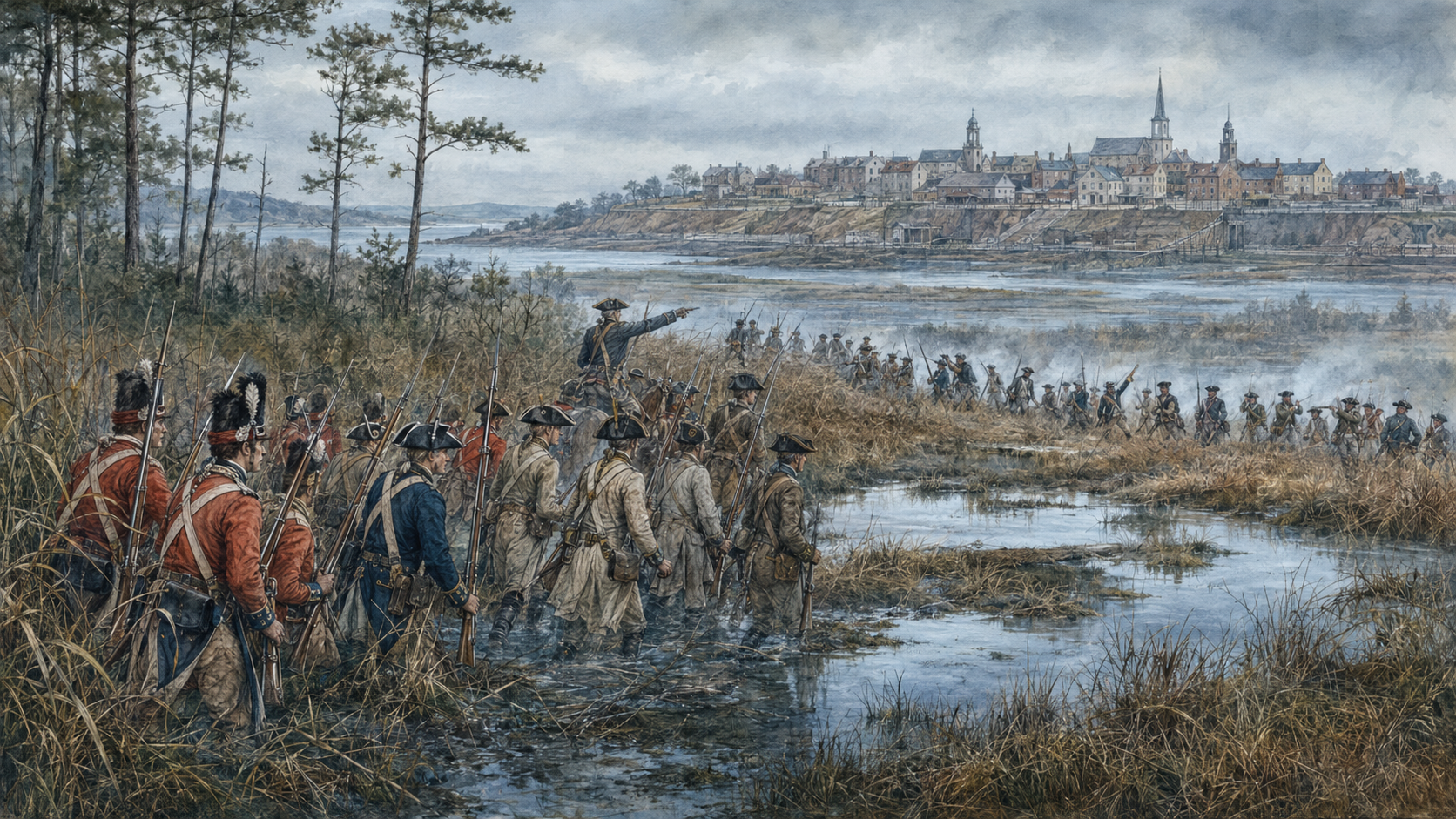
Local knowledge revealed a passage through the wet ground toward the American flank and rear. Accounts differ in their details and in how later writers identified the guide or guides who informed the British. The essential military fact is clear: Campbell learned that the supposedly impassable ground could be crossed. He sent troops along the concealed route while demonstrating against Howe’s front.
That discovery turned a difficult frontal attack into an enveloping movement.
The attack on December 29
Campbell organized his army so that one element pressured the American line while Lieutenant Colonel Sir James Baird’s light infantry moved through the marsh toward the rear. British and Hessian troops advanced from the southeast and seized the high ground. When Baird’s men appeared on the American flank, Howe’s position rapidly collapsed.
Some American units resisted; others broke under the combined threat from front and rear. Retreat routes through Savannah and toward the western bluffs became congested. Soldiers attempting to escape were driven toward low, difficult ground. Many were captured. Others drowned or disappeared into the swamps. Georgia signer George Walton was wounded and taken prisoner.
The fighting was short because the American position became untenable almost as soon as the flanking column emerged. By the end of the day, Savannah was in British hands.
Modern accounts generally report only a few dozen British casualties and several hundred American dead, wounded, missing, or captured, but exact totals vary. The contrast is more important than the disputed number: Campbell won the city at remarkably low cost, while the American defense in coastal Georgia was shattered.
A capital captured—and a government restored
Savannah’s fall was not merely a battlefield victory. British authorities intended to reverse the Revolution politically. Troops under Brigadier General Augustine Prevost soon arrived from East Florida, and the last American-held coastal post at Sunbury fell in January 1779. Royal governor Sir James Wright eventually returned, making Georgia the only former colony where British officials substantially restored royal government during the war.
Campbell moved inland and occupied Augusta on January 31. There, the Crown hoped to recruit Loyalists and secure the upper Savannah River. For a moment, the Southern Strategy seemed to be working exactly as designed: a port had fallen, royal authority had returned, and British troops had reached the backcountry.
But control remained fragile. Patriot militia stayed active. Loyalist recruiting parties had to cross contested country. The Patriot victory at Kettle Creek on February 14 damaged the recruiting effort and helped persuade Campbell to leave Augusta. Then the British struck back at Brier Creek on March 3, destroying a large Patriot force and tightening their hold on the lower state.
The pattern was already visible: occupation produced resistance; resistance produced retaliation; and military lines shifted without ending the political war.
Loyalty, slavery, and the meaning of British protection
The struggle over Savannah involved more than two uniformed armies. Georgia’s population included Patriots, Loyalists, people trying to remain neutral, Native nations protecting their own interests, free people of color, and thousands of enslaved people whose labor sustained the plantation economy.
British military movement created opportunities for some enslaved people to escape Patriot enslavers, seek British protection, or bargain for freedom. The New Georgia Encyclopedia records that about ninety enslaved men and women from George Galphin’s plantation sought freedom from Campbell during the 1779 movement toward Augusta and were escorted to Savannah. Other people were impressed as laborers, displaced, re-enslaved, or exposed to disease and violence.
The Revolution’s language of liberty existed beside a slave society, and the Southern Campaign made that contradiction impossible to ignore. Any complete history must follow not only armies and commanders but also the people who used the war to pursue freedom—and those whose choices were constrained by both sides.
Why Savannah mattered to the Carolinas
The capture of Savannah made every later Southern Campaign battle more likely. It gave the British a port, supply base, political foothold, and staging ground. From Savannah, Crown forces could probe South Carolina, threaten Charleston, support Loyalists, and move along the river corridor into the backcountry.
The victory also encouraged British leaders to believe that the Southern Strategy had been validated. That confidence survived warning signs at Kettle Creek and the failed 1779 move against Charleston. When a Franco-American army failed to retake Savannah in the Siege of Savannah, the British position looked even stronger. Sir Henry Clinton then mounted the much larger expedition that captured Charleston in 1780.
From there the war surged into the Waxhaws, Camden, Charlotte, Kings Mountain, Cowpens, Cowan’s Ford, Guilford Courthouse, and the interior posts of South Carolina. Savannah was the first door.
The battlefield and the modern city
Most of the 1778 battlefield has been absorbed into the modern Savannah landscape. The city’s streets, development, and later history can make the original terrain difficult to read. A surviving period map in the Library of Congress shows the dispositions of the American defenders and British-Hessian attackers and helps restore the relationship among the river, bluff, roads, town, and marshes.
The later 1779 siege is more visibly commemorated at Battlefield Memorial Park, but visitors should remember that Savannah witnessed two distinct Revolutionary War battles: the British capture in December 1778 and the failed allied attempt to recapture the city the following fall.
The larger lesson
Savannah demonstrates the difference between an operational success and a durable strategy.
Campbell’s attack was skillful. British sea power delivered a strong force to the coast. Reconnaissance exposed an American weakness. The assault achieved its objective at low cost. Royal government returned. By every immediate measure, the capture was a British triumph.
Yet the victory also committed Britain to governing a divided region with insufficient troops. The strategy required Loyalist support to appear, remain organized, and survive Patriot retaliation. It required coastal victories to translate into control of river valleys and backcountry communities. It required the British army to protect people who declared for the Crown across an enormous landscape.
Those demands would prove greater than the victory at Savannah suggested.
The Southern Campaign began with a city falling in hours. It would end only after years of civil war, exhausting marches, partisan raids, costly battles, and the surrender of another British army at Yorktown.
Continue the Southern Campaign
- Series hub: The Revolutionary War in the Carolinas: How the Southern Campaign Shaped Charlotte, Huntersville, and Lake Norman
- Next in chronology: The Battle of Kettle Creek: A Patriot Victory in Loyalist Georgia
- Regional connection: Uncovering Charlotte’s Role in the American Revolution
Research sources
- National Park Service, “Siege of Charleston 1780,” including the background to Britain’s Georgia operations: https://www.nps.gov/articles/siege-of-charleston-1780.htm
- American Battlefield Trust, “The Capture of Savannah”: https://www.battlefields.org/learn/articles/capture-savannah
- New Georgia Encyclopedia, “Revolutionary War in Georgia”: https://www.georgiaencyclopedia.org/articles/history-archaeology/revolutionary-war-in-georgia/
- Library of Congress, “Taking of Savannah in Dec. 1778”: https://www.loc.gov/item/gm71000888/
- American Battlefield Trust, “The Southern Theater of the American Revolution”: https://www.battlefields.org/learn/articles/southern-theater-american-revolution



Leave a Reply