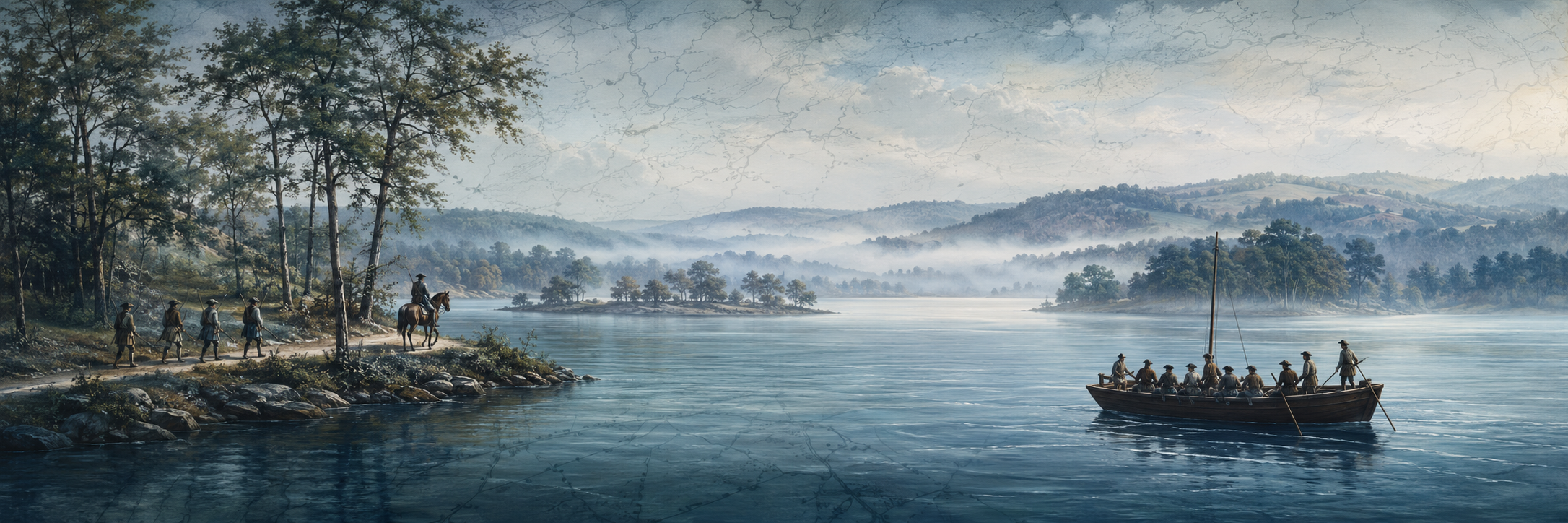
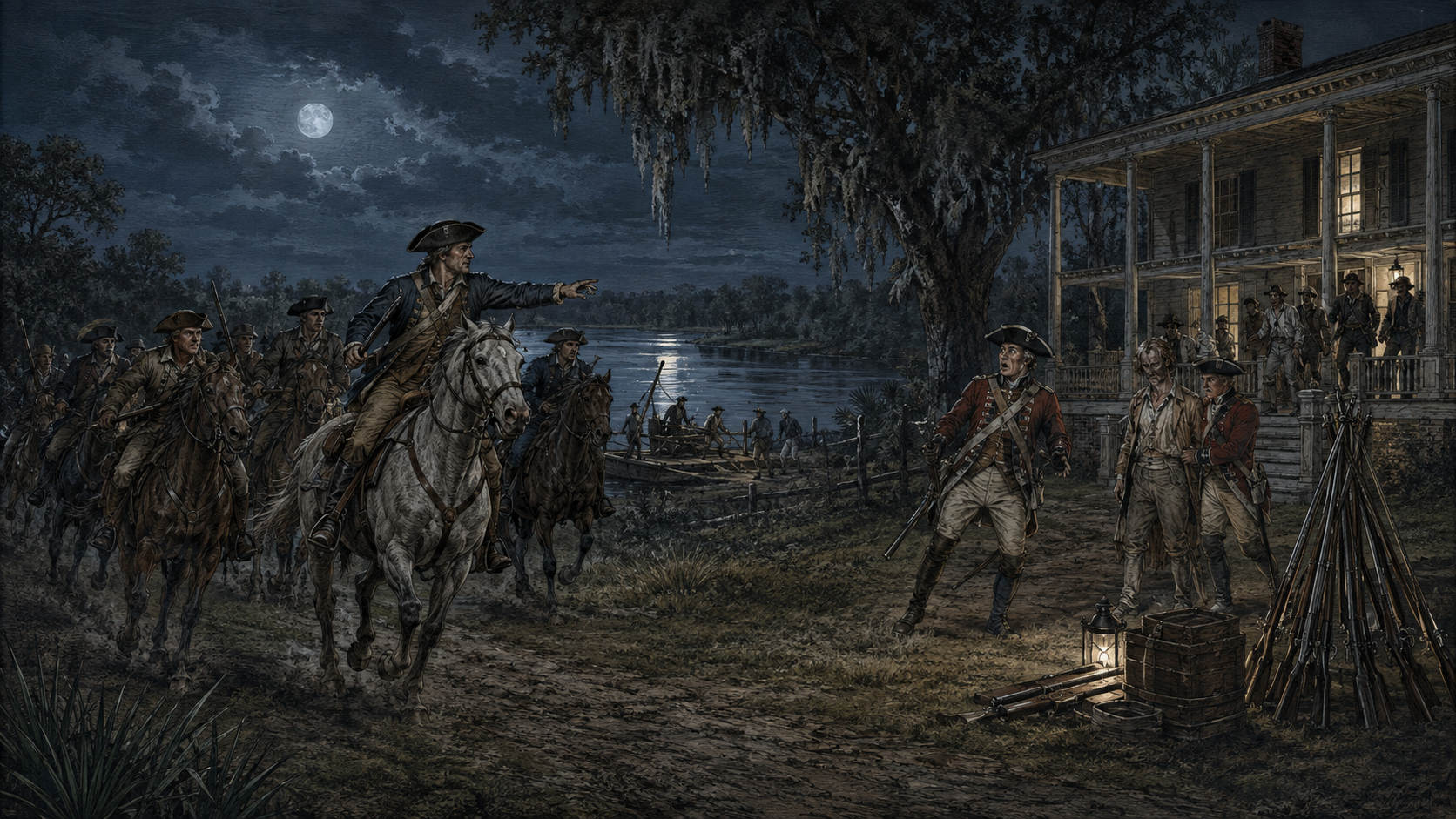
Nine days after Camden, Francis Marion surprised a British escort at Thomas Sumter’s abandoned plantation near Nelson’s Ferry. The rescue succeeded—but most liberated prisoners, exhausted and disillusioned, refused or failed to remain with him.
Working historical date: August 25, 1780
Location: Great Savannah above Nelson’s Ferry on the Santee River
Patriot commander: Francis Marion
Result: British escort surprised; Continental prisoners released
Written and curated by Christopher Adkins for The Lake Norman Brief’s Southern Campaign History Collection. The featured illustration is interpretive artwork, not a documentary photograph or exact battlefield map.
Francis Marion and the prisoners of Camden
The most revealing fact about Great Savannah is not that Francis Marion freed Continental prisoners. It is that most of them did not stay free with him.
After Camden (https://lkn-law.com/2026/06/26/battle-of-camden-1780-gates-cornwallis/), British detachments marched captured Maryland and Delaware soldiers toward Charleston. Near Nelson’s Ferry, one escort stopped at Thomas Sumter’s abandoned plantation, known as Great Savannah. Marion learned where they were, rode through the night, and attacked.
The operation was a tactical success and a window into the exhaustion of the American cause in August 1780.
Marion outside the Camden disaster
Francis Marion had served in the Continental establishment and fought at Savannah in 1779. An injury kept him away when Charleston surrendered. He later joined Gates’s gathering army, but Gates detached him to the Santee corridor to destroy boats, disrupt ferries, and interfere with British movement toward Charleston.
That assignment kept Marion away from Camden. When he learned of the defeat, he reportedly concealed the news temporarily because he feared his small militia would disperse. His concern was realistic. Militia service depended on local confidence, family security, harvests, horses, and belief that resistance remained possible.
Marion also learned that British troops had burned Pond Bluff, his plantation below Nelson’s Ferry. The destruction belonged to the wider coercive war of burned homes, seized supplies, and retaliation carried out by both sides, though not always on equal scale or authority.
A date the sources do not state uniformly
Modern battlefield interpretation often lists Great Savannah as August 20. Other accounts use August 25. Marion’s own report to Gates, written August 29, says that after hearing of prisoners traveling by Nelson’s Ferry, he marched with seventy men and “surprised them the 25th.” That near-contemporary statement is the strongest evidence for the article’s date.
The package should therefore use August 25, 1780, while noting that the American Battlefield Trust and Liberty Trail acknowledge an August 20-or-25 uncertainty and some timelines retain August 20. This is not a reason to conceal conflict; it is an opportunity to show readers how historians weigh evidence.
The attack at Great Savannah
Captain Jonathan Roberts’s detachment included troops of the 63rd Regiment, provincial soldiers, Loyalist militia, and guides—about thirty-eight men in many accounts. They guarded roughly 150 prisoners at or near Sumter’s house, approximately six miles above Nelson’s Ferry.
Marion’s strength may have been around seventy for the actual march, though broader summaries use about 150. After dark his men approached the plantation. A sentry fired an alarm shot, but the Patriots rushed the position before the escort could establish a strong defense. The fight was short. Marion’s force killed or captured roughly twenty-two British regulars and two Loyalists while suffering one killed and one wounded.
The prisoners were released. On paper, Marion had multiplied his force.
Why eighty-five men declined liberation
According to Marion’s report and modern summaries, approximately eighty-five prisoners refused to join him and continued toward captivity. Of those who initially followed Marion, nearly all soon disappeared; only a few remained when he reached his swamp base.
Their choice is often described as astonishing or ungrateful. A better interpretation starts with condition. These men had endured hunger, battle, defeat, wounds, lost officers, and the collapse of their army. Remaining with Marion meant immediate irregular service, uncertain food, no secure camp, and the risk of recapture or death. British captivity was dangerous, but it was a known status with established exchange possibilities. Desertion and refusal reveal exhaustion, not necessarily allegiance.
Marion understood the problem. His August 29 letter warned that the released men lacked command and would desert unless organized. The episode shows why manpower totals cannot be read as simple measures of military strength. Men must be fed, led, armed, persuaded, and given reason to believe their service has purpose.
The birth of a partisan reputation
Great Savannah did not reverse Camden. It demonstrated that British victory could not protect every road, ferry, escort, and overnight stop. A small local force could move through the Santee landscape, collect intelligence, strike, and vanish.
Marion followed with actions at Blue Savannah and Black Mingo (https://lkn-law.com/2026/07/05/battle-of-black-mingo-creek-francis-marion-1780/). These victories drew recruits and built the reputation later condensed into “Swamp Fox.” That nickname should not turn the history into legend alone. Marion’s effectiveness depended on local families, enslaved labor, guides, river knowledge, food networks, horses, and communities that paid a severe price when British columns retaliated.
Nelson’s Ferry as a strategic place
The Santee crossings connected Charleston with Camden and the interior. Ferries were infrastructure: boats, landings, roads, taverns, houses, and people who knew how to operate them. Destroying or controlling ferry craft could delay a column more effectively than holding miles of empty ground.
Great Savannah therefore belongs beside Camden, Monck’s Corner (https://lkn-law.com/revolutionary-war-carolinas-lake-norman-charlotte/), Lenud’s Ferry (https://lkn-law.com/revolutionary-war-carolinas-lake-norman-charlotte/), and later Fort Watson. Each article shows that Southern Campaign strategy followed water crossings and transportation nodes as much as political boundaries.
What visitors can see
The Great Savannah landscape is associated with the Pine Island Unit of the Santee National Wildlife Refuge near Summerton. Public access, trail routes, wildlife closures, hunting seasons, flooding, and accessibility can change. Direct readers to current refuge and Liberty Trail guidance. Never imply that an unmarked house site or archaeological feature is open for entry.
Sources and editorial notes
- American Battlefield Trust — Great Savannah
- American Battlefield Trust — Marion’s August 29 report
- The Liberty Trail — Great Savannah
- Use August 25 based on Marion’s letter; acknowledge August 20 in commemorative summaries.
Many modern summaries use August 20. Marion’s August 29 report states that he surprised the escort “the 25th,” making August 25 the strongest working date while the competing tradition remains visible to readers.



Leave a Reply