
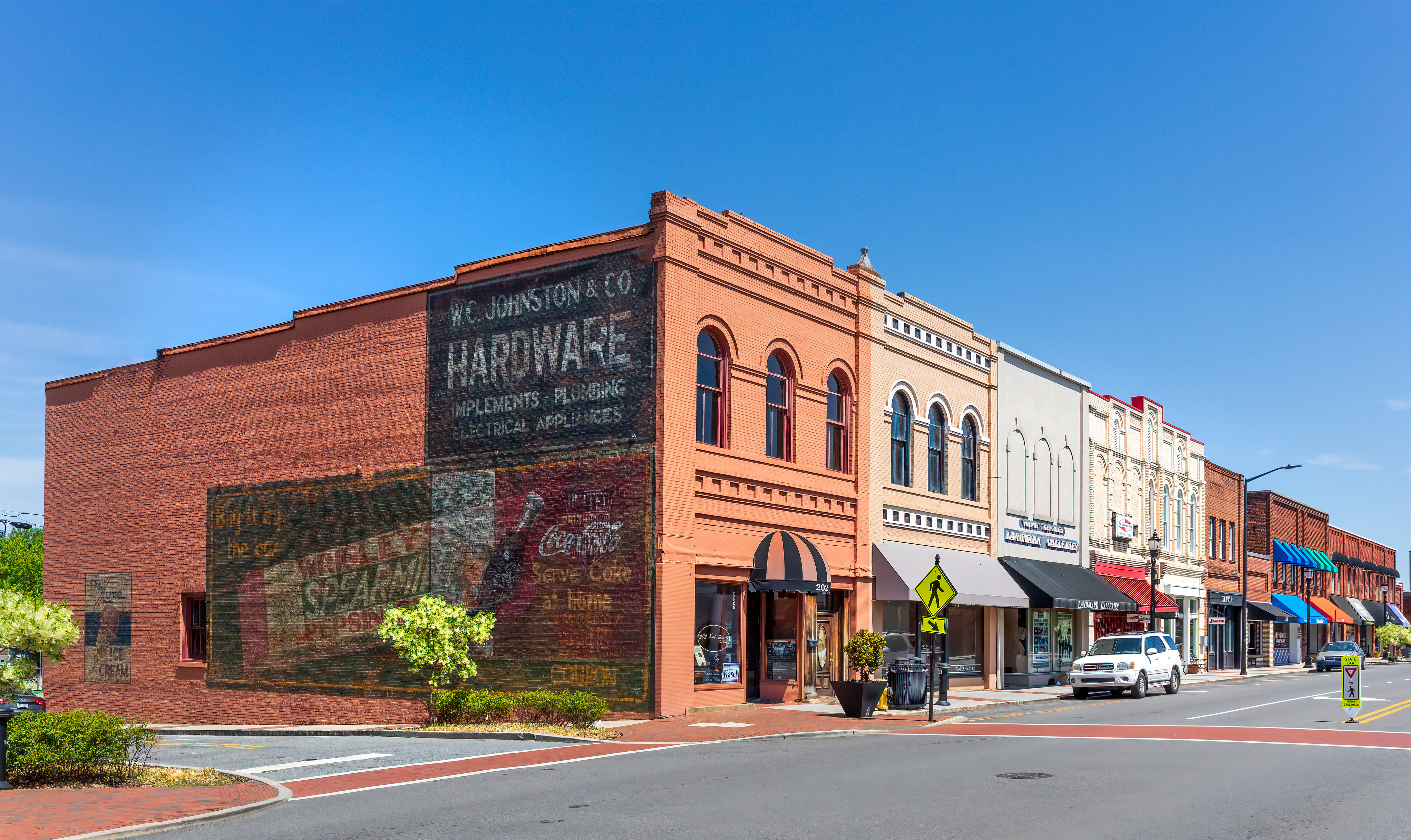

Modern-day downtown Mooresville, NC, blending historic charm with a growing Main Street district.
Mooresville, North Carolina began not as a township, not as a settlement with churches, mills, or a courthouse, but as a simple railroad siding carved into the rolling farmland of John Franklin Moore. In the mid-1800s, this land—quiet, rural, and worked by generations of the Moore family—lay directly in the path of the newly expanding Atlantic, Tennessee & Ohio Railroad. What happened next would transform a stretch of pasture into one of the most influential railroad communities in the Carolina Piedmont.
What started as “Moore’s Siding,” little more than a stop where trains could take on fuel and local farmers could ship goods, quickly became a magnet for opportunity. Merchants built storefronts near the tracks. Families settled close enough to hear the whistle. Property was divided, passed down, and sold—an early reminder of how much the growth of a town can hinge on land ownership, inheritance, and the same kinds of North Carolina estate planning decisions that still shape the Lake Norman region today. Before long, the siding was not just a feature on the railroad line—it was the nucleus of a growing community pulsing with commerce and possibility.
By the 1870s, the settlement had outgrown its nickname. The North Carolina General Assembly incorporated it officially as Mooresville, honoring the man whose foresight and farmland made the town possible. In just a few decades, a modest siding had become a bustling railroad hub—one that would eventually evolve into the thriving community known today as “Race City USA,” a place where the hum of engines replaced the hiss of steam but the spirit of motion and ambition remained the same.
What follows is a unified narrative of Mooresville’s beginnings: how a family farm became a town, how the railroad shaped its earliest identity, and how John Franklin Moore and his people influenced the community that still bears their name.
Before Mooresville: The Land and the Railroad
Long before the sound of a locomotive ever echoed across southern Iredell County, the land that would one day become Mooresville moved at the slow rhythm of farm life. The countryside was a patchwork of hardwood forests, red-clay fields, and winding creeks fed by the Catawba River basin. Deer moved through the tree line in the early mornings, and foxes trotted across the edges of pastures at dusk. Families worked the soil in much the same way their parents and grandparents had, coaxing corn, wheat, and cotton from the earth, keeping livestock, and carving their homesteads out of the rolling hills that bridged the Piedmont and the foothills beyond.
This region had been shaped decades earlier by waves of Scots-Irish settlers who drifted down from Pennsylvania along the Great Wagon Road, bringing with them a fierce independence and the instinct to build close-knit farming communities. Churches such as Centre Presbyterian and Hopewell served not merely as houses of worship but as gathering points for debate, community decisions, and mutual aid. Baptisms, funerals, militia musters, road petitions—almost all public life radiated from these early sanctuaries. By the early 1800s, the area around what would become Mooresville was dotted with family farms—self-reliant, stubbornly rooted, and connected to the land as if by blood.
The Moore family was one of these. Their farm stretched across fertile acreage south of Statesville, situated along a gently sloping rise that provided good drainage and excellent visibility—qualities prized by farmers but, unbeknownst to them at the time, of great interest to railroad engineers as well. The land held no formal settlement, no main road, no courthouse green. Travelers passed through on horseback or wagon, stopping at local homes for water or directions, but no one imagined the world would one day travel to this place.
Its value lay in the soil itself and in the families who understood how to make that soil sustain them.
By the mid-1800s, however, even the most remote stretches of farmland could not escape the ambitions of industry. North Carolina was struggling to modernize, to shake off its notorious reputation as the “Rip Van Winkle State”—sleepy, underdeveloped, and economically stagnant. State leaders worried that without railroads, the Piedmont would remain cut off from trade, overshadowed by the thriving ports and rail junctions of Virginia and South Carolina. Newspapers of the era warned that communities without rail connections risked becoming “islands of commerce,” left behind by the velocity of the age.
The idea of a new rail line linking Charlotte and Statesville began quietly in legislative circles, then gained momentum as businessmen, merchants, farmers, and civic leaders realized its potential. Cotton growers wanted faster routes to market. Merchants wanted quicker access to goods. Even church congregations saw a benefit: better movement of people and supplies could strengthen far-flung communities. The proposed line would connect two critical markets, shorten the movement of goods, and place North Carolina firmly into the web of Southern rail commerce at a time when railroads were the arteries of economic life.
The Atlantic, Tennessee & Ohio Railroad—known locally as the AT&O—was born from this urgency. Railroads of the era often followed terrain that mimicked ancient Indigenous footpaths and game trails, winding along ridges and natural drainage patterns. Engineers surveyed the countryside searching for land that offered a balance of elevation, stability, and accessibility. They avoided bogs, floodplains, and steep ravines. They chose high ground where tracks would remain dry and where locomotives could maintain consistent traction. That is how they came to the Moore farm.


The land John Franklin Moore inherited had exactly the qualities the railroad required: high, gently sloped ground; firm red clay that could hold a rail bed; long, unobstructed lines of sight across pastures; and a location nearly equidistant between two economic hubs. To the engineers, it was perfect. To the Moore family, it was simply home.
Some accounts from local diaries and oral histories describe the mild astonishment that rippled through the rural community when surveyors first appeared—men with brass compasses, wooden stakes, and heavy measuring chains, marking invisible boundaries through fields that had been plowed the same way for generations. Children reportedly followed behind them, half fascinated and half confused, asking whether those men were “drawing a new road in the dirt.” At least one elderly farmer in the area loudly proclaimed that “no iron horse will ever tame this land,” a sentiment that aged about as well as expected.
Stories vary about John Moore’s reaction. Some portray him as contemplative, standing at the edge of a field with his hands braced on his hips as he watched the men pace out a future only they could see. Others describe him as quietly optimistic, believing that resisting the railroad’s advance would be futile—and perhaps even foolish—given the opportunities it promised. What seems most consistent across these accounts is that John Moore understood something fundamental long before many of his neighbors did: the railroad was not simply passing through his land; it was bringing opportunity to it.
The arrival of the AT&O was more than a construction project. It was a turning point in the identity of the region. Farms that had once traded goods by wagon were now within reach of broader markets. Goods could move faster, cheaper, and farther. The very idea of distance began to shrink. With that came increased attention to how land was owned, inherited, and divided among families—a reminder that decisions made by one generation could alter the trajectory of the next, the same way thoughtful North Carolina estate planning continues to shape families throughout the Lake Norman area today.
When the route was finalized, one of the railroad sidings—a short length of track built parallel to the main line—was placed squarely on Moore’s land. A siding allowed trains to pass one another, to load and unload freight, and to store railcars temporarily. It was a simple operational choice for the AT&O, but for the region it marked the beginning of a transformation. Because the siding physically sat on Moore’s farm, people naturally called it “Moore’s Siding,” as though no one yet suspected that a future town was taking its first breath. But towns often begin exactly this way, in small and accidental moments that only later reveal themselves to be the hinge points of history.
A siding became a stop. A stop became a gathering place. A gathering place became a settlement rising out of the Carolina clay. And all of it began on a stretch of farmland that, only a few years earlier, had known nothing louder than a mule’s bray or a plow’s slow scrape through the soil.
Moore’s Siding (1850s–1873)
When the Atlantic, Tennessee & Ohio Railroad finally reached the Moore property, the transformation was both immediate and quiet—so quiet, in fact, that no one standing there in those first days could have imagined they were witnessing the birth of a town. Railroad workers drove stakes into Moore’s fields, cleared a level stretch, and laid down a short section of track parallel to the main line. This was the siding, a practical piece of railroad engineering meant to allow trains to pass, refuel, or take on water. Almost at once, the place acquired a name spoken in conversation as naturally as if it had always existed: Moore’s Siding.
The siding became a small but vital node in the widening rail network. Locomotives stopped to replenish their wood and water. Freight cars were loaded with bales of cotton, barrels of grain, timber, and livestock—products of the surrounding farms that, until then, had been limited to wagon transport. The sight of farmers arriving by horse-drawn carts to meet the train became a familiar rhythm. Even before a depot building stood on the grounds, Moore’s Siding functioned as an informal gathering place where neighbors exchanged news, traded goods, and measured their fortunes against the great iron road now cutting through their lives.
John Franklin Moore saw more than the practical utility of the siding. He saw momentum. He recognized—perhaps instinctively—that the railroad brought not merely movement but possibility, and that possibility needed shape, order, and vision. Many landowners of the period resisted the railroad’s intrusion, fearing loss of property or the disruption of traditional country life. But Moore, known among contemporaries as a man both pragmatic and forward-thinking, embraced the changes rumbling down the tracks.
Rather than allowing the railroad company to define the landscape, Moore began defining it himself. He envisioned a settlement that would grow organically around the siding, a place where commerce, community, and opportunity could converge. As passengers and freight handlers passed through, he encouraged the construction of the first stores—modest wooden buildings that clung close to the rails for easy access. These shops sold tools, provisions, and goods that traveling merchants brought from Charlotte, Salisbury, or even farther afield. Before long, houses appeared too, built by those who wished to live near the new artery of trade.
Moore did not rely solely on chance or speculation. He personally mapped out the first outlines of a village, marking plots on his land to be sold or, in some cases, granted to individuals who could help the community flourish. This was not uncommon in emerging railroad towns, but Moore undertook it with unusual deliberation. Stories suggest he walked the land with crude sketches in hand, favoring parcels near the siding for business development while allowing residential areas to spread outward toward the tree lines and gently curving creeks. In these earliest surveys was the skeleton of modern Mooresville, laid out on a farm that had once been only rows of crops and a family homestead.
That homestead, standing near what is now downtown Mooresville, would not survive into the modern era. The house itself is gone, replaced by the commercial blocks that came later, but its footprint lives on in the grid of streets and storefronts that form the town’s core.
The timing, however, was bittersweet. The rising promise of Moore’s Siding collided with the tumult of the Civil War. Railroads became strategic assets, sometimes targets, and development slowed across the South. The AT&O line itself was dismantled by Confederate troops in the later years of the war so the iron could be used elsewhere—an act that temporarily halted the young settlement’s upward trajectory. For a time, Moore’s Siding stood quiet, its future uncertain.
But when peace returned in 1865, John Moore returned to his project with renewed purpose. Reconstruction was a difficult era, marked by economic instability, political tension, and the complicated rebuilding of local life. Yet in that atmosphere, the reinstallation of the rail line brought with it a second wave of opportunity. Moore once again encouraged growth around the siding, convincing merchants to rebuild and farmers to invest. Families displaced by war moved into the area seeking fresh beginnings. Travelers again passed through, leaving behind stories and coins in equal measure.
By the early 1870s, what had emerged around Moore’s Siding was no longer a scattering of structures but a bona fide settlement—a place with rhythm, commerce, and identity. Though humble in architecture, it possessed something rare: direction. Moore’s quiet leadership and the stubborn persistence of local families had turned a patch of farmland into a community that seemed to grow every time a locomotive slowed to a halt.
The siding that once served locomotives now served people, and from that service grew the town that would soon bear John Moore’s name.
From Siding to Town: Incorporation of Mooresville (1873)
By the early 1870s, Moore’s Siding was no longer the modest outpost it had been in the decade before the Civil War. What began as a rail spur with a water tank, woodpile, and a few scattered structures had swelled into a recognizable settlement with its own pulse. The railroad had breathed life into the area, and the people who gathered around it gave that life shape.
The dirt paths worn by horse hooves and wagon wheels became informal streets lined with the necessities of a growing community. A blacksmith set up shop near the tracks to service wagons and shoe the horses that still delivered most goods to the siding. Small stores offered cloth, tools, seed, and the handful of luxuries rural families prized. The first boarding houses appeared for travelers making their way between Charlotte and Statesville, and merchants found steady business in the bustle created every time the locomotive slowed to a stop.
By now, locals had begun referring to the area simply as “the town at Moore’s Siding,” even though it had no charter, no official governance, and no boundaries recognized by the state. What it did have was people—families who wanted stability, civic identity, better roads, and some degree of oversight beyond the practical authority of the railroad itself.
As the population grew, it became clear that the settlement needed more than the loose organizational structure of a rail community. Residents wanted predictable road maintenance, formal recognition for businesses, and the beginnings of civic order: elected officers, the legal ability to levy taxes for improvements, and the authority to address disputes and community concerns. These were the building blocks of a functioning town, and the momentum to secure them came from the citizens who had placed their trust—and property—along the rails.
John Franklin Moore, though not a politician, was the natural figure around whom this push coalesced. He had sold and granted many of the lots, encouraged the clustering of commerce, and served as an informal problem-solver when disputes arose. His name carried weight, not through grand oratory, but because the town quite literally grew from his land and his willingness to embrace the future. In an era defined by property rights and legacy, Moore was viewed as a stabilizing presence—a man whose leadership, even when quiet, helped guide the burgeoning settlement toward legitimacy.
The formal process of incorporation required petitioning the state legislature. Community leaders sent word to Raleigh, describing Moore’s Siding as a thriving locality deserving recognition and the legal tools necessary for orderly growth. Their appeal aligned with a broader statewide trend: the Reconstruction-era legislature sought to modernize rural regions and promote economic recovery, and chartering new towns was an effective mechanism to support local organization.
On March 3, 1873, the North Carolina General Assembly approved the incorporation. With the stroke of a pen, what had begun as a practical railroad stop officially became the Town of Mooresville.
The choice of name was both obvious and deeply symbolic. Naming the town after John Franklin Moore was more than a gesture of gratitude—it was an acknowledgment that the place itself would not exist without him. His farmland formed the backdrop for the town’s growth, his decisions guided its early shape, and his vision distinguished it from countless other sidings along Southern railroads that never became anything more.
Yet the celebration was tempered by a quiet sadness. John Moore would not live long enough to witness the full unfolding of the town that bore his name. Within a few years of incorporation, he passed away in 1877, leaving behind a fledgling community still finding its identity. But the impact of his choices endured. The town’s first streets, first shops, first plots—all traced back to his practical generosity and his ability to see a future where many only saw farmland and iron rails.
Incorporation did not immediately transform Mooresville into the thriving hub it would later become, but it gave shape to the energy already present. It solidified a sense of belonging for those who lived near the tracks, offered the legal foundation for civic growth, and marked the moment when a rural siding officially declared itself a town.
And like all towns with deep roots, Mooresville would continue to grow outward from that original spark—the siding where trains stopped, goods were traded, and a community began to dream of what it might become.
John Franklin Moore: The Man Behind the Town
To understand Mooresville, you must first understand the man whose name it carries. John Franklin Moore was born in 1822 in Iredell County, part of a generation that inherited land not only as property but as identity. He did not arrive with the pomp of a politician or the swagger of an industrialist. He was a farmer and planter—a man bound to the rhythms of planting and harvest, as rooted in the Carolina soil as the oaks that lined his fields. But history is full of quiet figures who stand at precisely the right place when change comes rumbling toward them, and Moore was one of them.

Family records and local accounts paint a portrait of a man who was steady, observant, and reluctant to waste words. He was the kind of man who worked with his hands in the field by morning, then attended to business matters after supper—reviewing notes, walking boundaries, and tending to the slow, often invisible work of sustaining a farm and protecting his family’s interests.
Moore grew up in a region where community meant cooperation—barn raisings, shared harvests, families gathering for church or funerals. He learned early the value of negotiating disputes, settling disagreements over fences or water with fairness rather than force. These skills, so small in their moment, would later shape the character of a town forming itself around the siding.
Marriage rooted Moore even more firmly to the community. He and his wife, Eliza “Rachel” Summrow Moore—her family name sometimes recorded as Sumrow or Summers—built a household shaped by the values of their time: faith, hard work, and a deep responsibility to the land and the people who depended on it. Rachel, often overlooked in earlier accounts, played a far more influential role than the historical record typically acknowledges. Contemporary references describe her as capable, intelligent, and actively involved in decisions affecting the family property. She managed the home, but her influence extended well beyond it—standing beside John as a true partner in the creation of what would become Mooresville.
The couple raised several children—James Franklin, Mary E., Margaret, and Charles among them—who, like many families of the era, were involved in farming and small mercantile trade. They grew up in a house that sat on the very ground that would later form Mooresville’s commercial core, living daily life in the middle of what would eventually become downtown.
When the Atlantic, Tennessee & Ohio Railroad surveyed its path through southern Iredell County, Moore did not simply accept the intrusion; he studied it. Local lore suggests he spent evenings watching the survey markers appear across his fields, quietly calculating what this strange new power might mean for the future.
What separated Moore from many of his neighbors was vision. He understood that rails meant connection—connection to cities, to markets, to opportunity. He saw, in the iron lines crossing his land, a chance to build something larger than a successful farm. While others grumbled that their peace would be broken, Moore saw a community taking shape.
When he permitted the railroad to build the siding and depot, he was not acting out of resignation but intention. This decision would become the pivot on which the entire town turned. The siding bore his name because the land bore his name, and when people arrived seeking a place to trade, live, or begin anew, Moore met them not as a gatekeeper but as a guide.
He sold parcels when it encouraged industry, granted them when it encouraged growth, and coaxed the beginnings of civic life into a settlement that had no charter yet but already possessed its own identity. He oversaw the earliest shaping of streets and parcels, choosing carefully which plots to encourage for commerce and which should remain residential. This was not the grand, sweeping city planning of later centuries, but it was intentional, foundational, and remarkably effective.
Moore was never the mayor of Mooresville. He was something older and more archetypal: the founder in the literal sense, the man who made the first choices upon which all later choices rested.
His death in 1877 came too soon for him to witness the full flourishing of the town he began, but his impact remained visible long after. Rachel Moore survived him by nearly two decades and continued his work, advocating for the town’s early improvements, encouraging the formation of churches, and supporting the development of schools and civic infrastructure. Some local historians rightly credit her as a co-founder of Mooresville for the way she carried the project of the town forward after his death.
Today, John Franklin Moore rests in Willow Valley Cemetery in Mooresville—on land that was once part of his own farmland. The cemetery is historic ground: quiet, shaded, and deeply connected to the earliest layers of the community. His resting place is not in the downtown commercial core that later emerged, nor at Centre Presbyterian Church as sometimes repeated in older accounts, but rather within this established burial ground that holds many of the region’s early families.
His original gravestone is modest—appropriate for a man whose lasting influence came not from wealth or high office but from clarity of vision, generosity of action, and the simple courage to welcome the future when it arrived across his fields on steel rails.
Mooresville began with the land. It became a community because of the railroad. But it carries the name of John Franklin Moore because he could see what the future might become—and he welcomed it.


Early Post-Incorporation Life (1873–1900)
When Mooresville earned its charter in 1873, the town was little more than a handful of streets, a scattering of stores, and the steady, reassuring presence of the railroad. Yet incorporation did something profound: it gave the settlement identity, legitimacy, and the authority to chart its own path. What emerged over the next quarter century was a town learning to define itself—slowly at first, then with growing confidence as new industries, families, and civic institutions took root.
In the earliest years after incorporation, the heart of Mooresville continued to beat at the depot. Every train arrival was an event that could reshape the day—bringing letters, goods, travelers, and distant news in an era when information moved no faster than steam and steel could carry it. The whistle signaled more than transportation; it announced connection. For local children, it was a spectacle; for merchants, a business opportunity; for farmers, a means to move their harvests beyond the limits of wagons and rutted roads.
The town’s first formal streets began to take shape around this nucleus, some following old wagon paths, others carved deliberately along the grid Moore had envisioned. Wooden storefronts lined Main Street, offering essentials such as dry goods, hardware, medicines, and cloth. A post office was established, along with the first barber, shoemaker, and small repair shops—services whose absence a community could tolerate but whose presence marked its evolution from rural cluster to functioning town.
Churches expanded their roles as Mooresville grew, transforming from simple meetinghouses into hubs of moral, social, and educational life. Sunday gatherings were often the only time the entire community met under one roof, and sermons might include updates on local disputes, calls for civic improvement, or exhortations to uphold the values of a growing town. The earliest schools were taught in borrowed spaces, sometimes in church annexes or homes, but the desire for formal education was strong. By the 1880s, Mooresville began establishing dedicated school buildings, laying the foundations for the more robust public system that would come later.
Small industries began to appear as well. Blacksmiths expanded into machine repair as rail traffic increased. Gristmills along local creeks continued the old work of producing flour and cornmeal, but now with improved equipment and expanded distribution. Livery stables, essential for travel in an age of horses and wagons, were among the town’s busiest early businesses. These enterprises did not yet constitute an industrial boom, but they signaled a shift toward a more diverse local economy.

Civic life matured too. A town board was established to address matters such as road improvement, fire prevention, sanitation, and taxation for local improvements. Ordinances were passed to regulate businesses, maintain public order, and protect property. These early laws were simple but essential, the scaffolding upon which future growth would rely. With incorporation came the ability to organize public projects, encourage new businesses, and provide services that elevated the town beyond the informal, railroad-dependent community it had once been.
The community’s character during this period was defined by a mixture of old traditions and new ambitions. Mooresville remained, at heart, an agricultural town—its economy tied to cotton, corn, and livestock—but its people were increasingly aware that the world beyond their fields was changing quickly. The railroad not only brought news but demonstrated it: new technologies, new goods, and new possibilities continued to roll steadily into town.
By the turn of the century, the seeds planted in the earliest years—education, commerce, small manufacturing, and civic pride—began to mature. The town’s population grew, its streets filled with homes and shops, and a distinct identity emerged: Mooresville was a place where ambition met opportunity. Cotton mills were rising, churches and schools were multiplying, commercial blocks were taking shape along Main Street, and the railroad was bringing merchants, workers, and travelers from every direction. By the early 1900s, Mooresville would be counted among the fastest-growing towns between Charlotte and Statesville.
It would not stay a quiet railroad town for long. A new era of industry was on the horizon, one that would transform the town’s fortunes and reshape the lives of everyone who called it home.
The Rise of Industry and the Textile Boom
If railroads gave Mooresville its beginning, the textile industry gave it its future. In the late 19th century and the early years of the 20th, the American South—long dependent on agriculture—began a dramatic shift toward manufacturing, especially textiles. Cotton, once shipped away as raw fiber, could now be milled in the same communities where it was grown. Towns that embraced this transformation flourished; those that resisted risked being left behind. Mooresville chose the path of progress.
The arrival of textile mills marked a profound change in the town’s economy and identity. What had been a quiet agricultural community became part of a regional industrial awakening. Entrepreneurs recognized that Mooresville possessed the ideal conditions for textile production: abundant local cotton, proximity to the railroad, and a workforce shaped by generations of rural labor but ready for steadier industrial wages. Investors saw opportunity; Mooresville opened its doors.
The first large mills rose as imposing brick structures along the town’s edges, their smokestacks signaling a new era. The rhythmic hum of looms and spinning frames became a kind of industrial heartbeat, audible from blocks away. Mill towns across the South shared similar rhythms, but each had its own character. In Mooresville, the mills quickly became central to daily life. Entire neighborhoods—mill villages—sprang up around them, complete with worker housing, company stores, and community gathering spaces.
Work in the mills was demanding and often exhausting. Men, women, and even older children labored long hours among machinery that required constant attention. But the mills also brought opportunities that agricultural life could not always offer: more reliable income, a sense of community centered on shared labor, and a path toward economic mobility. Families who had once lived at the mercy of harvest cycles found new stability.


As industry expanded, so did the town. New businesses opened to meet the needs of mill workers: groceries, cafés, clothing shops, and services of all kinds. Churches built larger sanctuaries. Schools increased their staff and constructed new buildings. Public services—from lighting to road maintenance—improved at a pace unimaginable a generation earlier.
Textile owners and local leaders also invested in civic infrastructure. Some mill companies sponsored recreational spaces, community events, and even libraries for workers—a strategy as benevolent as it was practical, designed to cultivate loyalty and stability in the workforce. Civic groups formed, newspapers grew in readership, and the town’s cultural life flourished with a sense of shared purpose.
By the early 1900s, Mooresville had transformed from a modest railroad settlement into a regional industrial power. The mills did not just shape its economy—they shaped its culture, its neighborhoods, and its future. They brought people from across the region to live and work within the town’s expanding borders, adding diversity and depth to a community once defined almost entirely by farming.
The textile boom carried Mooresville well into the 20th century, forming the economic backbone that supported schools, businesses, churches, and civic projects. Though industries would later evolve and diversify, the legacy of the mills remains inseparable from the town’s identity.
Railroads made Mooresville possible. Textiles made it thrive. Together, they forged the modern town rising from the red clay and rails.
Culture, Architecture, and Civic Life in the Early 1900s
The early 20th century was a time when Mooresville refined not just its economy but its cultural and architectural footprint. As prosperity grew, so did the town’s desire to shape an environment that reflected its pride, aspirations, and distinct character.
Architecturally, the first decades of the century brought a flourish of stylistic diversity. Brick commercial blocks constructed along Main Street featured broad display windows, ornate cornices, and decorative brickwork—signatures of the Victorian and early-Edwardian eras. These buildings, many still standing today, conveyed a sense of permanence and ambition. Residential neighborhoods expanded with homes built in the Queen Anne, Colonial Revival, and Craftsman styles. Wraparound porches became social stages where families gathered in the evenings, exchanging greetings with passersby while children played in oak-shaded yards.
Civic institutions blossomed alongside this architectural growth. Public parks were laid out with walking paths and shaded benches. Libraries expanded their collections. Fraternal organizations—Masonic lodges, Odd Fellows, women’s civic clubs, and veterans’ groups—hosted events, sponsored improvements, and formed the civic backbone of community engagement. These groups often helped fund public works, beautification projects, and charitable efforts benefiting widows, orphans, and families in need.
Entertainment also matured. Traveling shows and vaudeville performers made stops in Mooresville, bringing music, theater, and the occasional magician or strongman act. Later, movie houses flickered to life, showing silent films and then “talkies” that captivated audiences unused to such spectacle. These venues became beloved gathering places, offering townspeople a brief escape from daily routines.
The improvements extended to public infrastructure. Water and sewer systems modernized. Electric lights illuminated streets once lit only by lanterns. Improved roads connected neighborhoods and facilitated commerce. Automobiles appeared in growing numbers, prompting debates at town meetings about speed limits, parking, and road maintenance—discussions that now read as charming but at the time touched on genuine questions of safety and modernization.
Culturally, Mooresville was marked by a strong sense of community cohesion. People knew their neighbors, supported local businesses, and attended civic events with pride. The town’s traditions—holiday parades, church revivals, school performances, and commemorations of veterans and founders—created continuity that bridged generations. These early traditions laid the foundation for the tightly woven community spirit that still defines Mooresville today.
Yet even amid prosperity, the town did not forget its origins. Older generations, many of whom had known the area before incorporation, told stories of the first stores, the first mills, and the early days when the train’s arrival punctuated the routines of daily life. Those stories became part of the town’s cultural memory, passed down over dinner tables and through school lessons, grounding modern progress in the legacy of the siding that started it all.
By the time Mooresville entered the height of the industrial age, it possessed not only economic strength but also cultural maturity—a town comfortable in its identity, proud of its past, and eager for what the future would bring.
The Depression and War Years
The Great Depression rolled across the American South like a slow, unrelenting tide, reshaping towns large and small. Mooresville, for all its industry and ambition, was not immune. Cotton prices collapsed. Textile orders tightened. Families who had once relied on steady mill wages suddenly found hours reduced or jobs uncertain. Yet even in hardship, the town’s character—rooted in resilience and community—held firm.
Neighbors looked after one another. Churches organized food drives, clothing exchanges, and charitable collections that sustained families through lean seasons. Small businesses adapted creatively, extending credit or bartering goods when cash grew scarce. Mill villages, already tight-knit communities, became even more interdependent as workers shared resources, cooked meals together, and supported one another through the anxieties of the era.
The railroad continued to function as Mooresville’s artery to the wider world, though with fewer passengers and lighter freight. The depot remained bustling enough to remind residents of better times, and it provided a symbolic reassurance: the rails still connected Mooresville to opportunity, even if opportunity felt distant.
As the 1930s gave way to the 1940s, global conflict reshaped the American economy. When World War II began, Mooresville’s mills ramped up production to supply uniforms, canvas, and other wartime textiles. The hum of machinery became the soundtrack of patriotism. Men enlisted and were sent overseas; women stepped into roles in mills, shops, and civic leadership positions once dominated by men. Rationing altered daily life, but community spirit intensified.
Local newspapers documented the era with proud solemnity. Articles chronicled enlistments, letters from soldiers abroad, and community efforts to support the war—victory gardens, scrap metal drives, and fundraising for the Red Cross and USO. Church bells rang for sons lost in combat, and their names became etched into memorial plaques that still stand today.
By the time peace returned in 1945, Mooresville had endured hardship, contributed significantly to the national war effort, and emerged with strengthened civic unity. The patterns of daily life had changed, but the town’s foundational resilience remained intact.
A new era—driven by optimism, prosperity, and growth—was about to begin.
The Postwar Boom and Suburban Growth
The decades following World War II brought some of the most dramatic transformation Mooresville had ever experienced. Across the country, returning veterans sought stability, modern homes, and better opportunities for their families. Mooresville, with its established industries, expanding infrastructure, and strategic location north of Charlotte and Huntersville, became an attractive destination for this new generation.
Housing developments spread outward from the town center like ripples on water. Streets once bordered by fields or forest now lined up with tidy homes—brick ranches, Cape Cods, and split-levels built for the suburban ideal of the era. New neighborhoods offered paved streets, sidewalks, and lawns where children rode bicycles, played baseball, or gathered for evening games of tag beneath streetlamps.
Textile mills continued to anchor the economy through the 1950s and 1960s, modernizing equipment and expanding operations. Wages improved. Businesses along Main Street thrived, from drugstores with soda fountains to clothing shops, appliance dealers, and family-owned restaurants that created the fabric of downtown life.
Automobiles reshaped the landscape. Highway improvements made travel faster, and as car ownership spread, Mooresville’s residents became more mobile. The construction of I-77 dramatically increased accessibility, placing Mooresville along a major corridor of commerce. This new connectivity intensified suburban growth, attracting newcomers and encouraging commercial development.
Schools expanded in size and scope, reflecting the national emphasis on education during the Cold War era. New facilities were built, and older ones enlarged, preparing a generation for careers in fields their grandparents could not have imagined.
Civic engagement blossomed. Rotary clubs, Lions clubs, veterans’ organizations, parent-teacher associations, and local charities organized events and projects that strengthened community bonds. Friday night football games became social rituals, drawing entire families to cheer under bright stadium lights.
By the 1970s and 1980s, however, the textile industry faced mounting pressures. Foreign competition, increased automation, and shifting global markets eroded local mill dominance. Some mills reduced operations; others closed entirely. The economic foundation upon which Mooresville had stood for nearly a century began to shift—yet the town, true to its history, adapted.
As one era waned, another was already building speed. Motorsports—once a hobby, then a cultural force—was about to become Mooresville’s new identity.
From Textiles to Motorsports: The Making of “Race City USA”
The rise of the textile industry had defined Mooresville’s early prosperity, but no industry lasts forever in its original form. By the mid-20th century, forces beyond local control—global competition, shifting labor markets, and technological change—began to erode the once-unshakable dominance of Southern textiles. Mills closed, consolidated, or restructured, leaving many communities across the Carolinas searching for new economic direction.
But Mooresville, forged by adaptation from its earliest days, was not destined to fade. Instead, it reinvented itself with an audacity perfectly suited to the American South in the age of horsepower: it became the beating heart of modern motorsports.
The seeds of this transformation were planted decades earlier, on bootlegger-era backroads where moonshine runners learned to coax extraordinary speed and control from cars built to outrun the law. North Carolina became fertile ground for stock-car culture, and by the time NASCAR emerged in 1948, the Piedmont—with its open land, mechanical expertise, and fiercely competitive spirit—was primed to become a racing epicenter.
Mooresville, still rich in machine shops and industrial skill honed during the textile years, became an ideal location for race teams. The town’s proximity to Charlotte, availability of industrial buildings, and relatively affordable land made it an attractive base of operations. Former mill structures, once filled with spinning frames and looms, found new life as fabrication shops, engine rooms, and race team headquarters.
By the 1980s and 1990s, Mooresville had become home to dozens of NASCAR teams and motorsports companies. Engine builders, aerodynamic specialists, chassis fabricators, and pit-crew trainers set up operations in town. The talent pool grew so deep that Mooresville attracted racers, mechanics, engineers, and designers from across the country. The humming sound of high-performance engines became as familiar as the mill whistles of generations past.
Community identity shifted alongside the economic landscape. Schools offered motorsports engineering or automotive technology programs. Local museums and attractions celebrated racing history. Restaurants and small businesses proudly displayed memorabilia from local teams. The town’s nickname—“Race City USA”—was not a marketing creation but an acknowledgment of reality. Nowhere else in the nation did motorsports culture so thoroughly saturate everyday life.
This new industry did more than replace the economic void left by textiles; it re-energized the town with a forward-facing, technologically driven identity. Motorsports attracted innovation, investment, tourism, and national attention. Families who once worked in mills now found livelihoods in engineering, fabrication, logistics, and race operations. Mooresville became a symbol of reinvention: a place where history and modernity collided at 200 miles per hour.
From cotton to carburetors, Mooresville’s ability to adapt—and to embrace opportunity—once again defined its destiny.
The Modern Era (2000s–Present)
By the dawn of the 21st century, Mooresville had become a study in reinvention. What began as a rural siding, then became a textile powerhouse, had now evolved into the undisputed home of motorsports engineering and innovation.
Race teams established enormous headquarters in and around town—sleek, modern complexes filled with engine dynos, wind tunnels, fabrication bays, and design studios. Companies like Penske Racing, JR Motorsports, and a host of others created a dense ecosystem where engineers, fabricators, logistics specialists, pit crews, and aerodynamicists collaborated on machines built to win on some of the fastest tracks in the world.
The town’s tourism economy blossomed alongside the industry. Fans from across the country traveled to Mooresville to tour race shops, visit the North Carolina Auto Racing Hall of Fame, or catch glimpses of teams preparing cars for upcoming races. Motorsports schools, specialty manufacturers, and niche suppliers created an interconnected economy unique to the region.

Meanwhile, Lake Norman—long a recreational gem—began driving residential and commercial expansion. Waterfront neighborhoods, marinas, golf courses, and upscale retail centers transformed Mooresville into a thriving hub for both families and professionals seeking proximity to Charlotte without sacrificing community charm. Population growth skyrocketed, attracting businesses, restaurants, breweries, and an increasingly diverse cultural landscape.
Despite modern development, Mooresville preserved its historic core. Main Street underwent revitalization, restoring century-old buildings as boutiques, cafés, and offices. The brick façades of the early 1900s now stood alongside contemporary businesses, blending past and present into a single streetscape.
Public investment expanded with the growth. Schools were modernized, parks improved, and infrastructure upgraded to support increasing demand. The town embraced technology and entrepreneurship, fostering a climate where traditional businesses and innovative start-ups could both thrive.
Through it all, Mooresville maintained the spirit that defined its earliest days: ambition, adaptability, and community.
Conclusion: A Town Shaped by Iron, Cotton, Engines, and People
Mooresville’s history is not a straight line—it is a series of reinventions, each era building upon the last in ways that reflect both necessity and vision.
It began with land. It grew with a railroad siding. It thrived with textiles. It transformed with motorsports. And today, it stands as one of the most dynamic towns in North Carolina.
What makes Mooresville unique is not merely its industries, but its character. At every turning point, the people of Mooresville chose adaptation over decline, opportunity over stagnation. Farmers embraced a railroad. Laborers powered textile mills. Engineers and mechanics built a motorsports empire. Families built neighborhoods, schools, and traditions that carry forward the town’s identity.
Mooresville is a community shaped not just by economic forces, but by individuals—John Franklin Moore foremost among them—whose choices became catalysts for growth. His decision to welcome the railroad onto his land set in motion a chain of events that continues to define the town nearly two centuries later. Rachel Moore, his widow, carried that vision forward, helping to nurture the churches, schools, and civic life that gave the new town its soul.


Today, as Mooresville continues to grow, develop, and diversify, it remains anchored by the same spirit that guided its earliest settlers: a belief in progress, a deep connection to place, and an enduring willingness to build something better for the next generation.
From red clay fields to roaring engines, from a humble siding to a thriving modern town, the story of Mooresville is the story of a community that has never stopped moving forward—a town born when a farmer welcomed a railroad onto his land and, almost without realizing it, founded a place that would carry his name into history.
About Adkins Law, PLLC
Adkins Law, PLLC proudly serves Huntersville and the Lake Norman community. Founded by attorney Christopher Adkins, our firm focuses on family law, estate planning, and mediation. With deep ties to the Lake Norman region, we combine local knowledge with proven legal experience. Whether you’re navigating a custody case, a divorce, or planning your family’s future, Adkins Law is here to help protect what matters most.

Leave a Reply