
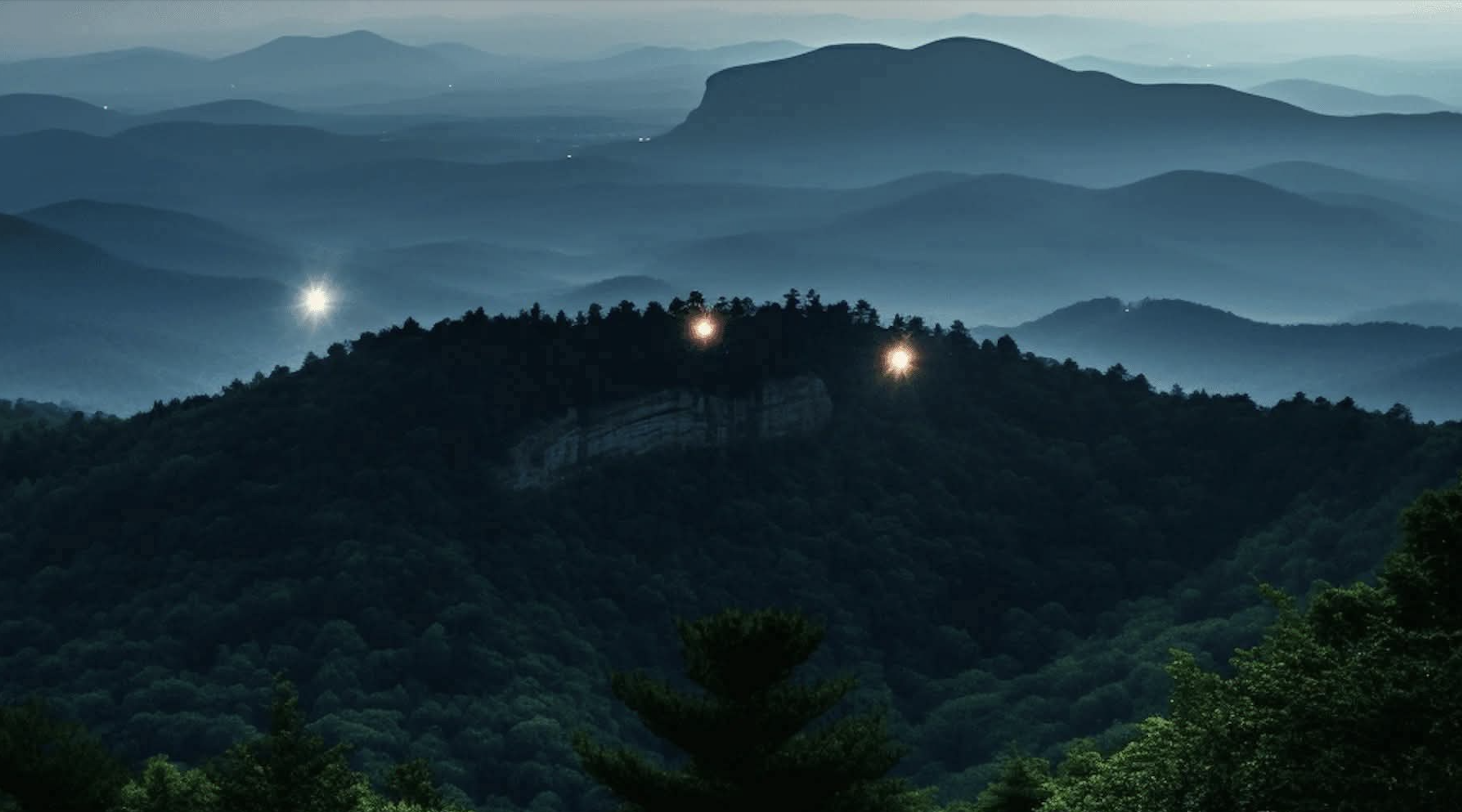

On a clear autumn night, as the stars settle over the Blue Ridge Mountains, the valleys around Brown Mountain glow with a quiet expectancy. From the overlooks along NC Highway 181, or from Wiseman’s View above Linville Gorge, the air is still, the ridgelines fade into indigo, and every few minutes someone whispers, “There—did you see it?”
A faint orb rises above the treeline. It drifts, hovers, and flickers out—only to reappear in another place entirely. Some say it’s an illusion. Others swear it’s alive. Whatever it is, this strange light has been haunting western North Carolina’s skies for more than a century.
A Mystery Born in the Blue Ridge
Brown Mountain lies on the Burke–Caldwell county line, about a dozen miles north of Morganton, in the rugged expanse of the Pisgah National Forest. The ridge itself is modest—just 2,600 feet high—but it sits above a basin of misty valleys and shadowed forests that seem to invite mystery.
It’s the kind of landscape where the imagination roams as easily as the wind. The mountain’s granite bones and quartz veins catch and scatter light, the air bends it, and something truly uncanny takes shape.
The legend of the Brown Mountain Lights reaches far beyond Burke County. It belongs to the entire high-country corridor that runs through Boone, Blowing Rock, and West Jefferson, towns where folklore, mountain music, and storytelling are as much a part of the landscape as the peaks themselves. Travelers who hike Grandfather Mountain or explore the Blue Ridge Parkway often detour south at night toward Linville Gorge, hoping to catch a glimpse of the lights for themselves.
The First Glimmers
Some accounts claim that people have seen the lights since 1833, though the first recorded newspaper mention came in 1913. A fisherman along the Linville River told the Charlotte Daily Observer he saw “mysterious red lights dancing above the horizon.” Others soon confirmed his story, and the legend was born.
Local folklore quickly tied the glowing orbs to older Cherokee and Catawba stories—battlefields, grieving maidens, and spirits wandering the hills with torches in hand. Later versions added the tale of a faithful slave searching eternally for his lost master, his lantern flickering across eternity.
As railroads expanded and towns electrified, explanations multiplied. Were these ghosts, campfires, or the first lights of industry reflecting through mountain fog?
Science Takes the Stage
In 1913, the U.S. Geological Survey sent investigator D.B. Sterrett to Brown Mountain. His conclusion—train headlights—was too mundane for most believers. When a catastrophic flood in 1916 washed out the tracks and the lights kept appearing, the mystery only deepened.
A second, far more rigorous study came in 1922, led by geologist George R. Mansfield. For two weeks, Mansfield and his team mapped every visible flash from stations at Loven’s Hotel, Gingercake Mountain, and Blowing Rock. His data told a consistent story:
“About forty-seven percent of the lights were automobile headlights, thirty-three percent locomotive headlights, ten percent stationary lights, and ten percent brush fires.”
The key, Mansfield realized, lay in the air itself. The Catawba Valley forms a natural bowl where layers of warm and cool air bend light like glass. When humidity and temperature are just right, distant headlights and fires appear to float above the mountains.
He wrote, “The Brown Mountain lights are clearly not of unusual nature or origin.”
And yet—people kept seeing them.
Skeptics, Scientists, and Seekers
In the decades that followed, the lights became a laboratory for curiosity. Oak Ridge National Laboratory experiments in 1977 recreated the phenomenon with a controlled beam, proving that atmospheric refraction could make a fixed light appear to hover in midair.
Appalachian State University in Boone installed low-light cameras above Linville Gorge and recorded more than 6,000 hours without finding anything unexplainable. Still, researchers like physicist Dr. Dan Caton and astronomer Lee Hawkins keep watching, drawn by the possibility that even one sighting might defy the pattern.
On the other side of the spectrum, Asheville-based paranormal investigator Joshua Warren believes the lights carry an electromagnetic signature, perhaps natural plasma or something not yet understood. “It doesn’t matter as much what’s happening,” he says, “as long as something is happening.”
Stories in the Sky
Every witness sees something different. Some recall pale spheres glowing through mist, others describe crimson orbs that pulse like living fire. One Morganton resident claimed he touched a light near the NC-181 Overlook in 1982—it felt, he said, “like sticking your finger in a socket.”
Bluegrass musician Scotty Wiseman turned the legend into song in 1961:
“High on the mountain and down in the valley below, the Brown Mountain Lights are still calling to me.”
Since then, the lights have inspired an X-Files episode, a 2014 feature film (Alien Abduction), and even a recurring festival in downtown Morganton. Founded by local artist Stacey Peek, the Brown Mountain Lights Festival blends live music, food, and tongue-in-cheek alien themes each October—proof that mystery and community go hand-in-hand.
Echoes Across Appalachia
Brown Mountain isn’t alone in its ghost-light fame. From the Maco Light near Wilmington to the Gurdon Light in Arkansas and the Raven Rock “Eternal Sentry” in eastern Kentucky, tales of wandering lanterns and will-o’-the-wisps dot the Appalachian map. Scientists call them reflections, refractions, or bioluminescent decay. Folklorists call them stories of loss, loyalty, and light that refuses to fade.
How and When to See Them
For the curious traveler, autumn remains the best season. Clear nights in October and November, especially after rain, offer ideal conditions. Prime viewing sites include:
- Brown Mountain Overlook on NC-181 (12 miles north of Morganton)
- Wiseman’s View above Linville Gorge
- Lost Cove Overlook (Milepost 310) and Green Mountain Overlook (Milepost 301) along the Blue Ridge Parkway
- Table Rock Mountain, where some hikers claim to see the lights both above and below the ridge
Arrive before dark, bring binoculars, avoid headlights and flash photography, and be patient. The lights rarely appear on demand—but that’s part of the charm.
An Enduring Wonder
Whether they’re ghosts, gases, or illusions, the Brown Mountain Lights continue to shimmer at the edge of understanding. They’re a reminder that mystery still lives in the mountains—that there are places where science and story meet, and both feel right at home.
As night deepens over Boone, West Jefferson, and the high ridges of the Blue Ridge Parkway, the horizon beyond Morganton flickers faintly. Some see headlights, others see history. Either way, the light endures—and so does the wonder.
About Adkins Law, PLLC | Huntersville, North Carolina
Adkins Law, PLLC is based in Huntersville, just north of Charlotte and the shores of Lake Norman, where community, family, and North Carolina heritage intersect. Led by attorney Christopher Adkins, the firm focuses on family law, custody, divorce, and mediation, serving clients throughout Mecklenburg and the Lake Norman region.
Like the stories that illuminate our state’s past, Adkins Law believes in guiding people through uncertain times with clarity and compassion—helping families find light even in life’s darkest moments.
📍 Adkins Law, PLLC — The family law firm in Huntersville, NC
🔗 Visit: www.huntersvillelawyer.com | Call: (704) 274-5677



Leave a Reply