

Overview
The Battle of Elizabethtown took place on August 27, 1781, in the small settlement of Elizabethtown, North Carolina — now the county seat of Bladen County. It was a pivotal clash between Patriot (Whig) militia and Loyalist (Tory) militia during the final stages of the American Revolution. Despite being vastly outnumbered, the Patriot forces achieved a decisive victory that shattered Loyalist influence in the lower Cape Fear region and restored Whig control over southeastern North Carolina.
In the months leading up to the battle, Loyalist militias had consolidated power in and around Elizabethtown, intimidating local residents and threatening nearby Patriot settlements. Determined to break this stronghold, a small band of roughly seventy Patriot militiamen — led by Captains Thomas Robeson and Thomas Brown — planned a daring night assault on a Loyalist force several times their size.
Guided by the intelligence of Sallie Salter, a courageous local woman who infiltrated the Loyalist camp disguised as an egg seller, the Patriots crossed the Cape Fear River under the cover of darkness. With no boats available, they improvised a risky crossing and crept toward the town, where the Loyalists were camped in a fortified position.
At dawn on August 27, the Patriots struck. Dividing into small units, they fired from multiple directions and shouted false commands to give the illusion of a much larger army. The Loyalists, caught by surprise and believing themselves surrounded, broke ranks in confusion. Many fled toward a nearby ravine along the riverbank — a steep gully that would forever be known as “Tory Hole.”
When the smoke cleared, the Loyalist commander John Slingsby was dead, his men scattered, and Elizabethtown firmly back in Patriot hands. The victory came at little cost to the attackers, who suffered only minor injuries.
The Battle of Elizabethtown proved to be far more than a local skirmish. It marked the collapse of organized Loyalist resistance in Bladen County and demonstrated how resolve, intelligence, and local support could overcome superior numbers. The engagement strengthened Patriot control across southeastern North Carolina and ensured that the Cape Fear region would no longer serve as a safe haven for Loyalist operations.
Today, the site of the battle is commemorated by the Tory Hole Memorial Park, which overlooks the ravine where fleeing Loyalists sought refuge. The quiet landscape stands as a reminder of how a handful of determined militiamen — supported by the bravery of local citizens — turned the tide of war in their community.
Forces and Commanders
The Battle of Elizabethtown brought together two vastly unequal forces — one confident and entrenched, the other smaller but determined.
Loyalist Forces
On the Loyalist side stood an estimated 300 to 400 Tory militiamen, commanded by Colonel John Slingsby and Colonel David Godden. Many of these men were local settlers from Bladen and neighboring counties who remained loyal to the Crown. Emboldened by earlier British successes in the region, they had established a fortified position in and around Elizabethtown, using the town as both a headquarters and staging area for operations against Patriot sympathizers.
The Loyalists were better supplied and confident in their numbers, believing their position to be secure. Their leadership, however, underestimated the resolve and local knowledge of the Patriot militia — a costly mistake that would soon unravel their control of the lower Cape Fear.
Patriot Forces
Opposing them was a small contingent of roughly 60 to 70 Whig militiamen, led by Captains Thomas Robeson and Thomas Brown. Most were farmers, tradesmen, and frontiersmen — citizen-soldiers drawn from the local countryside who had already seen their homes raided and families threatened by Loyalist patrols.
The Patriots lacked artillery, formal uniforms, and significant provisions, but what they possessed in abundance was determination and intelligence. Their knowledge of the terrain, combined with the crucial reconnaissance provided by Sallie Salter, gave them the tactical edge they needed.
Robeson and Brown’s men relied on stealth and deception to level the odds. Crossing the Cape Fear River under cover of night, they approached the Loyalist encampment from multiple directions, intending to strike before sunrise. Once in position, they coordinated their assault through shouted commands and musket fire, giving the illusion of a much larger army surrounding the town.
Outcome of Leadership
The difference in leadership proved decisive. Colonel Slingsby, mortally wounded early in the engagement, left his men in disarray. Without clear direction, the Loyalist ranks broke and fled toward the riverbank ravine now known as Tory Hole.
By contrast, Captains Robeson and Brown demonstrated initiative and adaptability — hallmarks of the successful Patriot militia commanders who turned smaller engagements into regional victories across the Carolinas.
The triumph at Elizabethtown not only shattered Loyalist morale in Bladen County but also validated the guerrilla-style tactics that characterized much of the war in the Southern theater. In the wake of the battle, Patriot authority was re-established in southeastern North Carolina, paving the way for continued resistance as the Revolution neared its end.
Prelude to Battle
By the summer of 1781, the struggle for control of southeastern North Carolina had reached a fevered pitch. The Loyalists, emboldened by British advances in the South, had entrenched themselves in Elizabethtown, transforming the quiet river settlement into a fortified outpost. From this position, they launched raids, seized supplies, and terrorized local Patriot families, hoping to stamp out Whig resistance once and for all.
The Patriots, though smaller in number, were unwilling to yield their homeland. Under the leadership of Captains Thomas Robeson and Thomas Brown, they gathered a volunteer force of about seventy men — farmers, woodsmen, and former militia soldiers — determined to reclaim the town and break the Loyalist hold on Bladen County.
Intelligence proved to be their most valuable weapon. A courageous local woman named Sallie Salter offered to infiltrate the Loyalist camp, posing as an egg vendor. Moving among the enemy lines with quiet resolve, she observed their numbers, fortifications, and watch routines before slipping back to deliver her report to the Patriot commanders. Her bravery and precise intelligence gave Robeson and Brown the advantage they needed to attempt a daring strike.
With no formal supply line and only the weapons they carried, the Patriot force set out through thick forest and swampy ground toward the Cape Fear River. Knowing that Loyalist scouts had removed all available boats to prevent pursuit, they improvised a risky nighttime crossing. The men waded and swam across the current, keeping their powder dry as best they could, emerging soaked but determined on the opposite bank.
Their plan was bold: a surprise dawn attack. Moving silently under cover of darkness, they divided into small squads and advanced through the outskirts of town. Each man knew the stakes — defeat would mean capture or death — yet morale was high. The men trusted their leaders and the intelligence gathered by Salter.
As they approached the sleeping Loyalist encampment, the Patriots positioned themselves along the edges of Elizabethtown, ready to strike from multiple directions at once. Their strategy relied on speed, confusion, and deception — the same tactics that had proven effective in other Carolina engagements where small Patriot forces overcame superior Loyalist numbers through cunning and surprise.
By the early morning hours of August 27, 1781, the stage was set. The Patriots, drenched from the river and shrouded in mist, stood poised to ignite one of the most dramatic reversals in the Cape Fear region — a night of fear, gunfire, and sudden victory that would echo far beyond the quiet banks of Elizabethtown.

The Battle
In the still hours before dawn on August 27, 1781, the Patriot militia crept toward Elizabethtown, their wet clothing clinging from the cold Cape Fear River crossing. The men moved silently through thickets and along narrow paths, their footsteps muffled by the sandy soil. Each carried a musket and a single powder horn — every shot would count.
Once within striking distance, the Patriots divided into small squads under Captains Thomas Robeson and Thomas Brown. The plan was to strike from multiple directions at once, creating the illusion of a much larger attacking force. As they took position around the sleeping town, Robeson gave the signal.
A burst of musket fire shattered the quiet. The Loyalist sentries, startled and confused, discharged their weapons into the air — an act that instantly betrayed their position and triggered the full Patriot assault. Shouts echoed through the darkness as the Whig militiamen advanced, yelling false commands like “Advance the right wing!” and “Form the line!” to make their numbers seem overwhelming. The echoes bouncing off the river bluffs magnified the effect, convincing the Loyalists they were surrounded by hundreds.
In the chaos that followed, Colonel John Slingsby, the Loyalist commander, was struck down. Leaderless and panicked, the Tory ranks broke. Many fled toward a steep ravine along the Cape Fear River, plunging down the slope in desperation. The gully would later be known as “Tory Hole” — a lasting reminder of the rout that unfolded there. Some Loyalists drowned attempting to cross the river, while others scattered into the surrounding woods.
The engagement lasted less than an hour, but the results were decisive. Seventeen Loyalists were killed, including Slingsby, while dozens more were wounded or captured. The Patriot force suffered no fatalities and only a handful of injuries — a remarkable outcome given the disparity in numbers.
By sunrise, Elizabethtown was firmly in Patriot hands. The victory sent shockwaves throughout southeastern North Carolina, mirroring the psychological impact of other regional triumphs such as Ramsour’s Mill, Shallow Ford, and Cowpens. These engagements, though fought by small local forces, collectively undermined British influence and Loyalist organization across the backcountry.
The Battle of Elizabethtown demonstrated how determination, deception, and knowledge of local terrain could overcome superior numbers. It also highlighted the increasingly desperate state of Loyalist morale in the closing months of the war. For the people of Bladen County, the night of August 27 would be remembered not just as a military victory, but as the moment their community reclaimed its freedom.

Aftermath and Significance
The Patriot victory at Elizabethtown on August 27, 1781, marked a decisive turning point in southeastern North Carolina. What began as a daring midnight raid by a handful of local militiamen ended as a complete rout of the Loyalist presence in Bladen County. In the weeks that followed, British influence across the lower Cape Fear region rapidly collapsed, and Patriot authority was re-established in towns and settlements that had lived under fear and uncertainty for years.
The elimination of the Loyalist garrison at Elizabethtown effectively ended organized Tory control in Bladen County. Without their local stronghold, Loyalist sympathizers either fled toward Wilmington — the last significant British foothold in the region — or laid down their arms entirely. This shift deprived the Crown of valuable local support, cutting off supply routes, communication, and intelligence from the backcountry.
For the Patriots, the victory had both practical and symbolic importance. It boosted morale across eastern North Carolina, proving once again that courage and clever tactics could triumph over superior numbers. The engagement echoed the spirit of other regional triumphs such as Ramsour’s Mill, Shallow Ford, and Cowan’s Ford — smaller in scale than the great set-piece battles but crucial in their cumulative effect on local control and civilian allegiance.
In the broader context of the Southern Campaign, Elizabethtown demonstrated how local militias, guided by homegrown leadership and intimate knowledge of the terrain, could dismantle Loyalist organization piece by piece. While the Continental Army fought formal engagements farther west and south, it was these localized victories that steadily eroded British reach and turned the Carolinas into a graveyard for Loyalist ambitions.
The battle also left a lasting mark on local memory. The ravine where the Loyalists fled, soon known as “Tory Hole,” became part of Bladen County folklore — a physical reminder of the night when the oppressed became the victors. Generations later, the site was preserved as Tory Hole Memorial Park, overlooking the same Cape Fear River the Patriots once crossed in darkness. Visitors today can walk the shaded paths and stand above the steep embankment where Loyalist soldiers once leapt in panic, their flight immortalized in the county’s Revolutionary legend.
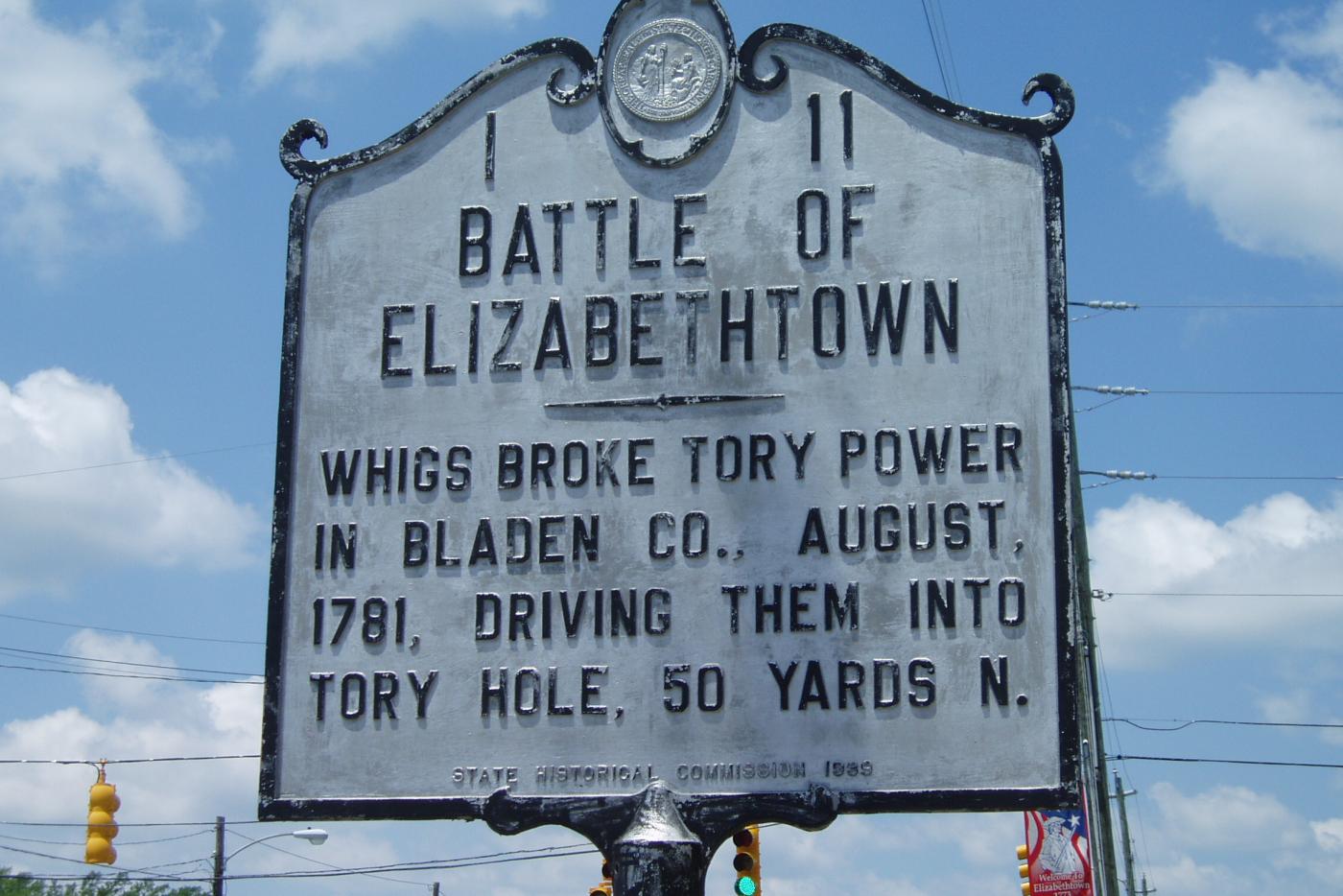
A North Carolina Historical Marker (I-11) now stands on Broad Street (NC 41/87) in downtown Elizabethtown, commemorating the engagement and its heroes. The quiet town bears little resemblance to the embattled settlement of 1781, yet the spirit of its defenders endures — a testament to the resilience and unity that defined North Carolina’s struggle for independence.
Interesting Details and Legacy
- The “Tory Hole” Ravine:
The most enduring landmark of the Battle of Elizabethtown is the deep ravine along the Cape Fear River, forever known as “Tory Hole.” As the Loyalist lines collapsed, panicked soldiers fled toward the river, many tumbling into the steep gully to escape the pursuing Patriots. Some drowned attempting to cross the river, while others hid among the brush and sandbanks until daylight. Over time, the name “Tory Hole” became part of local memory — a physical symbol of both Loyalist defeat and the chaos of civil war that divided Carolina communities. Today, Tory Hole Park preserves the site as a quiet memorial to the battle. - The Courage of Sallie Salter:
The success of the Patriot ambush would not have been possible without Sallie Salter, a local woman whose bravery rivaled that of any soldier. Disguised as a humble egg seller, she walked straight into the Loyalist camp and carefully noted their strength, positions, and defenses before slipping back through the lines to report to Captains Robeson and Brown. Her intelligence was instrumental in shaping the Patriots’ attack plan, and her story remains one of the most remarkable examples of female espionage in the Revolutionary War’s southern theater. - Outnumbered Yet Victorious:
The odds at Elizabethtown were daunting — barely seventy Patriot militiamen against nearly four hundred Loyalists. Yet through deception, coordination, and sheer nerve, the smaller force prevailed. This use of stealth and psychological warfare reflected a pattern seen across the Carolinas, from King’s Mountain to Ramsour’s Mill, where militia forces learned to turn local knowledge and guerrilla tactics into strategic advantages against better-equipped foes. The victory at Elizabethtown became another example of how the Revolution in the South was won as much by community resolve as by battlefield strength. - A Community’s Enduring Memory:
Each year, the town of Elizabethtown honors the battle with local commemorations and historical programs, keeping the memory of the engagement alive. The ravine at Tory Hole remains a place of reflection, shaded by pines and overlooking the same stretch of river that once witnessed panic and victory. These remembrances connect modern residents to the generations who fought to secure their freedom — a living testament to the Revolutionary spirit that still defines the Cape Fear region.
Map and Location
The Battle of Elizabethtown unfolded in what is now the heart of downtown Elizabethtown, North Carolina — a few hundred yards from the Cape Fear River in Bladen County. The landscape that once echoed with musket fire and shouted commands is now a peaceful community bordered by rolling hills, river bluffs, and hardwood forest.
The battle took place near the steep ravine that would later be called Tory Hole, where retreating Loyalists fled in panic as the Patriots advanced. This natural feature — a deep cut in the riverbank shaded by pines and oaks — remains one of the most distinctive geographical landmarks associated with the Revolutionary War in southeastern North Carolina.
Modern visitors can explore the preserved site at Tory Hole Park, located off Broad Street (NC Highway 41/87). The park sits adjacent to the original battleground area and features interpretive signage, shaded walking trails, and overlooks above the ravine. The nearby Cape Fear Riverwalk offers views along the same stretch of water the Patriot militia crossed on the night of August 26–27, 1781, making it one of the few Revolutionary sites in the Carolinas where the terrain still closely resembles its eighteenth-century appearance.
Elizabethtown lies approximately thirty miles south of Fayetteville and seventy miles northwest of Wilmington, positioned along one of the key interior river routes that linked the coast to the Carolina backcountry. Its strategic location — at the midpoint between the Cape Fear’s upper and lower reaches — made it a natural point of contention during the Revolution.
Today, historical markers and public exhibits throughout Bladen County commemorate the battle and its legacy. Visitors traveling through the Cape Fear Heritage Corridor can include Elizabethtown on a broader tour of Revolutionary-era sites such as Ramsour’s Mill, Cowan’s Ford, and Moore’s Creek Bridge, connecting the story of Tory Hole to the wider struggle that defined North Carolina’s fight for independence.
Why It Matters
Though small in scale compared to the major engagements of the American Revolution, the Battle of Elizabethtown captures the very essence of how the war was fought and won in the Carolinas. It was not a clash between distant armies on grand fields of battle, but a struggle waged in the heart of local communities — neighbor against neighbor, Loyalist against Patriot, each fighting for a vision of the future they believed was right.
The engagement highlights several defining themes of the southern war effort: the power of local intelligence, the resilience of the militia, and the strategic impact of even the smallest victories. The intelligence gathered by Sallie Salter and the bold leadership of Captains Robeson and Brown demonstrate how the Revolution’s outcome often hinged on quick thinking, courage, and community cooperation rather than sheer military strength.
The victory at Elizabethtown also underscores how a single skirmish could reshape the balance of power in an entire region. By breaking Loyalist control in Bladen County and cutting British influence along the Cape Fear River, the Patriots not only liberated their community but also strengthened North Carolina’s overall position within the southern theater.
More broadly, the battle reflects a pattern seen across the Carolinas — from Cowan’s Ford to Ramsour’s Mill — where determined local forces, often outnumbered and outgunned, changed the course of the war through grit, ingenuity, and unity. These engagements collectively eroded British authority, transforming scattered uprisings into an unstoppable tide of rebellion.
Today, the Battle of Elizabethtown stands as a testament to the enduring truth that history is often shaped not by the mightiest armies, but by ordinary people in extraordinary moments. The courage of those few Patriots, their reliance on one another, and their defense of home and liberty remind us that freedom in the Carolinas was won not just on distant fields — but in the woods, rivers, and small towns that defined North Carolina’s frontier.
Adkins Law, PLLC: A Law Firm Located in Huntersville NC
At Adkins Law, PLLC, we are proud to serve families in Huntersville, Mountain Island Lake area, and the greater Lake Norman region. Just as the men at Elizabethtown stood for resilience and community, our practice is dedicated to guiding clients through life’s challenges with strength and clarity. Whether you need help with family law, custody, estate planning, or mediation, our team is here to stand by your side and protect what matters most.
Click here to contact Adkins Law, PLLC to arrange a consultation with an experienced family law attorney.





Leave a Reply