
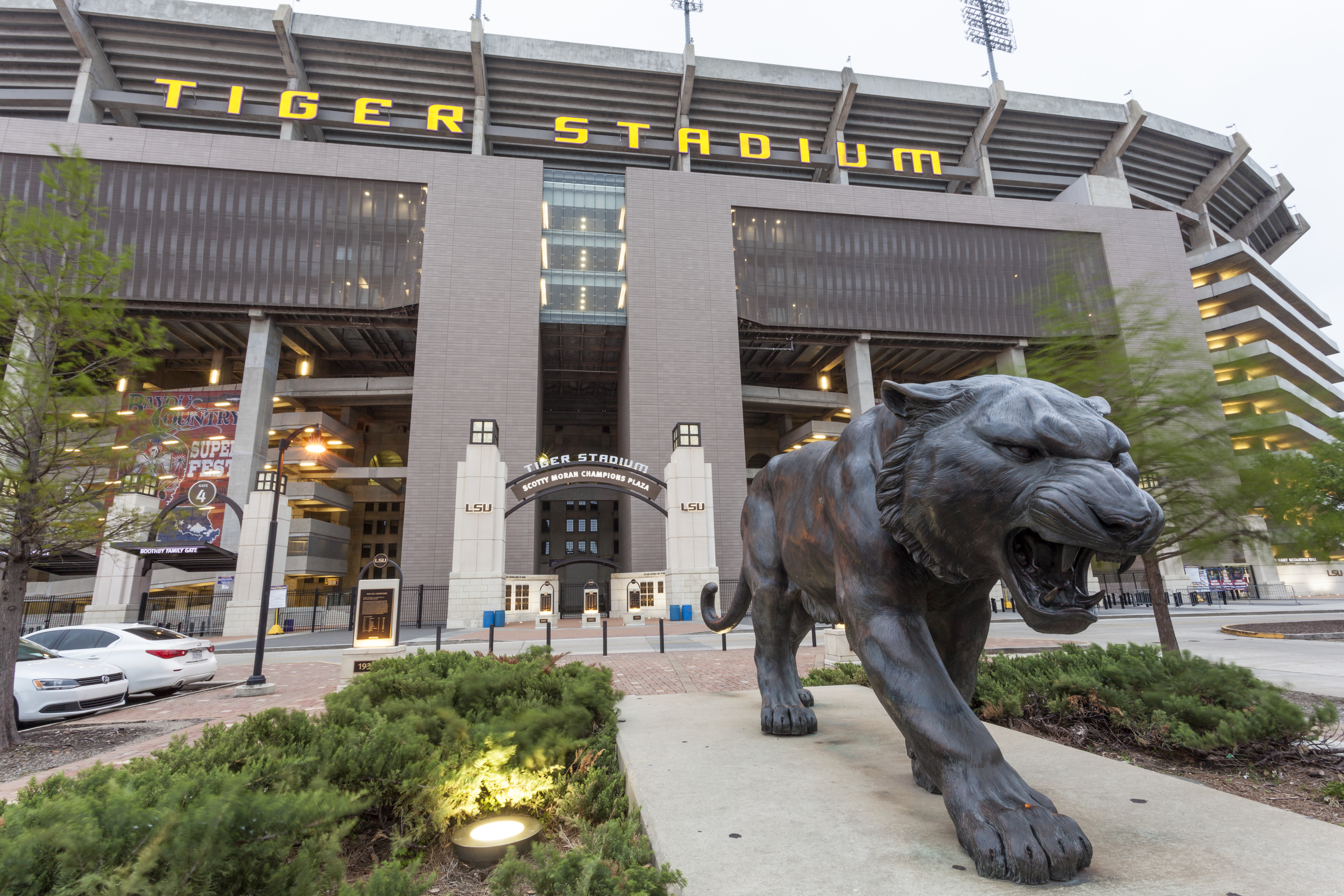

Louisiana State University, better known simply as LSU, is more than a school — it’s a symbol of Louisiana itself. From humble beginnings as a small military academy in the 1850s, LSU has grown into one of the South’s premier public universities, celebrated for its academic programs, cutting-edge research, and athletic dominance. Its story is one of resilience, transformation, and tradition — much like the state it represents.
What began with fewer than 20 students in Pineville has blossomed into a flagship university with more than 35,000 students in Baton Rouge. Along the way, LSU has endured wars, fires, relocations, political battles, and social upheaval, emerging stronger at every turn. Today, the university stands not just as a center of higher learning but as a cultural cornerstone — home to “Death Valley,” the roar of the Tiger Band, and a national reputation for excellence.
Early Beginnings: 1853–1869
Louisiana State University’s story begins in 1853 with the founding of the Louisiana State Seminary of Learning & Military Academy in Pineville. The vision was bold for its time — to create an institution that combined the rigor of higher education with the discipline of a military academy. It was modeled after the United States Military Academy at West Point, reflecting Louisiana’s desire to prepare both civic and military leaders.
The seminary’s first superintendent was none other than William Tecumseh Sherman, who would later become a legendary Union general during the Civil War. Sherman played a pivotal role in shaping the early curriculum and standards of the fledgling institution, setting expectations for discipline, scholarship, and character.
However, the Civil War cast a long shadow over the school. The seminary closed in 1861 as the conflict engulfed the South. After the war, the school attempted to reopen, but instability and limited resources made progress difficult. Then in 1869, tragedy struck when a fire destroyed the Pineville campus.
Rather than signal the end of the institution, the disaster became a turning point. LSU relocated permanently to Baton Rouge, a move that set the stage for its growth into a flagship university. The resilience displayed during this era — overcoming war, loss, and displacement — would become a defining theme in LSU’s history.
Growth in Baton Rouge: 1870–1900
The relocation of LSU to Baton Rouge after the 1869 fire marked a new chapter in the university’s history. By the late 19th century, LSU had begun to evolve beyond its early military identity. While cadet uniforms and drills remained part of daily life, the university broadened its mission to serve the wider educational and economic needs of Louisiana.
The transformation was driven in part by the Morrill Act of 1862, which established land-grant colleges across the United States. As Louisiana’s designated land-grant institution, LSU was tasked with advancing practical education in agriculture and the mechanical arts while still providing a foundation in the liberal arts and sciences. This dual mission helped LSU become a critical engine of progress for the state’s economy, particularly in farming and industry.
During this period, LSU expanded its curriculum to include engineering, agriculture, and liberal studies, preparing graduates not only for military service but also for leadership roles in business, government, and education. The university also began attracting a broader student body, moving beyond its early, narrow focus to become a more inclusive institution for Louisiana’s young men.
The seeds planted in this era set the stage for LSU’s transformation into a true state university. It was in Baton Rouge, during these formative decades, that LSU established the foundation for the academic, cultural, and athletic traditions that would define its identity in the 20th century.
The Modern Campus: 1920s–1930s
The 1920s and 1930s marked one of the most transformative chapters in LSU’s history. With strong state funding and the political influence of Governor Huey P. Long, the university embarked on an ambitious expansion that reshaped its identity and physical presence.
LSU relocated to its now-iconic campus along the Mississippi River in Baton Rouge, trading its scattered older facilities for a unified and striking design. The new campus was built in the Italian Renaissance style, featuring red-tiled roofs, stucco walls, elegant arches, and wide, tree-lined quads. Towering live oaks, sprawling green spaces, and carefully designed courtyards gave the campus a sense of both tradition and grandeur.
This period also represented a turning point for LSU’s role in Louisiana. The university’s enrollment swelled, new academic programs were introduced, and the foundations for LSU’s research mission were firmly established. The school began to resemble not just a regional college, but a flagship state institution — much like Appalachian State University in Boone, North Carolina, which followed a similar trajectory of growth in the early 20th century as it expanded from a teachers’ college into a comprehensive state university.
By the end of the 1930s, LSU had fully transitioned into the modern era, with a campus and reputation that matched its aspirations. The grand setting along the river remains one of the most distinctive and beautiful college campuses in America — a symbol of the resilience and ambition that have defined LSU throughout its history.
Postwar Expansion: 1940s–1970s
The decades following World War II ushered in a period of remarkable growth for LSU. Like many American universities, LSU benefited enormously from the G.I. Bill, which enabled thousands of returning veterans to pursue higher education. Enrollment surged, classrooms filled, and the campus expanded to meet the needs of a rapidly changing society.
During this era, LSU broadened its academic reach, developing nationally recognized programs in law, medicine, engineering, and the sciences. These fields not only fueled Louisiana’s economic growth but also elevated LSU’s reputation as a comprehensive research institution. The university became a hub for innovation, training future leaders, professionals, and public servants.
Yet, the postwar years were not without challenges. The civil rights movement reshaped the landscape of higher education across the South, and LSU became a pivotal site in this struggle. In 1959, A.P. Tureaud Jr., the son of prominent civil rights attorney A.P. Tureaud Sr., enrolled as the first Black undergraduate student at LSU. His admission marked a watershed moment in both the university’s and Louisiana’s history, symbolizing a long-overdue step toward integration and equality.
The 1960s and 1970s saw LSU continue to modernize, constructing new facilities, expanding its student population, and building a stronger identity as Louisiana’s flagship public university. It was a period of both progress and growing pains, as LSU balanced tradition with transformation.
By the end of the 1970s, LSU had firmly established itself as not just a regional powerhouse, but a nationally recognized institution. Its growth in academics, diversity, and infrastructure laid the foundation for the vibrant, expansive university that thrives today.
Athletics and the LSU Tigers
No history of LSU would be complete without its athletics — and especially its football program, which has become synonymous with Tiger pride. The LSU Tigers first took the field in 1893, beginning a tradition that would grow into one of the most celebrated legacies in college sports.
Over the decades, Tiger Stadium, famously known as “Death Valley,” has earned a reputation as one of the most intimidating venues in all of sports. With over 100,000 fans packing the stands on Saturday nights, the deafening roar of the crowd has often been described as registering on seismographs. Few visiting teams leave Baton Rouge without being overwhelmed by the atmosphere.
The Tigers have claimed multiple national championships — in 1958, 2003, 2007, and most memorably in 2019. That 2019 team, led by quarterback Joe Burrow and coach Ed Orgeron, went 15–0 and is widely regarded as the greatest college football team of all time. With a record-breaking offense, a Heisman Trophy winner, and victories over seven top-10 opponents, the 2019 Tigers didn’t just win games — they dominated an era.
LSU’s football legacy also includes icons like Billy Cannon, the 1959 Heisman Trophy winner whose Halloween night punt return against Ole Miss remains one of the most famous plays in SEC history, and stars like Leonard Fournette, who helped define the Tigers’ modern running game.
Beyond football, LSU has excelled in numerous sports. The Tigers’ baseball program has won multiple College World Series titles, making it one of the most successful in NCAA history. Basketball, gymnastics, and track & field have also produced Olympic athletes, national champions, and professional stars.
The school’s colors — purple and gold — and its beloved live mascot, Mike the Tiger, have become enduring symbols of Louisiana pride. Together, they represent a culture of excellence, tradition, and unshakable loyalty that unites students, alumni, and fans across the globe.
Research, Academics, and Global Reach
Today, LSU stands as a top-tier research university and a cornerstone of higher education in the South. With more than 35,000 students and a worldwide alumni base, it has built a reputation not only as Louisiana’s flagship institution but also as a university with national and global impact.
LSU is home to renowned facilities such as the Pennington Biomedical Research Center, which leads groundbreaking studies in obesity, diabetes, and nutrition, and the LSU Law Center, which produces lawyers and leaders across Louisiana and beyond. The university also supports cutting-edge healthcare and medical training through the LSU Health Sciences Centers in New Orleans and Shreveport, where future physicians, nurses, and researchers are trained to serve communities throughout the state.
The university’s research strengths reach far beyond medicine and law. LSU is a leader in coastal studies and hurricane science, providing critical insights into Louisiana’s ever-changing shoreline and the impacts of climate change on the Gulf Coast. Its work in energy research and engineering supports the region’s vital oil, gas, and renewable energy sectors. From chemistry and environmental science to digital media and business innovation, LSU fosters an environment where students and faculty contribute solutions to some of society’s most pressing challenges.
Global partnerships and exchange programs extend LSU’s influence across borders, allowing students to study abroad and collaborate with international institutions. This global reach reflects LSU’s commitment to preparing graduates not just for Louisiana, but for the world.
In combining strong academic traditions with world-class research, LSU continues to shape the future while honoring its role as the heart of Louisiana’s educational system.
LSU Today
From its origins as a small military academy in the mid-19th century to its modern status as Louisiana’s flagship university, LSU’s story has been one of resilience, growth, and transformation. With more than 35,000 students, a worldwide alumni network, and a reputation for academic rigor paired with powerhouse athletics, LSU continues to shape leaders not only for Louisiana but for the nation and beyond.
LSU’s influence is visible everywhere: in groundbreaking research on coastal resilience and hurricane science, in its contributions to law and medicine, and in the legacies of athletes who became legends on both college and professional stages. The university embodies Louisiana’s character — bold, determined, and deeply rooted in tradition.
Perhaps no symbol captures LSU’s spirit more than Tiger Stadium, affectionately known as Death Valley. While Clemson often points to the 1940s as the origin of the nickname for its Memorial Stadium, LSU has made Death Valley into something larger — a national icon of intimidation. With a capacity topping 100,000 fans, seismic noise levels, and unforgettable moments under the lights, Baton Rouge’s Death Valley has become the definitive standard. In fact, many argue that while Clemson may have used the name first, LSU has owned it best, turning Tiger Stadium into the most feared environment in college football.
Today, LSU stands as a proud representative of Louisiana — a place where history, tradition, and ambition come together. Whether through its academic achievements, cultural impact, or Saturday night dominance in Death Valley, LSU remains a university that commands attention and respect on every stage.
Closing Note
Whether you know LSU for its cutting-edge research breakthroughs, its far-reaching cultural influence, or the deafening roar of Tiger Stadium on a Saturday night, the university stands as one of the South’s most influential institutions. Its history reflects Louisiana itself — a place shaped by struggle, resilience, and the relentless pursuit of excellence.
From educating military cadets in the 1850s, to producing civil rights trailblazers in the 20th century, to dominating the college football world in 2019 with one of the greatest teams ever assembled, LSU’s story is one of constant reinvention and enduring pride.
Today, LSU isn’t just Louisiana’s university — it’s a national brand and a global force. For students, alumni, and fans alike, it represents community, tradition, and the unshakable spirit of the Tigers. And for those who step into Death Valley, there’s no mistaking it: LSU is more than a school. It’s an experience, a legacy, and a living symbol of Louisiana’s enduring heart.
Adkins Law, PLLC is proud to serve families and individuals across Huntersville and the Lake Norman area. Our firm focuses on family law, estate planning, and mediation, providing trusted legal guidance with a local touch. If you need an experienced attorney who understands both the law and the community, Adkins Law is here to help.





Leave a Reply